
I have always wanted to write an article on this subject but somehow never had the right recipe to push me. However, I stumbled across an article by the veteran Charles Onyango Obbo which summarily concluded that Africa should lease out its land to large financially able corporates as well as embrace GMOs wholesale. GMO is an acronym used to denote Genetically Modified Foods but actually stands for Genetically Modified Organisms.
In his article, the veteran publisher states; “The wider environmental crisis in the region has probably reached a level that state resources alone cannot reverse. The farmers have reached their wit’s end, and are not able to pay for environmental repair to their lands.”
The use of the term “probably” in the statement above is tactical and I commend him for that. However, his conclusion that the farmers cannot pay for the environmental repair was probably aimed at justifying the recommendation that followed;
“… someone with lots of money needs to come in, and for that to happen governments and activists in the region will have to embrace the idea of concessioning land to foreign nations and firms eager to lease it for farming.”
While he appreciates that land leases to foreign entities have not traditionally gone down well with the masses, I beg to differ with the insinuation that the solution to the incompetence of our local agriculture is moneyed foreigners entering the fray. They are welcome, Yes but the lack of good governance processes especially when it comes to acquisition of these lands by investors tends to be the genesis of the animosity.
There are a number of scenarios where rural dwellers are duped with job offers in order to quit their lands. After the investor sets foot, a handful are picked with the rest left to forge out new professions overnight. To make matters worse, the percolation of the returns from the natural resource are largely felt by the investors only with the locals being relegated to the periphery. As a result, absolute poverty simply multiplies, leading to the escalation of uncalled for vices like robbery.
As someone in close touch with rural dwellers and a small scale farmer at that, I have realised that our farmers are half the story when it comes to the problem of poor production. The Governments have let us down so much with their round peg in a square hole approach towards addressing farmers’ challenges. According to the International Fund for Agricultural Development (IFAD), small holders manage over 80 per cent of the world’s estimated 500 million small farms and provide over 80% of the food consumed in a large part of the developing world.
If small holder farming is a success elsewhere, why can’t it be the case in East Africa? The issue is more complex than the small holder farmers themselves. At the start of the current rainy season, I did purchase Beans and Ground nuts from an apparently reliable seeds supplier only to achieve a germination rate of less than 30%. As I speak, I can’t replant since am not certain about the length of time left for the rains to stop (Please do not remind me to use a bicycle for irrigation). This is a common tale among most of our farmers who see entire seasons fail as a result of supply chain issues. In other cases, the produce may be in abundance in the rural farms but infrastructural challenges prevent it from reaching your favourite supermarket. Under such circumstances, one shouldn’t hastily blame the farmer. I once came across cabbage farmers in Butaleja district who were stuck with large succulent cabbages and were offering them for sale at UGX 300/= (less than 10 US Cents).
Our governments need to handle this Agricultural support with as much expertise as they do when it comes to facilitating foreign industrialists. Facilitating these small holder farmers in a manner that is not aimed at merely ticking off deliverables but creates the much needed positive change is what we need. The so called primitive agriculture is definitely likely to benefit from such an honest approach.
Mr. Onyango Obbo goes ahead to endorse genetically modified foods wholesale. I understand his frustration as an urban dweller whose only concern is to find food readily available on the supermarket shelf. However, there is an uglier side to this whole GMO industry that needs us to tread with caution.
As a farmer, I am scared of GM Crops due to the following reasons;
-
GM Crops are patented. A patent is a license (usually given by government) conferring a right or title for a set period, especially the sole right to exclude others from making, using or selling an invention. If any farmer is found growing GM crops without proof of having purchased them from the company holding the patent rights or its agent, serious litigation is expected. A number of cases have been recorded so far with the Monsanto Canada Vs Schmeiser case garnering a lot of publicity.
-
Companies coming up with these GM foods are now in a better position to control the entire supply chain of their product right from seed supply to herbicide/pesticide use. They have the ability to genetically link their crops to selected herbicides and pesticides that they themselves produce hence locking out other players in the industry. This is likely to create monopolies in the market eventually. Roundup is a weed killer that Monsanto has successfully managed to link to its GM crops like the Soya Beans (Heard of crops referred to as Roundup Ready?). As a result, its application in a field with their crops achieves much more success than alternative options. The desire to maximise profits and control entire business ecosystems is likely to leave the farmer unfairly exposed to corporate manipulaton.
-
Contamination. The GM crops have been known to be so aggressive that they end up contaminating organic plants in nearby locales. I first heard this from some rural farmers who always claimed that certain seeds they bought had the net effect of causing a poor harvest among their local alternatives. Science today has proven it and there are land mark cases where GM companies have sued farmers for continuing to grow crops that have been inadvertently crossed with their GM varieties. According to Planetnatural.com, “Between 1997 and 2010, Monsanto sued at least 144 farmers and settled with some 700 others it accused of growing their patented GMO crops often canola seed or soy beans without purchase. Gag orders were imposed on those who settled. The irony here is that these growers wanted nothing to do with the GMO crops. They claim that the GMO crops trespassed on their property and grew there without their knowledge or consent.”
-
Defying Tradition. Farmers growing GMOs are not allowed to utilise seed from the previous season’s harvest if the court case against an Indiana farmer is one to go by. Essentially an African farmer will be expected to always buy their seeds or else they end up in a court of law for saving and replanting seed.
-
Cost Trap. Over reliance on the corporate world for the entire lifecycle of a farmer’s crops is likely to lead to a spike in food prices in future. Once these profit motivated companies take control of the global food supply from the seeds to the table, they will dictate prices and cause artificial price rises or drops akin to the OPEC era when oil prices were globally manipulated by a selected club of countries.
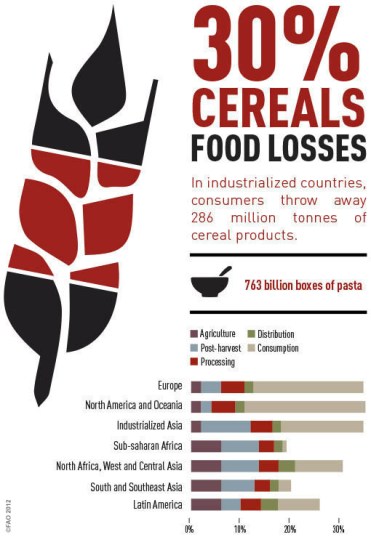 According to FAO, over 90% of the food loss across the Agricultural value chain in Sub-Saharan Africa is at the pre consumption level (growing, post-harvest, processing and distribution) with the consumption level contributing less than 10%. While increased production is the holy grail touted by the GMO crowd, failure to address the current food loss elements in our value chain will still lead us back to square one.
Without doubt bwana Onyango Obbo, we all want to see a smoothly flowing food value chain with no interrupts like you have rightfully observed, however, it doesn’t necessitate us to jump from the frying pan into the fire. We know what the problems are and their solutions. We just need the right policy pursuits by our leaders.
God Bless
Follow @wirejames on twitter

 The Wire Perspective