
Blog Archives

Plastics!! Why we Love and Hate them in equal measure


Driving home one evening, a salon car ahead of me belonging to a diplomatic entity in Uganda slowed down as we approached a small bridge at the bottom of a valley in Kiira Town Council. In an instant, I saw the driver throw out of his window a container wrapped in a plastic bag (kaveera). I suppose the container must have been plastic too, judging by its apparent light weight. My eyes followed the package only to see it end up in the water stream below that turns into a mini river whenever the rains display their potential. Hooting and flashing my car lights, I made an effort to make him aware about my discomfort over his action. Unfortunately, I doubt he got my point. It’s an act that has been deemed normal by many.

One can hardly walk for more than ten metres in any urban area of Uganda without coming across some form of plastic either being used by someone or littering the street. Plastics have become so commonplace that they are a significant component of our garbage today. Take time and check out the Nakivubo Channel and you’ll cringe at the amount of plastics that litter that waterway, to the extent that the city authorities placed metallic nets in the channel to trap them.

Did you know that plastics are also naturally occurring in space? Titan, the biggest moon of the planet Saturn was found to have a lot of propylene which is basically plastic.
garbage_skip_kireka2

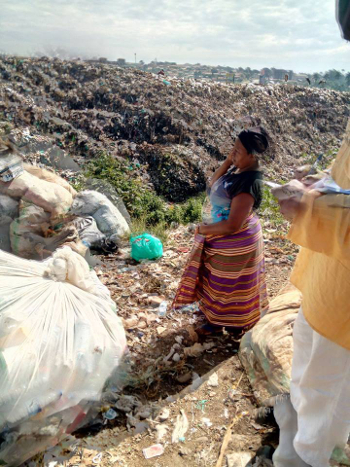
Garbage skip in Kireka, Kiira Municipality

Within Kireka town, just next to the railway line, there is this garbage dumping site that I have had the chance to visit. Plastics are practically littered all over the place making one wonder whether our homes yield more plastic garbage than the decomposable food waste.


Why are plastic products so popular today?

Love them, hate them, plastics have numerous benefits they bring into our lives hence ensuring their popularity and wide spread use.

Durability: Plastics are highly durable. In other words, they are able to resist wear and tear, decay among others. This effectively makes their usage potentially long term. They are designed to withstand tough conditions.

Cost Effectiveness: Without doubt, plastics are a much cheaper packaging material than metal, wood or even glass alternatives. This is more-so the case with those made out of petrochemicals. This is one of the reasons why the cost of some products like bottled water or soda is very consumer friendly. Try comparing the cost of a 300ml soda canned in a plastic and another in a glass bottle. The difference is obvious.

Design Freedom: Plastic offers a lot of flexibility for the manufacturers. The range of shapes, configurations, colourings, printing among others that can be enforced with plastics beats alternative materials like glass by far. This allows plastics to be moulded into bottles, trays, containers, carry bags, canisters, medical devices and much more.

Easy to Transport: Plastic containers are very easy to use when transporting products. They usually take up less space, aren’t fragile like glass hence not requiring special care during the process of transportation.

Light Weight: Being lightweight, plastic bottles or containers are preferred by many to pack food or carry drinks and the fact that they are available in all kinds of shapes, they meet the needs of nearly every one.

Safety: Plastics are shatter proof and even when they fall down, they hardly fragment into dangerous small little pieces like glass tends to do.

Re-usability: People tend to re-use plastics in very ingenious ways. During the rainy season, it’s common to see ladies using plastic bags to shield their hair from rain water. Some food joints targeting the bottom of the pyramid market tend to re-use mineral water plastic bottles to supply fruit juice to customers. As to whether some of these re-use cases are healthy, that’s a story for another day.

When all is said and done, there are numerous calls that have for long been made to ban plastics on grounds of their harmful effect upon the environment. Indeed the dangers of plastics are so grave but then again, their benefits are quite compelling too. Its kind of like a love-hate relationship that man has with them.

Have you ever walked along a suburb road after some heavy rain? You are greeted by a very big amount of plastic litter that has been washed from the various homes and dustbins by the rain water. It’s such an eyesore to those that love even the most basic form of orderliness. Interestingly, return after a few hours and you’ll hardly see the plastic trash.

Now that we are faced with this menace of plastics littering nearly every where we are, what should we do?

Until I visited the Plastics Recycling Industries (PRI) in the Nakawa Industrial area, I must confess that I was one of the proponents of a blanket ban on plastics. However, after seeing the massive potential in recycling plastics, my mind has since changed significantly.

One of the biggest answers to this conundrum is the need to Reduce, Reuse and Recycle plastics. We need to consider this three part approach seriously.

Reduce: Have you bothered to find out how much plastics you accumulate each day through your purchases and lifestyle choices? Each time you walk into a shop, the most obvious packaging they are likely to give you is plastic. Sometimes based on the products purchased, you are given multiple plastic packages for each item. Must you really get all of them? Could using a trolley to dump the purchases in the boot of your car be a better alternative?
Take the case of water. Each time you buy a plastic bottle of water or soda, it is usually dumped after use. Do you really need to buy that bottle each day? Can you for instance have a water bottle that you fill with water or juice each morning as you head to office? Can your office opt for those water dispensing cans that enable one use any cup available?
From a personal experience, when I begun separating my trash at home to isolate the plastics, I was amazed to find the huge amount of plastics we accumulated. The plastic trash was twice the size of the other waste within a span of two weeks. This led me to change our purchase habits with the aim of lowering our use of plastics at home. You too could do something similar.

Reuse: When confronted with plastics, it is important to always think about the possibility of reusing them. The habit of merely throwing them away contributes to their rapid accumulation in the environment. The plastic bags (kaveera) that we take home daily and just throw away can be reused the next time you go for shopping. Why not give that a try?
Plastic containers are reused in homes to plant flowers, vegetables and spices by backyard gardeners. This allows you to enjoy the health benefits that accrue through enjoying home grown foodstuff while also positively utilising a plastic that could have otherwise been discarded.
Plastic bottles have been used as construction material for low cost houses and they have proven their versatility in this.

Recycle: Finally, if you can’t reduce or reuse that plastic, the next option is to recycle. Discarding the plastic in a manner that ensures it is easily recyclable is crucial. While must of us lump up our garbage for disposal, it is vital that we started sorting it prior.
It’s not a Ugandan thing to be orderly when it comes to garbage but we need to develop the habit. I have found that cultivating a habit of separating decomposable from non-decomposable garbage is a good first step in the process of recycling. Many of the steps gone through by the recyclers would be skipped if only those of us disposing the plastics made an effort to do some basics. These include;
• As you dispose of the plastic, it’s a good idea to have it placed in independent bags from the rest of the garbage.
• Remove any labels from the plastic package if present.
• Separate the plastic bags (kaveera) from PET (soda and water bottles) and HDPE (jerrycans) plastics. Each of those has a different processing approach and a lot of man hours are spent by the recyclers doing just this separation.
• Rid the bottles or containers of any content like liquids and foods.
• Separate the bottle covers from the bottle as they are made of different material hence requiring separate processing approaches.

Plastics can be turned into a great opportunity for all.

Meet Kafeero (name not real) a 20 year old youth who spends the day traversing residential areas in Kireka and Banda searching for plastics from homes, business premises and open gutters. He then takes his collection to a Plastic4Cash collection centre which pays him for his collection per kilogram of weight collected.plastic_4_cash
Plastic4Cash are plastic material collection centres set up by Coca Cola in conjunction with the Kampala Capital City Authority. Anyone is free to take their collection of plastics and get paid. Primary sorting of the plastics is done here to ensure that unwanted material like rubber, stones and other substances do not find their way to the factory.
This centre then aggregates its entire collection and dispatches it to the Plastics Recycling Industries (PRI) another arm of Coca Cola that specialises in recycling plastics.

Upon arrival at the PRI, another phase of sorting occurs based on colour of the plastics as well as material type i.e PET or HDPE. The sorted plastics are then baled using some compactor machine to shrink the size of the containers and fit more plastics in a much smaller confined space. These plastics are then fed to a label remover to remove any paper or removable form of label present. It is after this stage that they are ready to go into the shredder. The shredder then tears the plastics into small thin strips of plastic that are washed clean and bagged for sale.

pri_process_scaled

Coca Cola’s product sales dump 800 tons of plastics onto the market monthly. Uganda has numerous companies like Coca Cola that are doing the same. While it is hard to know the net amount of plastics by weight dumped onto the market monthly, a conservative estimate would put it at 3,000 tons (Three Mega Tons). PRI currently collects abut 250 tons monthly for recycling with a goal to hit the 320 ton mark this year.

This shredded or recycled plastic is indeed a potential income earner judging by the fact that in 2017 alone, recycled plastics exports hit the US$ 4 Million mark. This revenue can grow if only the collection of these plastics improved.

Having observed the entire plastics value chain, I can assure you that there are numerous individuals living off these plastics on a daily basis. The recycling opportunity has presented them with a chance to get into gainful employment and abandon their alternative and dangerous lifestyles.

Let’s do our part as consumers and make plastics recycling a reality.

James Wire is a Business and Technology Consultant based in Kampala, Uganda
Follow @wirejames on Twitter.
Email lunghabo [at] gmail [dot] com

Photo Credit: Mr Buwembo Joachim and Mr. Robert Oduori

Additional Resources
http://blog.catalpha.com/what-makes-plastic-containers-so-popular
http://www.recoup.org/p/185/why-plastic-why-plastic-packaging

Mwenda, Land Grabs aren’t an answer to the Commercialisation of Agriculture


Land grabbing in Uganda has received a new ally, Andrew Mwenda. According to the Observer Paper, while addressing a Policy Think Tank, he said that, “it is through land grabs for commercial agriculture that Europe managed to industrialise, a thing that should occur in Uganda. While I had chosen to dismiss this as another attention seeking gimmick by this seemingly expired economic and political pundit, an afterthought led me into crafting a response.

Some people think that Mwenda’s statement is merely aimed at courting controversy. I say, NO. Mwenda is dead serious. He represents a group of nouveau riche whose unending primitive appetite for resource accumulation is mind boggling. These so called elites will stop at nothing to centralise wealth in order to be the Russian Oligarchs of Uganda. They want at whatever cost to create legacy families akin to the Kennedy, Rockefeller, Ford families this time using crooked mechanisms that will control the nation’s resources for centuries to come. To them, the end justifies the means. Mwenda is simply spilling the secrets of their private chats to the general public.

Late last year, I did interact with a moneyed young man who came to Kampala by hitching a lift on a milk truck a few years ago and is now worth billions of shillings. He told me off the cuff that, “I don’t see why peasants still hold onto land. We should take it away from them and instead employ them to work on the newly created larger farms.” An attempt at reconciling his rags to riches story with his new found mindset left me reeling in shock. This moneyed young man is a true reflection of what Mwenda is saying. This trend of thought is highly justified by a significant section of the elites that are having it all smooth sailing after choosing to be politically correct.

Does Land size really matter?

My brother Mwenda quoted the example of Europe in the middle ages and how land grabbing was used to boost agricultural production. I would like to encourage him to desist from becoming a slave of relic thinking. What may have worked in the 18th century may not necessarily work today. There is a lot that has changed over the centuries and for one to expect superimposing 18th century Europe onto 21st Century Uganda is very mind boggling a prospect.

Research indicates that land size is not really the issue. Depending on which country you go to, the local circumstances dictate what works best. In the USA, Brazil and Europe, large farms have been associated with increased productivity while in East Asia, a region with similar demographics to Africa, an inverse relationship has been found between land size and productivity. Smaller farms are actually producing much better per unit than the larger farms.

Commercialisation of Agriculture doesn’t necessarily mean having access to large swathes of land. It is simply the production of crops and farm animals for sale. The problem with some of our allegedly exposed elites stems from watching too much TV and seeing the large farms in Europe and USA then expecting that superimposing the same here will automagically work.

After the second world war, Japan broke down land into affordable units for small holder farmers. The country had identified that “landlordism” was a source of a lot of evils to numerous farmers. They then undertook a reform that involved taking land from especially absentee landlords and facilitated the previously renting farmers to become “owner farmers.” Prior to these reforms, Landlords owned nearly 50% of all farmland in Japan hence perpetuating the Landlord-Tenant arrangement that was rife in the rural areas. Of the 5.5 million peasant farmers, a third of them rented land from these landlords and always surrendered half of their produce as rent. Today, these small holder farmers are largely responsible for the high value agricultural produce that Japan exports all over the world.

In Asia, Agriculture is largely characterised by smallholder cultivators. The average size of areas cultivated is as indicated below;

  • Bangladesh 0.5 hectares

  • Nepal and Sri Lanka 0.8 hectares

  • India 1.4 hectares

  • Pakistan 3.0 hectares

In China, 95% of the farms are smaller than 2 hectares while in Bangladesh 96% of farms are for small holders cultivating 69% of the arable land. If you are a regular in supermarkets, Asian processed foods litter our shelves and one might be fooled into thinking that their source is large scale farms. Smallholder contribution to the total value of agricultural output is significant in many Asian countries. Globally, they account for nearly 70% of the food supply.

As opposed to increasing farm size, the reverse is happening in Asia. China’s farm size decreased from 0.56Ha in 1980 to 0.4Ha in 1999; Pakistan from 5.3 Ha in 1973 to 3.1Ha in 2000; Philippines from 3.6Ha in 1971 to 2Ha in 1991 and India from 2.2Ha in 1950 to 1.33Ha in 2001.

Interestingly, this drop in acreage coincided with the successful green revolution in Asia that saw a bumper growth in the production of largely rice, maize and wheat. This implies that Uganda’s increased food production can still occur even in the current dispensation of smallholder farming. It has happened in the rice industry where our rice production has steadily grown over the years from a mere 26,000 tons in 1990 to 231,000 tons in 2012. Remember, rice growing in Uganda is largely a commercial farming engagement. The success it has registered can be replicated to other crops.

In Colombia, 11,000 land owners have accumulated 67% of the of the most fertile land leaving the rest to some 11 million people to use. They did this through dispossession and forceful displacement of millions. As a result, in 2013, the country was second to Syria in having the highest number of Internally Displaced People at 6 million. This status-quo is partially responsible for the numerous civil wars the country has faced for decades. I guess having faced years of internal strife in Uganda, our gluttonous elite need to realise that we can very easily descend into anarchy and civil war as a result of these forceful land grabbings.

Coming closer home to Africa, we have good examples of land grabs that have come back decades later to haunt the beneficiaries. In the late 19th century, Cecil Rhodes duped the native inhabitants of Zimbabwe into handing over their land to him. What followed was the dispossession of Africans from their land. Privileged whites gained land swathes in thousands of acres. This injustice stayed deep in the hearts of many indigenous people and when the conditions proved right, the land repossession occurred at the turn of the 21st century. Though handled poorly and largely politicised, it still pointed to the fact that people wanted that injustice addressed.

In South Africa, a similar land grab occurred centuries ago. However, lately, we are seeing a resurgence in the calls for land expropriation from the White landlords to the Black South Africans. One could easily have put this off as the wishful thinking of the poverty stricken masses but that isn’t the case. I am in the know of a number of elites that are warming up to get a share of the land in order to try their hand at farming. Mr. Julius Malema the Commander in Chief of the Economic Freedom Fighters has emphasised this as one of the key pillars his party is pursuing.

The question of commercialising agriculture shouldn’t be looked at from the lens of the developed countries. We have our unique ecosystem that requires unique approaches. The Africa Agriculture Status report of 2017 states, “…the type of agricultural transformation relevant today is very different from the kind of green revolution transformation that Africa aspired to in earlier decades. The new agenda needs to be much more focused on a market driven business agenda that encompasses the entire food system, not just agricultural production. But Africa is at crossroads: should it go for a food system transformation led mainly by large commercial farms and large agribusinesses, as in many rich countries? Or should it go for an inclusive transformation based on commercial smallholder farms and SMEs along value chains. A large farm, large agribusiness approach would leave millions of small farms and businesses without adequate livelihoods, whereas an inclusive approach could engage more of them in productive employment, create more attractive jobs for young people, help reduce poverty, inequality and food insecurity…” I fully concur with the observations in this report.

Africa is estimated to have 51 million farms of which 41 million of them are smaller than 2Ha in size and the number keeps increasing. It is also noted that many of these farms are efficient low cost producers which obtain higher yields on average than many larger sized farms and are able to compete in markets given a fair opportunity. So, just like the Asian green revolution, it is plausible for these farms to contribute to a successful agricultural revolution in Africa that is employment intensive and pro-poor.

The radical shift that is being proposed by Andrew Mwenda and his bunch of wannabe bourgeoisies without doubt will lead to the following:

  • Increased income inequality. The richer get richer as the poor get poorer. Colombia and South Africa are a good example.

  • Strife. With a populace deprived of its land, expect only mayhem. There might be some semblance of stability for a while due to the political status-quo but when tides change politically, trouble beckons. Liberia, Sudan and Sierra Leone have suffered civil wars sparked off by land grabbing. In 2012, Ethiopian tribes embraced arms against the military in the attempt to halt the diversion of the Koka river to irrigate a Malaysian plantation project.

  • Removal of identity. Land is not a mere item that is commercially quantifiable like these crude capitalists want to make it seem. Ugandans are attached to their land in more ways than one; spiritual in terms of the traditional rituals as well as physical linkages akin to one knowing that I come from say Butaleja District are of paramount importance.

  • Food insecurity. People have grown up feeding themselves directly from the land. To take that away and expect them to fend for themselves using alternative means is to invite hunger into their families.

My final advice to Mwenda and his crew is to reduce on the greed. You are what you are because of this very society that you now despise like a plague. You rose through the ranks because of the goodwill of this very society. Most of you have very humble rural upbringings and you benefitted from the goodwill of numerous strangers while on your way up through life. Is this the best way you think that you can repay this same society? You might dismiss me as a moralist who has no business talking to capitalists but of what use is a business that is devoid of human values?

Think again Mwenda. You grew up in a farming family, you saw how many families in your village benefitted from farming. I am sure you are bright enough to reconcile your current mindset with your past experiences. A word to the wise is sufficient!

James Wire is a Small Business and Technology Consultant

Blog: wirejames.com

Twitter: @wirejames

Email: lunghabo (at) gmail (dot) com

Sources

Agricultural Land reform in post war Japan: Experiences and Issues

Smallholder farming in transforming economies of Asia and the Pacific: Challenges and Opportunities.

Coping with the Food and Agriculture Challenge: Smallholders’ agenda

Forced DIsplacement, concentation of land property and the renter political economy in Colombia

Africa Agriculture Status report 2017: The Business of smallholder agriculture in Sub-Saharan Africa

The social Political Impact of Land grabbing in Africa and its destabilising effects