
Seated in one of the local banks, I observed this gentleman that had come to apply for a loan as he drew an elaborate map to his place of abode in order to fulfil the requirement on the Loan Application form of Home Address.
A day later, a friend of mine who had planned to visit me at home called on reaching Mukono town and asked for directions to my place (of course he knew better not to ask for my address). Using landmarks, this is how my instructions went; Pass by two petrol stations on Kayunga Road, look onto your right and identify a Mormon Church. Thereafter, turn right at a Hardware shop and on reaching School X slope down till the second Boda Boda stage I’ll be waiting for you there!!!!
What a mouthful. All this could have been summarised in a single address statement 41 Gulu Road, Kitete, Mukono Town Council.
So, why is it that apart from a few upscale residential areas like Kololo, we hardly have any address system in Uganda? Is it that someone hasn’t realised how hard it is to forcefully teach people geography? Or could it be that we are too used to our landmark approach that we find it convenient enough for our operations? Is it that Ugandans don’t see the need to receive mail at their doorstep (ala DHL style) in preference for a trip to the Post office?
The lack of a proper addressing system is the reason Posta Uganda can’t make home and office deliveries of mail to-date. This has made them lose alot in terms of potential earnings from clients that need such services. As the country’s systems go electronic, the need for a proper addressing system that can allow for easy digitisation is even more crucial. It will for example prove a lot easier for one to receive a product they have ordered online from Masikini or that Lunch package from Jumia Foods. With GPS having been demystified and made fully available on phones, we would be spared the potential exposure of our geographical ignorance.
In March 2008, a consultant commissioned by the Universal Postal Union (UPU) and Posta Uganda Ltd completed a study on The Methodology to Develop and Disseminate Physical Addresses and Post Codes in Uganda. He made it clear that Uganda’s need for an addressing and Post code system is long overdue considering that street naming is incomplete and house numbers are not in use. The UPU defines a Post Code as; … the fundamental, essential element of an address. It is a key component of a postal addressing system. A unique, universal identifier, it unambiguously identifies the addressee’s locality and assists in the transmission and manual or automated sorting of mail items.
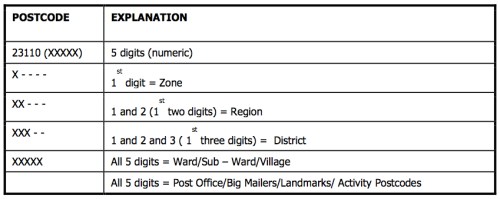
The Ministry of ICT in conjunction with the Uganda Communications Commission and Posta Uganda Ltd undertook to implement this project and went ahead to draft the National Addressing Standards that were approved by the UPU and Uganda National Bureau of Standards. The country adopted a five digit numeric system as represented in this picture.
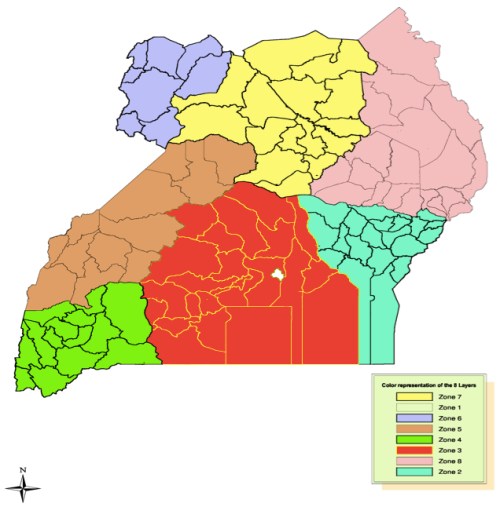
The Country is divided into 8 administrative zones with each one having a code.
Entebbe town was selected as the trial location in order to make proper assessments of what a national roll out would entail. To-date scanty information is available about the success or failure of this trial save for some information about its launch in 2013 and a query by Members of Parliament in May 2012 about the status of the pilot project which had received a vote of 50 Billion Uganda Shillings.
On the contrary, Rwanda which started off on a similar initiative nearly the same time like we did faced some hiccups but was able to overcome them and cover the entire Kigali City by 2013. The city has been able to set up the physical addresses, street name signs (which included renaming some streets) as well as house number plates. They even went ahead to engage Google Ireland to upload Kigali Street Map onto Google Maps making it convenient for those with electronic devices to find their way around the city.
But why are these post codes and addressing systems important?
-
On the security front, with the increasing threat of terrorism, monitoring can be enhanced considering that the area identification challenge will have been addressed. This can fit into the National ID system that has a provision for identifying the address of the ID holder which information under current circumstances isn’t easy to trace.
-
Improved Delivery of Public services. We have had incidents where Ambulance Services, the Fire Department or even security forces get lost while responding to calls made by those in distress.
-
The health sector can be armed to better monitor incidents of disease outbreak, child birth, deaths among others and target their campaigns appropriately.
-
Banks, Insurance and other institutions stand to have better knowledge about the spread of their clientele thereby determining where they locate key services like ATMs and branch offices.
-
Businesses can utilise this information to better organise their sales and marketing efforts like targeted promotions as well as follow up initiatives like locating product depots among others.
-
Utility services are likely to have an improved relationship with clients through a more efficient and easy to use addressing system that ensures bills get to customers on time and at the lowest possible cost. Currently, different utility firms have to design their own addressing systems to monitor their customers. National Water and Sewerage Corporation is one such entity that did just that when it shouldn’t have, since it isn’t their core business.
-
Institutions like Uganda Revenue Authority and City/Municipal authorities can use this system to better monitor tax payers. Collection of Ground rates, Property tax among others can be simplified.
-
For financial institutions, the risk premium for lending money to customers is likely to reduce as a result of less opaque customers who can easily be traced. This in the long term can translate into lower interest charges by banks on loans advanced.
It’s therefore a foregone conclusion that we are lagging behind as a nation if we can’t set some of these pre-requisites in place to take advantage of an economy that is going digital. The time is now to stop the “find me by the tree near the boda-boda stage” addressing system to one that will make it easy for all to understand.
A call goes out to the Ministry of ICT, UCC and Posta Uganda to share with us what has been done so far in advancing this initiative. Otherwise, we might be led to believe that it has been struck by the same disease of in-action that has characterised many well meaning projects in this country Uganda.
James Wire is a Business and Technology Consultant based in Kampala, Uganda
Follow @wirejames on Twitter.
Email lunghabo [at] gmail [dot] com


 The Wire Perspective