
Going Digital can lower Uganda’s 700 Billion 2021 Election bill


The announcement by Hon. David Bahati that the budget for the next election is hovering around UGX 700Bn (USD 190M) plus the further shocking revelation by the spokesperson of the Electoral Commission that they requested for more than UGX 1 Trillion (USD 270M) for the same purpose has left many of us agape.

Justifications are being made about the rising costs to handle the election as well as the increased electoral areas like districts and constituencies. However, all this is being said with an analog mindset.

The Ugandan media has made the public get accustomed to hearing figures in Billions of Shillings being thrown around and is now preparing us for Trillions. This trend favours the corrupt officials who now have an opportunity to increase their corruption margins on government undertakings. It is very likely that nearly 40% of what the Electoral Commission budgets for elections fizzles away in unclear circumstances, serving the interests of the unknown.

As concerned citizens, we should not just blindly accept what is being proposed for expenditure. One wonders why the relevant officials cannot sit down and come up with ways of lowering the cost of our elections especially now that we are even celebrating twenty years of the existence of the Uganda Communications Commission (UCC). The UCC proudly boasts of having facilitated the spread of broadband and telephony services all over the country.

From a technology mindset, Uganda is capable of continuously lowering its spend on elections if only we were willing to think through our processes, challenges as well as resources.

What are some of the key areas of spending under the current modus operandi of the Electoral Commission during elections?

  1. Printing of Ballot Papers (Done from outside the country)

  2. Distribution of polling material

  3. Facilitation of Election Polling Officials

  4. Printing of requisite paperwork for the Polling officials like the Voters’ Register

  5. Security

  6. Registration of Candidates

Digital Proposal

As a country, we have a National Identity database in place which can be relied upon for electoral matters. It is the single most effective source of citizen verification. This alone will erase the need for having a voter’s register printed out for each polling station. Money saved.

Electronic gadgets that are not only portable but also easy to deploy can be procured for verification of voters at the polling stations or even the registration of candidates. This will eliminate the need for an extra polling agent at a station whose role is to look up the voter’s name, verify with the ID and then tick the name. A polling station would only need one agent to man it.

The same electronic gadgets should be able to display the candidates to be voted for and by a mere touch of the screen, the respectively chosen candidate gets a vote. Through data streaming, the information instantly gets relayed to the control center. This eliminates the need for printing expensive ballot papers and distributing them under high security.

Finally, there s a need for a back end software system that should be able to integrate all these activities and deliver results with the requisite levels of integrity. This software can be developed by a team of locals and open sourced for others to learn from through sharing.

One may ask, how do we get the good local software developers?

Easy!!! Put up a competition for teams to come up with concepts on software design aimed at meeting the specified needs of the Electoral Commission (EC). The winner gets the opportunity to work with the EC to meet their expectations.

This way, we have the potential to cut down our planned expenditure of UGX 700 Billion by at least 50%. We still have two years to go. Can we start now?

James Wire is a Business and Technology Consultant based in Kampala, Uganda
Follow @wirejames on Twitter.
Email lunghabo [at] gmail [dot] com
Saying Bye Bye to Land fraud


Headlines like 5000 families evicted off their land; Hundreds left homeless in fresh Apaa land eviction; 200 people evicted from Mukono Land are commonplace in Uganda’s media.

Talking about land and its ownership elicits a lot of emotions in Uganda today. No day passes without an article in the media over land wrangles, displacement of the poor masses, killings, fraud, among others. The situation reached a point where the president had to appoint a special commission to investigate land matters across the country.

Currently, anyone can become a land dealer without the need for certification or registration. This has led to many conmen opting for this profession. By having easy access to land titles of their clients, they are in a much better position to manipulate and fraudulently transact on their behalf over and above the issued mandate. Sometimes they connive with a few unscrupulous officials within the Lands docket at the ministry to achieve their intended goals.

Uganda’s land administration has over the times been burdened by numerous challenges which led to a massive degradation of services. During the last decade, the idea of a Land Information System was mooted to enable transformation of the land management from the then manual to electronic operations. In 2010, the process of setting up this information system begun and a lot has been achieved over the last eight years.

The Land Information System aims at:

  • Faster resolution of land disputes

  • The prevention, reduction or elimination of – backdoor transactions, forgeries and graft as well as challenges associated with missing land records.

Upon completion, there shall be full integration of physical planning, surveying, valuation, land administration and land registration.

One stop land transaction centres called Ministry Zonal Offices have been set up to eliminate the need for people flocking the Kampala or Entebbe lands office for transactions. Spread across the country, they are expected to reduce the pressure on the operations at the headquarters. You can find them in Kabale, Luwero, Mityana, Mbarara, Tororo, Jinja, Mukono, Gulu, Arua, Mbale among others.

Land tenure is defined as the relationship that individuals and groups hold with respect to land and land based resources like trees, minerals etc. In Uganda, we have according to the law the following land tenure systems;

  1. Customary land tenure: Is applicable to specific areas and subject to customary laws. It could be owned individually, communally or jointly by a group of people. It is the easiest to process considering that one doesn’t have to go beyond the district authorities to attain the ownership certificate.

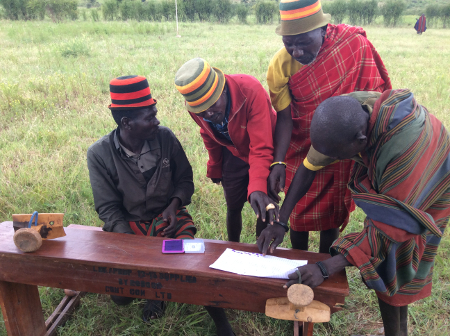
    karamojong_elders

    Karamojong elders signing up for a communal customary certificate of ownership.

  2. Freehold tenure: Involves holding of registered land in perpetuity or for a period less than perpetuity which may be fixed by a condition. It enables the holder to exercise subject to the law, full powers of ownership of land.

  3. Mailo tenure: Involves the holding of registered land in perpetuity and has its origins from the allocation of land pursuant to the 1900 Buganda agreement. It is mainly confined to central Uganda. It permits the separation of ownership of land from the ownership of developments on land made by a bonafide occupant.

  4. Leasehold tenure: A system of owning land for a particular period of time. A landlord or lessor grants another person (tenant or lessee) exclusive possession of land usually for a defined period.

A number of changes are taking place at the Ministry of Lands, Housing and Urban Development that the public may not be aware of due to the poor information flow. I was surprised to learn that most of the land related transactions that we quickly relegate to middlemen can be easily handled directly by us landlords.

The processes of acquiring or subdividing titles, title verification, placing caveats, ownership transfer etc have all been eased by the computerisation. Before you opt to pay millions of shillings to get this done for you, give it a try yourself first.

Titles as a standard do have photos of the owner(s) and the database maintains contact numbers to which an SMS message is sent every time a transaction is being carried out on the respective title. This is expected to help owners keep track of what is going on.

All services for land transaction can be accessed through the geographically spread out zonal offices, currently 13 operational with a target of 21. Without doubt, this addresses congestion at the head office as well as the delays that have been typical of this process.

Did you know that there are free pre-approved government house plans? You can use them and save the money spent on paying for a houseplan.

Did you know that there are approved physical plans for urban areas? As you buy land, it helps to consult these physical plans to ensure that your intended purpose of land use is in line with the plan otherwise you might be stopped in your tracks after spending money. Find some of those approved physical plans here.

These developments in the land sector have been beneficiaries of the Competitive and Enterprise Development Project (CEDP) for Uganda, a project funded by the Government of Uganda with credit from the World Bank.

James Wire is a Business and Technology Consultant based in Kampala, Uganda
Follow
@wirejames on Twitter.
Email
lunghabo [at] gmail [dot] com