
The issue of schools is on most people’s lips following the release of exam results by the Uganda National Examinations Board. As students report back to school, the school fees expectations of most private schools have left parents agape. Matters are made worse by the non-school fees requirements that in some cases amount to nearly 50% of the school fees charges.
Back in my home village located in Naweyo sub-county, Butaleja district lies the once great Bukedi College Kachongha. This school was known for its academic exploits in the same vein as others like Tororo College, Nabumali High School, Teso College, Ombaci College, Jinja College, Busoga College Mwiri, Nyakasura School, St Leo’s College Kyegobe, Sebei College, Comboni College, Manjasi High, Tororo Girls School, among others. All this happened during their golden years of the 60s, 70s and 80s.
Bukedi College disintegrated due to a multiplicity of factors only to become a shadow of itself. A few years ago, some old students started pushing for the revival of this school and I happened to be a well-wisher/observer of these efforts. I saw how they battled all odds to restore sanity at the school as well as get it streamlined. Small efforts created small achievements that built up one day at a time. It is therefore no wonder that after so many years in the doldrums, the school has registered its best performance over the last decade.
Some of the old giants that are still on top of their game like St. Mary’s College Kisubi, Kings College Buddo, Namilyango College, Gayaza High School, Mt. St Mary’s College Namagunga, Ntare High School all have strong and functional Old Students’ networks that play an active role in the school’s affairs. Seeing what Bukedi College Old students have been able to achieve in just two years lends further credence to this school of thought.
I then ask myself, what if those of us complaining about the failure of schools that we studied in decades ago chose to be more proactive and worked towards reviving them? Couldn’t this be an opening towards better performance hence increasing the school options that today’s parent has? Why should a parent from Kumi send their child to a school in Mukono district yet well functioning Teso College lies within their environs?
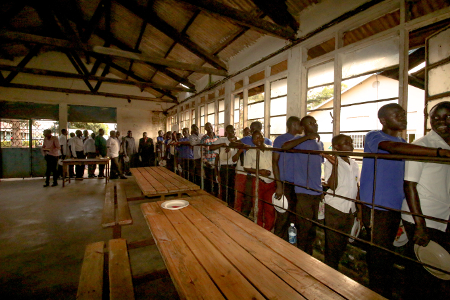
BCK Students lining up for lunch in the dining hall
The massive drop in performance of most government aided schools fostered the growth of private led secondary schools that took on the mantle of giving parents hope in good grades for their children. These schools then begun pegging their school fees on performance. Since they churn out numerous distinctions, they use that as a right of passage to have their fees increased year in, year out. Parents seem not to have any fall back position and hence have become victims of this plot by the private schools. If something isn’t done to arrest this, future generations shall have an even bigger problem on their hands.
Some of the benefits of reviving these historical schools include among others:
Lower School Fees. The capacity of these government aided schools is averagely 1,000 students and if only their standards can be improved, it means that close to 20,000 places can be availed nationwide in just 20 historical schools for students to study in a competitive environment and have a chance of passing well. The biggest losers if this happens are private schools whose fees structure hardly matches that of these government schools. This should push them to lower their fees or even close shop. For the uninitiated, there was a time when the likes of Tororo College would send over 100 students to Makerere University in a single year.
Less Congestion. The congestion in schools within Central Uganda i.e Kampala, Mukono, Wakiso, Lugazi, Mpigi is likely to decrease. Parents in Kampala for whatever reason could choose to take their children to a well performing upcountry school and less countryside parents would struggle to get their children into schools around greater Kampala.
Increased Nationalism. The existence of decent schools across the country could help us relive the days when it was not strange for an Easterner to send their child to study from Kabale. This has the effect of opening us up to the entire country as citizens thereby fostering greater understanding and appreciation of one another. Today, it is not surprising to find a person that has never travelled beyond 50Km from their home.
Cultural Understanding. Since most of these historical schools are located in places with distinct ethnic backgrounds, they offer parents a chance to expose their children to their culture. I may choose to take my son to Bukedi College Kachongha so that he can get a chance to master the Lunyole language as well as understand the people better. The same would apply to a parent from West Nile where Ombaci College and Mvara SS are.
The continued survival of that historical school is highly dependent on you the Old Boy/Girl. Remember, ours is the last generation that saw the greatness of some of these schools. If we do not act now to restore them, our children are very likely never going to know their importance in Uganda’s education space. Let us learn from the demise of Namasagali College.
Adapting from Bukedi College, below are some highlights on how the OB network is transforming it.
-
Commenced engaging the school in 2015.
-
Student population had dwindled from 1,200 to 130 only.
-
The school was a dumping ground for indisciplined teachers.
-
It had been turned into a mixed school as well as a day section introduced.
-
There was no Board of Governors in place.
-
In 2017, student population dropped to 54. The school nearly lost its centre numbers.
-
There were no first grades for the last five years.
The OBs then decided to take action in liaison with other stakeholders;
-
Lobbied for a new Head Master and Deputy.
-
Took on a new bursar
-
Got a laboratory attendant
-
Instituted a Board of Governors
-
Relieved non performing teachers of their duties
-
Hired temporary teachers
-
Introduced incentives for teachers and students
-
Repaired student dormitories
Results? The UCE 2018 has shown a significant improvement with the school registering 6 first grades, 11 second grade and 11 third grade. Considering the fact that for the last five years there had been no single first grade, what appears like a simple performance to others is a very big step in the right direction. I can only predict a brighter future for this school.
This is my parting shot, take time to think about the wretched nature of your old school, do not give up, mobilise your network of old students and start changing things for the better. One day, you too shall be proud of that school the way SMACK, Namilyango, Gayaza, Buddo, Namagunga old students are of their own.
Take charge.
James Wire is a Business and Technology Consultant based in Kampala, Uganda.
Follow him @wirejames on Twitter
Email lunghabo [at] gmail [dot] com

