
Tag Archives: James Wire

Cryptocurrencies – What is Bitcoin?


For those that are digitally alert, no day passes without you hearing about Bitcoin, Onecoin, Litecoin, Ethereum, Ripple among others. This is a follow up article on an earlier one I wrote introducing blockchain and cryptocurrencies. It is helpful to first understand blockchain before diving into the world of cryptocurrencies.

What is a cryptocurrency? This is a digital currency that uses cryptography for security.

Digitally, cryptography involves creating written or generated software codes that allow information to be kept secret. It converts data into a form that is unreadable for an unauthorised user, thereby enabling it to be transmitted without fear of an unintended recipient understanding it hence enhancing its integrity.

What is a currency:

  • A Medium of exchange – It is a more efficient way of exchanging products and services as opposed to barter trade.

  • A Store of value – A mechanism by which wealth can be saved and retrieved in the future with some predictability e.g gold, silver, reserve currencies, stocks, bonds etc.

  • A Unit of account – A standard measurement of the value of goods, services, assets and other economic activities e.g. the value of a soda versus ten passion fruits.

A journey through history shows that we have traversed from barter trade all the way to the current paper money as depicted in this image.currency_years

Digital money has been making its mark over the past few decades. As opposed to cryptocurrency, digital money is defined as any means of payment that exists purely in electronic form. Mobile Money would be an ideal candidate in this regard. The reason it can’t be called cryptocurrency is the absence of cryptography.

Cryptocurrencies can be characterised by some or all of the following attributes;

  1. Entirely virtual currency created by computer code.

  2. Rely on the use of cryptography to effect highly secure transactions as well as the creation of new units of the currency.

  3. Rely on a publicly available ledger to keep a record of transactions undertaken.

  4. Use a wallet (defined later) to facilitate transactions.

  5. They are highly decentralised in nature of operation as a result of most of them depending on the blockchain technology (this was covered in the previous article).

  6. Due to the dependence on blockchain by most cryptocurrencies, transactions aren’t easily reversed once approved.

  7. User identities are protected. The public ledger maintained never bears any detail that can uniquely identify a user.

Traditional monetary systems entail Governments issuing money which is then controlled by a Central bank eventually getting to the users through the commercial banks. This implies that there is heavy control by the issuing authority of the currency.

Enter cryptocurrencies, unlike the traditional monetary systems, they are fully decentralised with no central government control. Think about it as community generated currency though this time in a digital format. Money is what it is because people agree to it as a medium of exchange. Hence, any community of people that come together and agree to create their own currency and trade in it can validly create a currency.

Enter Bitcoin

Bitcoin is a cryptocurrency that uses decentralised technology for secure payments and storing money that doesn’t require banks or people’s names. BC_Logo_

It was the first cryptocurrency to be formed in 2009 and has since gone on to be the most widely used or preferred. It has no government backing, no delays when sending money as well as minimal transaction fees if any (due to the elimination of the numerous third parties).

Some terminologies to be familiar with before we proceed are:

  • BTC: A common unit used to describe one bitcoin, just like one US Dollar.

  • Bit: There are 1,000,000 bits per bitcoin, 1 bit = 0.000001 BTC.

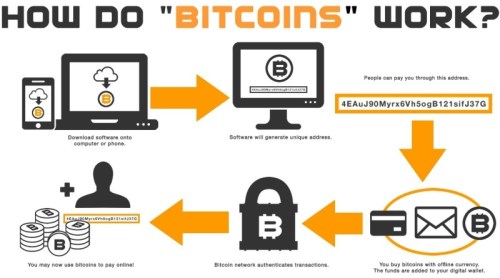
  • Bitcoin Wallet: This is where you store your bitcoins. It is a program that manages your bitcoin addresses and allows you to transact. In otherwords, it is a collection of addresses and the keys that unlock the funds within.

  • Bitcoin Address: Is also regarded as the public key, it is like an email address. You issue this to anyone you expect to receive payment from. Always advisable to create a new one for each transaction. You are at liberty to have as many as possible.

  • Private key: Every public key has a private key associated with it. It is a secret piece of data that proves your right to spend bitcoins from your wallet. Kind of like a password.

  • Bitcoin Client: Is the software application or web service managing your wallet and addresses. It connects a user to the Bitcoin network.

Ownership of bitcoins is established through digital keys and signatures. The keys are generated locally using the Bitcoin Client then stored in a bitcoin wallet. These keys then allow the user to sign transactions thereby providing proof of ownership of the traded bitcoins.

Be very careful who generates your private keys and where they are stored. Read more on Bitcoin security !!!!!
bitcoin-work-1

Types of Bitcoin Clients

  1. Full Client: This is a client that stores the entire history of bitcoin transactions, manages the user’s wallets and can initiate transactions directly on the Bitcoin network. It never communicates the private keys and stores them locally.

  2. Web Client: Is accessed through a web browser (kind of like Gmail) and stores the user’s wallet on a wallet owned by a third party server. It relies entirely on third party servers.

  3. Lightweight Client: It stores the user’s wallet but relies on third party owned servers for access to bitcoin transactions and the network. Just like a full client, it stores the private keys locally.

  4. Mobile Client: Largely used on smart phones, it can operate as a full client, lightweight client or web client. Some mobile clients can be synchronised with a web or desktop client, providing a multi-platform wallet across multiple devices, with a common source of funds.

We noted earlier that the “Keys” are very crucial towards the security of your bitcoins. How you store them is determined a lot by your choice of Bitcoin wallet and client.

Local Storage – If you have a good computer and take steps to avoid intrusion or exposure, this option is fine. However, if your computer is hacked into, crashes and you have no backups, or you forget your passwords, then most likely your private keys and bitcoins will be lost forever. You trade off convenience for security in this case.

Remote Storage Reliance is on a third party. If their security is compromised or they act maliciously, your bitcoins are lost forever. Third party exchanges are more likely targets for intruders, when compromised, you are likely to lose your bitcoins for good. The biggest offer here is exchanging security for convenience.

Feel like getting started with Bitcoin? Get more details here.

Bitcoin’s value is increasing in leaps and bounds by the day, the cryptocurrency is gaining lot of credibility in mainstream financial circles. From Europe to Asia and the Americas, restaurants and various businesses are embracing bitcoins as a form of payment. By October 2016, there were 1,587 Bitcoin ATMs worldwide. Virgin Galactic, a Space Tourism company accepts bitcoin payments from customers. The University of Nicosia in Cyprus was the first ever such institution to accept school fees payments in bitcoins.

Over the past one year i.e. November 2016 to November 2017, the price of a bitcoin has early increased tenfold. From US$ 706 on the 14th of November 2016 to US$ 6,863 as of the 15th of November 2017.

bitcoin_1year

Bitcoin price growth over a one year period

If you want to familiarise yourself more with cryptocurrency trading, set up an account. I used Coinbase to set up mine and it gives me rates in Uganda Shillings equivalent for Bitcoin, Ethereum and Litecoin. All these are different cryptocurrencies one can trade in. The snapshot below shows that within a span of one month, the price of one bitcoin currently at UGX 25,069,624 increased by 22% reflecting a net gain of UGX 4,540,169.

Screen Shot 2017-11-15 at 10.25.17

A typical Coinbase account

You may be scared by the cost of a bitcoin being at UGX 25 Million. That shouldn’t bother you so much. You don’t have to buy an entire bitcoin to trade. Remember as earlier noted, a bitcoin is divisible into 1 million bits. This literally means that at the going rate, 1 bit costs UGX 25. So, with UGX 100,000 you could literally buy 4000 bits which is the equivalent of 0.004 bitcoins (BTC).

[Begin Update]

After getting feedback from readers about Coinbase not supporting operations in Uganda, I did some further research and came across SpectroCoin . According to the website, they have support for cryptocurrency trading in Uganda complete with Mobile Money integration allowing you to purchase as low as UGX 500/. This is not an endorsement of their service but like any other venture, I advise you to tread very carefully to avoid making mistakes.

[End Update]

The world is entering a phase of cryptocurrencies, much as there might be a lot of doubt cast upon this trend, the reality is that it’s a matter of time before they too gain credibility just like any other innovations that were derided in the past. Should you be considering them as a form of investment? That is another question that shall be addressed separately.

I hope this has been helpful. Feel free to ask questions in the comments section.

James Wire is a Small Business and Technology Consultant based in Kampala, Uganda

Follow @wirejames on Twitter.

Email lunghabo [at] gmail [dot] com

Other Articles:

Simplifying Blockchain and cryptocurrencies for a Ugandan

Other Sources:

  1. http://www.ironlotuspt.com/images/content/bitcoin-work-1.jpg

  2. https://coinlist.me/wp-content/uploads/2016/12/how-does-bitcoin-work.jpg

  3. http://www.pulselive.ug/bi/finance/finance-bitcoin-just-hit-an-all-time-high-heres-how-you-buy-and-sell-it-id7457611.html

  4. University of Nicosia, Msc in Digital Currency notes.

Job loss is real!! Always be prepared.


A couple of weeks back, I was invited by an organisation that was laying off a number of employees to give them a pep talk on their next life. While preparing for the presentation, I was reminded of the story of the impoverished family whose only cow was pushed off the cliff. This is a story I covered in a previous article.

Most times, when we get employed, the default tendency is to gel into the organisation, adapt to its culture and blend with the politics. People who had all these grandiose plans of structuring their lives in a certain way, unknowingly abandon their script to follow the ideas developed by the group think of the work environment. Very few ever get to seriously plan for what they would do if they lost their job in an instant.

Let’s take the example of Balozi (hypothetical name), he joined a reputable telecom company as a graduate trainee, worked well and was eventually conscriptedas a full time staff. His starting salary was too good to be true for a graduate and the first thing that struck his mind was to acquire the kind of things that would make him gain acceptance among his workmates. Before we knew it, he had acquired a car, rented an expensive apartment in an exclusive neighborhood that he hardly spent time in.Each year, he had to visit a foreign destination during his annual leave complete with a lady friend. Each promotion came with an increase in salary which drove him into acquiring taste for a more expensive lifestyle. He took on consumption of foreign liquors, became a golf club and gym member, had a plush wedding and basically got everything going for him.

Just when he was basking in his success, news trickled in that the company was downsizing and his department was bound to be affected first. Before the news could sink in, he received information that he was on the list of those to be relieved of their duties. Balozi was dazed. He couldn’t imagine a life outside this company. All his networks were heavily dependent on his high life which was funded by the hefty salary he commanded. To cut the long story short, when he assessed the so called businesses he was investing in, none could keep him afloat. Starting with the send off package that he was given, Balozi laboured so hard to keep up appearances. After the funds dried up, all hell broke loose starting right from home where he could hardly even pay rent.

Now, you might or might not be a Balozi but what do we learn from Balozi?

Jobs are never permanent.For any job you get, whether you’re young or old, just know that a time is going to come when you’ll part ways with it. The circumstances around your parting may be positive or negative but that’s not the issue. So, as you join, invest time inplanning for your exit when it eventually happens.

Job loss can occur unexpectedly.An impression has been created that big companies or organisations cannever fail while small organisations are more likely to fail. This is a lie. There are numerous cases of large multinational companies that have unexpectedly wound up leaving thousands in tears.

Enron – One of America’s largest ever energy companies in history. The company was such a high flier that no one could believe when it tumbled within a span of five months following the resignation of the CEO in August 2001 to filing for bankruptcy by December of the same year. On the day it filed for bankruptcy, all employees were given 30 minutes to pack their belongings and vacate the offices. 62% of the 15,000 employees lost all their savings which were pegged on the company’s stock.

Lehman Brothers – Having been around for over 150 years, no one had any reason to doubt such a company’s ability to continue being in existence However, the global financial crisis of 2007 had a different idea altogether. The closure of one business unit in 2007 led to the loss of 1,200 jobs instantly. By the time the company filed for bankruptcy in 2008, a total of 25,000 jobs had been lost. This company’s failure triggered some form of economic turmoil which affected numerous other companies with an overall job loss in the region of 6 million.

Back home, we have some notable examples;

Greenland Bank – In 1999, this Ugandan bank that had gone international with branches in Kenya and Tanzania was closed by the Central bank subjecting its close to 700 employees to overnight unemployment.

Other companies that have closed shop include; Uganda Airlines, Uchumi Supermarket, Nakumatt Supermarket, Zzimwe Construction, Regency Hotels, Property Masters, International Credit Bank, Cooperative Bank, GTV, Sembule Steel Mills etc.

Even with colleagues around us, it helps to keep an intact mind. Friends, colleagues and the various groupings of people we associate with are good. However, amidst all the deep rooted interactions we have with them, it always helps to avoid losing our True north. The true north is what or whom the real you is. Many are the ideas we get from our groupies but not all are worthy of pursuit. At the end of the day, the buck starts and stops with you as regards your future or that of your family. Why for example did Balozi choose to rent a very expensive apartment yet he could settle for a much cheaper but decent house and put to productive use the saved money?

Group think isn’t necessarily Good think. There is usually this cow herd mentality among groups that wants to push everyone to toe a particular line. This tends to put too much pressure on individual members to toe the line. Take the example of the standard practise by most workers to raise money (saved or borrowed), buy land and build a house. It makes sense depending on what scale of earning you are at or alternative sources of income at your disposal. Noble idea? True. Good idea? Probably not. Having only a single income of not more than UGX 2 Million monthly, would you prefer to invest a borrowed UGX 80 Million in a house you will merely be sleeping in and use as a trophy for bragging rights or would you rather invest that amount in some rental units that earn you income equivalent to half your monthly salary? Which option would make you pay off your loan much faster?

Always have alternative investments. It doesnt matter how comfortable your job seems to be. The default should be for you to have some alternative investments in place to ensure that your income is diversified. However small the income is from the diversified investments, do not give up having a portfolio of these investments. When the shock of a job loss comes, these investments would very easily keep you buoyant until your next lucky break for a job.

Lifestyle can be a life maker or breaker. The way we lead our lives has a heavy impact on the kind of progress we make. Without going into details, there are wasteful and gainful lifestyle habits. There is this school of thought that believes that an individual’s economic progress is merely dictated by how much they earn. I must say, it’s not entirely true. Economic progress is largely determined by how wasteful we are with our income. The less wasteful we are, the higher the chance we have of growing our wealth

A few days back we woke up to the news of Kakira Sugar Works planning to lay off 4000 workers. In the Telecom sector, a good number of staff has been laid off with more job cuts to continue. The fear and uncertainty is high among employees who are fully aware about the difficulty involved in acquiring new jobs. Maybe you’re in a similar state, maybe not, however, either way, you need to prepare yourself for this kind of eventuality.

If you lost your job today, this is my advice to you;

Have a Cool Off period. Have you ever worked on a computer or phone only for it to malfunction? Often times, a simple restart (switch off-on) sorts out the problem. By taking sometime off the worries of work and a predetermined 8 to 5 routine, you will be able to draw into your innerself and reflect more on what you want. This will help you relaunch better with a more focused plan for either acquiring another job or launching your own business operations.

Reassess your priorities. Each of us at any one time has priorities. These priorities are usually determined by the environment we are engrossed in. The priorities of a married corporate professional are starkly different from those of a young unmarried graduate. Use this time off work to assess yourself and see how much progress you’ve made to achieve your goals. Are you still on course or have you veered off course? What corrective action do you need to engage in, if any?

Take stock of your alternative income generating activities if any. You probably have some side business activities that predate your job loss. Sieve them carefully, see how they perform, assess their potential and work towards growing them or dropping those that are merely a burden. You might have to survive off these businesses opportunities for a while as you work out the way forward. Its funny but most side businesses run by employed people tend to be heavily subsidised by the proprietor to the extent that they fail when the subsidies cease to flow in.

Scale down activity in all spheres of your life. Loss of a job implies loss of income. This calls for boot strapping. The circus you have been living through has to stop. You need to make tough choices in your lifestyle. If you have been supporting numerous causes, they are likely to get hit. Your goal is to stretch your financial reserves over the longest possible period as you work on the way forward considering that you could go for a few months or even a year without a job.

Effectively plan for your retirement benefits. Some employers will retire their employees with some form of benefits. For the case of the organisation I dealt with, they did this. Often times, you find people grumbling about how much or little money they have been given. My observation over the years reveals that, no money is too much or too little. I recall a former Bank of Uganda top official who squandered retirement benefits of UGX 450 Million he received in the 90s only to die a few years later out of frustration. Then again, I know of a gateman who was laid off and given UGX 3.6 Million as a send off. Today, he’s running a very successful poultry and piggery farm that earns him five times what he used to earn as monthly salary. What this implies is that your focus should be on planning well for the benefits you’ve been given.

Finally, you have the choice to view a job loss positively or negatively. When given lemon, bitter as the fruit may seem, you can still make lemonade out of it. The circumstances you’re faced with shouldn’t discourage you from the determination to pursue progress, ensure that you learn the key lessons to propel you forward. Your cow (job) may have been thrown over the cliff but its absence is getting you thinking in a bigger and better way.

James Wire is a Small Business and Technology Consultant based in Kampala, Uganda

Follow @wirejames on Twitter.

Email lunghabo [at] gmail [dot] com