
Tag Archives: satellites

Minister Musenero, Enough with the Lies!!!


They were intentionally stingy with information as they planned for the PearlAfricaSat-1 Uganda’s first ever Satellite (Cubesat).

They gave the impression that it was going to solve numerous challenges regarding information collection in the country.

The overrated Dr Musenero said the satellite would play a vital role in planning and resource management and environmental impact assessment in the oil and gas industry in Uganda. A position I was able to corroborate in an interview I had with one of the satellite developers.

She used this opportunity to take numerous photo opportunities that commenced with the preparations for the satellite launch, all through the actual launch and eventually the bragging rights that ensued.

She got the President to start bragging about another achievement by 4ras in  NRM (those who know, know) of getting the country into Space. Numerous apologists including yours truly went around screaming themselves hoarse about the achievement. Like infants who have no idea about the existence of lies, we chest thumped and went ahead to educate anyone who dared listen about Space and the opportunity we were going to exploit. All this amidst a face off with verbal artillery worse than the IDF bombs hitting Gaza.

Little did we know that the overall mission was shrouded in mystery. Dr Musenero and her cabal never told us that;

  • The Cubesat had severely limited abilities.
  • The Cubesat had a one year lifespan.
  • The Cubesat would never dish us the holy grail.
  • And so on and so forth.

The question now comes up, Dr Musenero, why did you conveniently hide this information from the masses as well as the appointing authority?

Were you trying to cover up and ensure that the overly inflated budget is not tampered with?

Are you trying to take advantage of our President’s love for sciences to fool him through okugumaaza ?

Late last year, you complained that there was no money to set up the support infrastructure at the Mpoma Satellite station hence the reason for the in-operation of the satellite.

A few months down the road, you are being quoted as stating that the Cubesat was meant to last one year in space.

Which is which dear Minister?

Along the way, you have also talked of launching another satellite. Why the rush madam? When you have not accounted for the first satellite? As citizens, we are yet to see any fruits from that satellite however basic its abilities were.

Even when a bicycle may not be as fast as a car, it can still be evaluated and proof of value availed. Why are you shying away from putting on the table the output of all this dream project? And do not tell us that you only report to the president. This is not classified information.

Online sources indicate that our satellite faced a tragic demise when it dropped back into the Earth’s atmosphere on the 16th of May 2023.
But where ZimSat-1 (The Zimbabwe Satellite) was actually able to receive and transmit data as well as take a couple of pics of their country, PearlAfricaSat-1 was not able to transmit anything since its deployment from the ISS.
Did you ever tell the President about this tragic failure that kicked off from the word go? Dear Ugandans, our satellite hardly lasted 6 months in space and by the look of things, gave us nothing totally.

Dr. Musenero, beaming with joy during the launch of PearlAfrica Sat 1

You go around imposing on every Tom, Dick and Harry how your Science docket is very important without demonstrating its importance. I am actually in support of the Parliamentarians who earlier today chose to chase you away from the committee meeting when you were about to once again begin belching inaudible utterances about sciences.

Honourable, otujooze nnyo (You have really under looked us). Enough is enough of this self-importance that is leading us no where.

As a scientist, I relish the day I will have an opportunity to face off with you on the subject matter that you think is trademarked to you.

Wake up dear Minister. We are not all blind. The ongoing nonsense is very visible to many. However, they choose to zip their mouths. Do not take our silence for stupidity.

Stop making patriotism a hard paper Ugandans.

For God and My Country  

James Wire
X (Twitter) – @wirejames
Threads – @wire_james
The unravelling reality of Space Travel


Welcome back the Shepard, perfect landing, we made history today. Now, who wants to go to space?” said the commentator in the video after the second landing of the New Shephard rocket that Blue Origin has been working on to realise the dream of space travel. Wondering, what the heck this is all about?

Let’s go down memory lane. The 18th and 19th centuries were spent with various individuals experimenting on air travel. Many mistakes were made, however, their persistent efforts paid off when at the dawn of the 20th century, The Wright brothers among others were able to come up with mechanised flight.

The first commercial flight in recorded history occurred on January 1st 1914 between St. Petersburg and Tampa in the USA covering a distance of 21 miles (34 Kilometres) in 23 minutes at an altitude of 15 feet (5 metres). The amount paid then by the passenger was US$ 400 which is equivalent to almost US$ 10,000 today.

KLM the world’s first commercial airline opened it’s doors in 1919 and transported 345 passengers and 25,000 Kg of mail and cargo in its first year. This is equivalent to the load carried by a single Boeing currently. Since then, a lot of progress has been made in the aviation industry with flights today traveling non stop for over ten hours at speeds we currently consider fast.

In the middle of the 20th century, the space race begun and was largely a two horse battle between the American and Soviet Governments. The Soviets drew the first blood by sending the first man to space as well as launching the first ever satellite. Subsequently, the Americans outdid them by landing the first men onto the moon. Alot of effort has since gone into space related research with the launch of numerous satellites and probes sent to distant planets.

The entry of private players into the Space Age that had been a monopoly of state actors begun remarkably changing many things and injected a lot of much needed money as well as innovative ideas.

In 2002, the commercialisation of space travel saw Mark Shuttleworth become the first African to travel to space and spend eight days at the International Space Station. It however came at a hefty cost of Twenty Million US Dollars. Not many can afford such sums of money to achieve the dream of space travel.

One of the reasons space flight has traditionally been expensive is the need to use new rockets each time a pay load has to be taken to space. It is similar to having to purchase a new plane for each flight that is going to be made. There has always therefore been a need to come up with ways of landing rockets safely back to earth and reusing them for future missions.

On April 29th 2015, Blue Origin launched the first flight of the New Shepard rocket that flew upto 307,000 feet (Approximately 94 Km) which was just 6 Km shy of the Kármán Line at the altitude of 100Km regarded as the Edge of Space. The rocket came back to earth and made a successful upright landing much to the joy of the development team.

As if that was not enough, seven months later, on November 23rd 2015, a repeat flight was made by the same rocket that achieved a distance of 329,839 feet (100.4 Km) above the earth effectively reaching the edge of space.

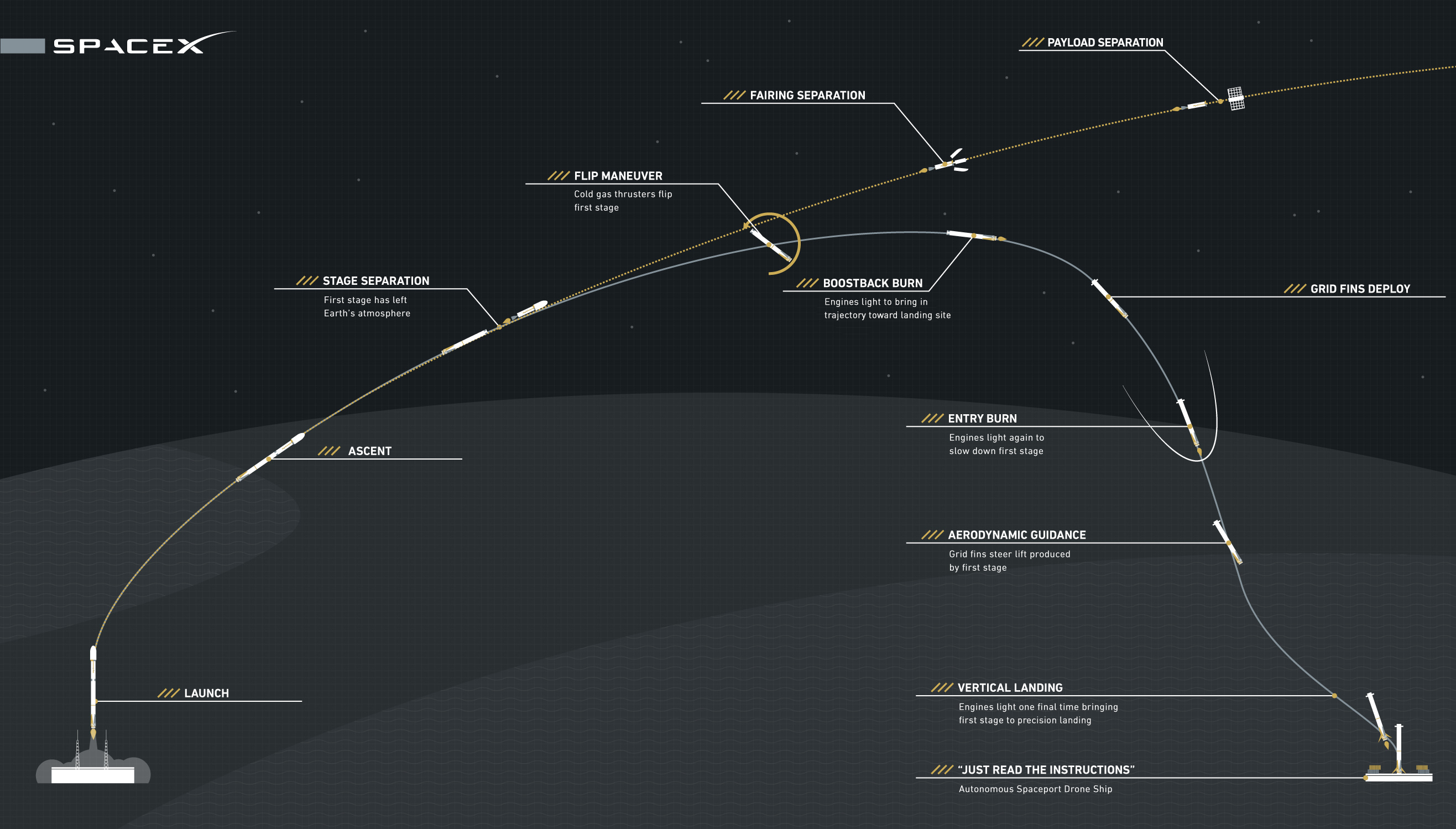
On the 21st of December 2015, Space X a company whose goal is to enable people live on other planets sent the Falcon 9 rocket to space and it duly delivered eleven (11) low earth orbiting satellites after which it returned and landed safely back on earth. Similar to Blue Origin, Space X took the game further using a more powerful rocket while attempting a much harder feat. Not to be outdone, the New Shepard was sent on another trip back to sky on 22nd January 2016 confirming to many that Blue Origin means business.

16892430560_f87dff78c0_o_1

Falcon 9 rocket route plan. Picture courtesy of SpaceX

What does this all mean to humankind?

“If one can figure out how to effectively reuse rockets just like airplanes, the cost of access to space will be reduced by as much as a factor of a hundred. A fully reusable vehicle has never been done before. That really is the fundamental breakthrough needed to revolutionise access to space.” Elon Musk, Space X founder.

At the turn of the 20th century, the pride of many was being able fly in an aeroplane and visit other continents on earth. The 21st century however has come with its own demands. Today, with a greater understanding of the solar system, galaxies and the universe, humanity is aspiring to colonise other planets and make them habitable or at worst extensions of our civilisation. Why can’t one go for holiday on mars or the moon? How about taking a guided tour of the Solar system giving you an opportunity to see planets like Pluto, Saturn and it’s many moons all from the heavens’ eye view? Imagine closely trailing a comet or asteroid on its journey orbiting the sun? Let alone having real estate on the moon with a retirement apartment for you? For the work freaks, wouldn’t a floating office in space give you the extra zeal to work?

All this may seem too imaginary and unreal but it’s as outrageous to you just as the idea of flying an aeroplane was to earth’s inhabitants six centuries ago. The human race has all it takes to conquer the universe and with the advances made technologically, one day at a time, I can’t rule out inter planetary travel being the norm in the next thirty years with inter galactic travel being achievable within a century from now.

Our ability to visit space repeatedly, at will and with ease will go a long way in enabling us push the boundaries of space ambition. A rocket should be able to take off from earth, deliver passengers into space and return all within minutes and then make another flight within the hour, essentially being re-used five to eight times a day. That way, the cost of access to space per head will drastically go down.

This is one of the reasons am excited about the foresighted approach of the new Ugandan Secondary School syllabus that has added Astronomy as part of the package to be taught to students. A good understanding of what the universe has in store for us will push our children into aspiring to challenge the new horizons. Maybe it could also be one of the solutions to the numerous land conflicts that we are faced with.

@wirejames on twitter

Subscribe to this blog to get regular updates for new posts.