Tag Archives: space

Deleted Satellite – Uganda, a nation let down by clueless officials


Being a patriot in Uganda is one of the most energy sapping endeavors. It is the quickest shortcut for anyone determined to develop ailments like high blood pressure, broken heart syndrome, hyperglycemia, insomnia, depression, anxiety, hyperalgesia (stress induced pain), inflammation, ulcers, diarrhea among others.

Like a faithful wife being serially cheated on every day, one wakes up to one depressing story after another.  

From a boxing perspective, these stories are akin to being given a Jab that lands on your forehead with the knuckles, followed in quick succession by a cross, lead hook and rear hook. As you stagger to regain stability, they move in with a lead uppercut that sends you facing upwards and while you process the ongoing pain in the jaw, a rear uppercut completes the process leaving you sprawling on the ground. (Only Naguru Boys can comprehend this best.)

Facts speak for themselves, failure (scandal) after failure. Off head, we have;

  • Lubowa Hospital
  • The Akon City Project
  • The 31 Billion Shillings Covid Vaccine
  • The Naguru-Nakawa Satellite City land heist
  • The Rats that cost 8 Million Shillings each
  • The long awaited Kiira Motors Electric Vehicles
  • The Karamoja iron sheets saga
  • CHOGM
  • Global Fund
  • Temangalo
  • The ID Scandal of 2010
  • Isimba Dam Saga
  • Karuma Dam
  • Kiira Motors….

And now, The Satellite De-orbiting that others have termed as deleting.

Deorbiting a satellite simply means bringing a satellite back down to earth after it has completed its useful life. Uganda launched this Cubesat in November 2022 and while it was not meant to last forever in space, we expected it to serve for at least five years.

Upon its launch, there was a lot of fanfare, a typical habit of Ugandan Government officials aimed at justifying uncalled for expenses. I watched the event live and the beaming wide smile of triumph by Minister Dr. Musenero was all over the media.

The team of engineers led by Mr. Bonny Omara was upbeat. It heralded the dawn of a new era. I could feel their exuberant youthful energy reverberate all the way onto Twitter where they kept sharing snippets of the work done.

I am very certain that this team had a lot in mind about where they can lead this country in that regard if and only if they are given the necessary support. However, I guess we are faced with an environment littered with deceptive governance in our lovely country.

The media reports the minister stating that the initiative lacked 5 Billion Shillings to set up the necessary ground infrastructure to support the satellite. This is total balderdash, nonsense and baloney.

For a Government whose Parliament has just spent Billions buying cars for former speakers, one that is going to swallow up over 1.3 Trillion Shillings during its current term, a hastily approved borrowing spree of 7 Trillion Shillings and you tell a sane brain that there was lack of 5 Billion shillings to see this satellite project through?

Who planned this initiative in the first place? How do you procure a car without factoring in where you will park it, how you will repair it, how you expect to fuel it among other things?

This in my view is utter nonsense (with all due respect).

Satellite technology is being made to seem like a very complex game for Ugandans but this should not be the case as we have very brilliant people that can partake of it. This perception is being intentionally perpetuated by individuals that would like to milk as much as they can from such seemingly novel endeavors that are made to look complex.

You have journeymen like Kanye West meeting the president to talk about nothing and maybe partake of a photo opportunity yet there are more sound and nationalistic brains being shielded from educating him about futuristic patriotic initiatives.

In October 2023, someone raised a question directed to the Minister about the lack of our satellite’s signal on various tracking sites. No feedback was forthcoming from her or the ministry. One wonders why yet she had this Teletubby visage a year earlier during the launch.

If there is one disservice this nation is facing, it is the disengaged approach towards doing things. While you have an initiative like the Satellite in place being glorified as the next best thing to happen to the country, deep within the minds of the stake holders, you got the following thought patterns;

The Engineering Team – Getting the country to partake of modern technology in order to facilitate problem solving in one way or another.

Some Government Officials – Seeing how much to overbill this engagement in order to build flats in Kyanja

The Ugandan Layman – Experiencing improved service delivery

Do you see the glaring disconnect in expectations once one digs deeper into the minds of the different stakeholders on any project in Uganda?

A classic example are the COVID 19 rats that were purchased at the cost of a Toyota Vitz each. While appearing before a Parliamentary Committee, the Minister’s team justified this by claiming they were high tech and would be used to reproduce more without the need for additional purchases.

Ask the same team today, years later how many rats we have in place following the planned multiplication and they will start mumbling gibberish claiming that the food budget was inadequate hence leading to their death.

I am one individual who tends to stretch his faith in my country and do face a lot of ridicule as a result. However, I think for the sake of my desire to live a longer life, I might have to join the skeptics.

Now I realise why they say that communication should not be taken prima facie. Always look at the source of the communication, if it grunts like a pig, then it is a pig.

Jim Spire recently made a statement on X (Twitter) where he said, “I asked a Prof friend why the British built strong infrastructure (buildings, dams, railways that still stand) even when it was clear that they were leaving. In his view, it’s not just about hope for neocolonialism, but also because building strong things is part of their culture.

When shall it be culturally enviable for us to do things that last?

On a side note, I have learnt that the UPDF is training its officers on matters to do with Astronomy and Space endeavors. This is very good to know because we are becoming an interplanetary specie soon and Uganda could lead the way when it comes to the African Union’s need to deploy in Space. Bravo!!!

I look forward to the day we shall have sober brains steering the various initiatives that are birthed in this country.

Happy New Year 2024. May you be better at what you do.

James Wire
X – @wirejames
Threads – @wire_james

Uganda’s Gorillas Vs Space Tourism


I have observed the uncoordinated approach being put into promoting Uganda’s tourism with the latest being the signing up of a one Zari as the country’s tourism ambassador. This came shortly after the much publicised visit of Kanye West and his family.

First and foremost, I am left wondering which would be a better catch for tourists to visit Uganda. Is the Kardashian wannabe in the form of Zari a better prospect to bring them on than a community of pygmies leading their lives in the environs of the mountain gorillas? The former is largely an actress making a very big effort to impress while the latter are all natural and as authentic as they get. I leave the conclusion on this to you.


mountain_gorilla

Baby Mountain Gorilla chilling with its mother. Bwindi Forest, Uganda. Photo Credit: Vincent Mugaba

However, as usual, as my mind wandered off to Uganda in 2090, I asked myself, will this tourism of seeking visitors that want to see wild animals, view birds, climb mountains etc still be the in-thing? There is an attempt of late to even tap heavily into the upscale tourists market in order to get premium visitors into the country.

I am sorry to say this but apart from earning salaries for today and probably scoring cheap short term achievements, there doesn’t seem to be a serious futuristic plan (three decades and beyond) for tourism as an integral player in the local economy.

Some countries like China and the USA are already constructing facilities that can house most of the wild life that we boast of and this shall most likely drastically reduce visits of tourists interested in game watching if nothing changes in our offering. The greatest impact will be on the mass low end slipper wearing and hiking tourists whose dollars are significant due to their large numbers. They probably might prefer to visit the new retrofitted zoos in their home countries that give them an African experience.

It is strange to see that nothing is being talked about as regards Space Tourism and interplanetary travel. I know anything to do with matters beyond the Earth’s atmosphere elicits a lot of ignorance among Ugandans and this does not spare the working class and elites. There is a sad silence on matters to do with Space as many professionals meant to plan for the future of this nation spend time scampering around to acquire wealth in all manner of ways without ever thinking of how they should secure a prosperous Uganda for their great grand children.

If Uganda is to remain a key player in the tourism industry, it has to warm up to the coming Space Age. Defined as, “the practise of travelling into space for recreational purposes,” Space Tourism is the next big thing. Man has conquered land and the next frontier provoking our imagination is Space.

In April 2001, Dennis Tito an American Engineer and multimillionaire was the first space tourist to venture into space at a whooping US$ 20 Million. Using a Russian Soyuz spacecraft, he spent 7 days 22 hours and orbited the earth 128 times with two Russian Cosmonauts.

Shortly after, in 2002, Mark Shuttleworth the first African space tourist followed suit. The brain behind Canonical the proprietors of Ubuntu Linux Operating system, Mark is a highly accomplished South African businessman who sold his digital certificate company Thawte Consulting for close to US$ 575 Million to Verisign in 1999. He spent eight days at the International Space Station. This same guy in 2006 visited Uganda as a special guest at a technology workshop that yours truly helped organise in Kalangala.

Since his space visit, a handful of other space tourists have accomplished the feat generating a lot of excitement about the potential of touring space.

Someone may ask, what is special about going to space?

Edgar Mitchell, an Apollo 14 astronaut said, “From out there on the Moon, international politics look so petty. You want to grab a politician by the scruff of the neck and drag him a quarter of a million miles out and say, ‘Look at that, you son of a bitch.’”

The view of the earth from space is regarded as a very breath taking one, slide in the weightlessness as a result of zero gravity and you have an out of this world experience. While in space, you have no direction you can call down or up because your body rotates all over the place like a free flowing ballon in the air.

For freshly married couples, the possibility of honeymooning on the moon shall soon be a reality after hotels and other settlements are built there. With technologies like 3D printing this shall be very possible in the not so distant future. Mars is another prospect for settlement for colonisation by man and it is considered an even better option for habitation. While travel times are currently lengthy with six months being the shortest possible time to make it on a oneway trip, the experience of being in space on a 500 Million Kilometre journey (do I see your jaw drop?) travelling at an average speed of 97,000 Km/hour is freaky yet exciting to say the least.

You have initiatives like the Aurora Station which is a hotel planned to be located in orbit 200 miles above the earth. It’s hoped to go live in 2021 and a 12 day stay shall have a starting cost of US$ 9.5 Million which is much less than the US$ 20 Million that other space tourists have paid in the past. This is a sign that the costs while still high currently are going to drastically drop in the next decade or so. Guests a the hotel shall have access to high speed wireless internet, so your WhatsApp and Facebook Live won’t be missed.

One of the things I fancy most as a Christian is attending a church service in Space. That can definitely be such a marvel. Imagine the pastor preaching without a pulpit while floating freely within the congregation which has to equally float, twist and turn to keep him/her in sight. Wow!!!

The United Arab Emirates launched the Mars 2117 which is a 100 year project whose aim is to establish the first colony on Mars within that time. Scientific research on techniques like Terraforming is making Mars a much more realistic prospect for settlement within the next fifty years.

The eventual winner in tourism is likely to be an opportunity to explore the Solar System and tour planets like Saturn, Uranus, Neptune, Venus among others. With current technologies, this would be a one way trip with no prospect of ever returning. However, research into Faster than Light Travel, Wormholes and Blackholes could easily open up travel through the vast expanse of the universe to humanity. This for example could enable a tourist reach Kepler-186f an earth like planet 557 light years away (Multiply that figure by 9.5 Trillion Kms to get the equivalent distance in Kilometres) within a few minutes. This planet is human habitable and has red instead of green plants. Want to know why? Get ready to visit.

Back to Uganda’s tourism push, if we can’t be part of this action in space, we should consider the Tourism industry as one of those that are likely to become extinct or remain a refuge for the locals only. It’s not too late though for us to keep up with the times. There are a number of opportunities we can tap into that shall keep us relevant in the Space Tourism age. One of the most notable ones is the construction of a Spaceport.

A spaceport is a site for launching or receiving spacecraft. It has the capability to launch spacecraft into orbit around the earth or onto interplanetary trajectories.

Why is Uganda ideal for a Spaceport?

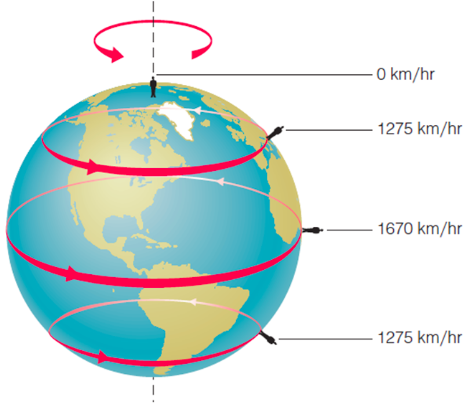
The earth is always spinning around on its axis and without noticing it, we the inhabitants are also spinning at the same speed that it does wherever we are located on the earth. Anything or anyone situated at the equator is moving at a speed of 1670 Km/hour while those located midway between the poles and the equator are moving at a slower speed of about 1180 Km/hour. The speed keeps reducing as you go further to the poles.

Screen Shot 2018-11-06 at 15.04.22

Illustration of the speed differences in the Earth’s rotation. Picture Credit – Wholedude.com

You’re probably wondering how true this can be? Well, imagine this, get three spots; one at the pole, another midway between the pole and the equator and a third one at the equator. When the earth makes a complete revolution, each returns to its original position in the same 24 hours. Due to the shape of the earth being round with its widest section at the equator, the spot at the equator definitely moves many more kilometres than its counterpart spots at the pole or midway between the pole and the equator. This then confirms that the land at the equator moves faster than at any other place on the earth.

Launch of spacecrafts is a very expensive affair thanks to the current expensive technologies of petroleum fuel propulsion that we have to contend with. It costs SpaceX US$ 62 Million to launch the Falcon 9 rocket each time while the Falcon Heavy costs US$ 90 Million to launch. In fuel requirements, the Falcon 9 needs 409,000 litres of fuel to launch. Launching a spacecraft follows the principle of making sure that it travels fast enough to avoid being dragged back by the earth’s gravitational force through what is termed as achieving escape velocity.

With that background, it is clear that the spin of the earth can give the rocket launch an advantage. If a rocket is at the equator, even before firing, it already has a speed of 1670 Km/hr. The net effect of this is a drop in launch costs, especially on fuel.

Uganda being at the equator has all it takes to offer this added advantage and host Africa’s only cost effective Spaceport. The spillover effect of this facility could entail:

  • Turning Uganda into a one stop place in Africa for launching and operating spacecraft.

  • The emergence of technically qualified personnel in the growing field of spacecraft engineering

  • The design of new training courses at universities aimed at meeting the human resource demand at the Spaceport and its suppliers.

  • Numerous jobs created.

  • Tourist gateway to Space among others.

So, to the honchos directing Uganda’s tourism industry, Amos Wekesa, John Ssempebwa, Stephen Asiimwe and others, it is time you refined your creative juices to plan for Tourism Uganda in 2090. Your unborn descendants shall be proud of you.

James Wire is a Business and Technology Consultant based in Kampala, Uganda
Follow
@wirejames on Twitter.
Email
lunghabo [at] gmail [dot] com