
Tag Archives: Technology

The unravelling reality of Space Travel


Welcome back the Shepard, perfect landing, we made history today. Now, who wants to go to space?” said the commentator in the video after the second landing of the New Shephard rocket that Blue Origin has been working on to realise the dream of space travel. Wondering, what the heck this is all about?

Let’s go down memory lane. The 18th and 19th centuries were spent with various individuals experimenting on air travel. Many mistakes were made, however, their persistent efforts paid off when at the dawn of the 20th century, The Wright brothers among others were able to come up with mechanised flight.

The first commercial flight in recorded history occurred on January 1st 1914 between St. Petersburg and Tampa in the USA covering a distance of 21 miles (34 Kilometres) in 23 minutes at an altitude of 15 feet (5 metres). The amount paid then by the passenger was US$ 400 which is equivalent to almost US$ 10,000 today.

KLM the world’s first commercial airline opened it’s doors in 1919 and transported 345 passengers and 25,000 Kg of mail and cargo in its first year. This is equivalent to the load carried by a single Boeing currently. Since then, a lot of progress has been made in the aviation industry with flights today traveling non stop for over ten hours at speeds we currently consider fast.

In the middle of the 20th century, the space race begun and was largely a two horse battle between the American and Soviet Governments. The Soviets drew the first blood by sending the first man to space as well as launching the first ever satellite. Subsequently, the Americans outdid them by landing the first men onto the moon. Alot of effort has since gone into space related research with the launch of numerous satellites and probes sent to distant planets.

The entry of private players into the Space Age that had been a monopoly of state actors begun remarkably changing many things and injected a lot of much needed money as well as innovative ideas.

In 2002, the commercialisation of space travel saw Mark Shuttleworth become the first African to travel to space and spend eight days at the International Space Station. It however came at a hefty cost of Twenty Million US Dollars. Not many can afford such sums of money to achieve the dream of space travel.

One of the reasons space flight has traditionally been expensive is the need to use new rockets each time a pay load has to be taken to space. It is similar to having to purchase a new plane for each flight that is going to be made. There has always therefore been a need to come up with ways of landing rockets safely back to earth and reusing them for future missions.

On April 29th 2015, Blue Origin launched the first flight of the New Shepard rocket that flew upto 307,000 feet (Approximately 94 Km) which was just 6 Km shy of the Kármán Line at the altitude of 100Km regarded as the Edge of Space. The rocket came back to earth and made a successful upright landing much to the joy of the development team.

As if that was not enough, seven months later, on November 23rd 2015, a repeat flight was made by the same rocket that achieved a distance of 329,839 feet (100.4 Km) above the earth effectively reaching the edge of space.

On the 21st of December 2015, Space X a company whose goal is to enable people live on other planets sent the Falcon 9 rocket to space and it duly delivered eleven (11) low earth orbiting satellites after which it returned and landed safely back on earth. Similar to Blue Origin, Space X took the game further using a more powerful rocket while attempting a much harder feat. Not to be outdone, the New Shepard was sent on another trip back to sky on 22nd January 2016 confirming to many that Blue Origin means business.
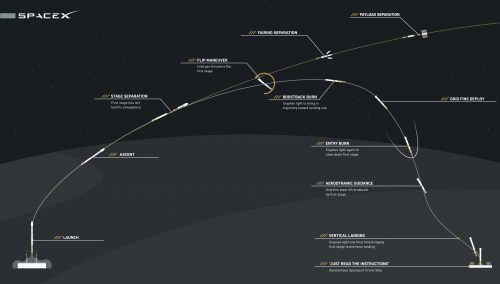
16892430560_f87dff78c0_o_1

Falcon 9 rocket route plan. Picture courtesy of SpaceX

What does this all mean to humankind?

“If one can figure out how to effectively reuse rockets just like airplanes, the cost of access to space will be reduced by as much as a factor of a hundred. A fully reusable vehicle has never been done before. That really is the fundamental breakthrough needed to revolutionise access to space.” Elon Musk, Space X founder.

At the turn of the 20th century, the pride of many was being able fly in an aeroplane and visit other continents on earth. The 21st century however has come with its own demands. Today, with a greater understanding of the solar system, galaxies and the universe, humanity is aspiring to colonise other planets and make them habitable or at worst extensions of our civilisation. Why can’t one go for holiday on mars or the moon? How about taking a guided tour of the Solar system giving you an opportunity to see planets like Pluto, Saturn and it’s many moons all from the heavens’ eye view? Imagine closely trailing a comet or asteroid on its journey orbiting the sun? Let alone having real estate on the moon with a retirement apartment for you? For the work freaks, wouldn’t a floating office in space give you the extra zeal to work?

All this may seem too imaginary and unreal but it’s as outrageous to you just as the idea of flying an aeroplane was to earth’s inhabitants six centuries ago. The human race has all it takes to conquer the universe and with the advances made technologically, one day at a time, I can’t rule out inter planetary travel being the norm in the next thirty years with inter galactic travel being achievable within a century from now.

Our ability to visit space repeatedly, at will and with ease will go a long way in enabling us push the boundaries of space ambition. A rocket should be able to take off from earth, deliver passengers into space and return all within minutes and then make another flight within the hour, essentially being re-used five to eight times a day. That way, the cost of access to space per head will drastically go down.

This is one of the reasons am excited about the foresighted approach of the new Ugandan Secondary School syllabus that has added Astronomy as part of the package to be taught to students. A good understanding of what the universe has in store for us will push our children into aspiring to challenge the new horizons. Maybe it could also be one of the solutions to the numerous land conflicts that we are faced with.

@wirejames on twitter

Subscribe to this blog to get regular updates for new posts.

#Anonymous to Hack #Uganda


160115192610-anonymous-2-540x304

Anonymous hacktivists Image courtesy of CNN

We are Anonymous,

We are Legion,

We do not Forgive,

We do not Forget.

That is the introduction to the press release by Anonymous, the globally acclaimed Hacktivist group that pursues anyone and everyone they deem as being unfair to society. In a February 17th 2016 press release published on the Anonymous Video Network, they state;

“Operation Africa is an ongoing operation by several activists within Anonymous who have begun cooperating. The focus of the operation is the disassembly of corporations and governments that enable and perpetuate corruption on the African continent. This consists of organisations responsible for child abuse labour as well as internet censorship within the continent and globally. We are fighting alongside other operations such as OP Nigeria as well as Anonymous SA to help free the continent from exploitation as well as the plague of exploitation that has been occurring for centuries…. No Longer will we stand by and watch these blatant abuses of power occur. We will continue to fight for their liberties until all our brothers on the continent are freed from the shackles of corruption and greed.

We will not sleep

We will stop at nothing

We are Anonymous

They should have expected us”

A follow up of this threat on the Anonymous Website reveals that Uganda is one of the countries they are initially targeting. The concerns these hactivists have regarding Internet Censorship and Corruption hit the Bull’s Eye when it comes to my country.

In the run up to the elections of February 18th 2016, I was taken back when I saw the display of military hardware that the Government had just imported and the subsequent chest thumping by the security agencies. In this day and age, it is important to know that the threats are changing. It seems like we are speeding past the era of physically confrontational armed rebellions that involve spending days and nights in bushes and spilling blood. Field battles while fighting for a cause are being replaced by online activism.

Why should we be concerned about the threat that Anonymous extends?

Other than defacing some random websites here and there, this group has the ability to inflict serious damage if they put their minds to it. I know the Uganda Police has put up a cyber crime unit but it’s abilities are still wanting due to numerous reasons.

Some of the most hard hitting acts Anonymous could engage in and affect the Government of Uganda could be;

  1. Shutdown of all Government related Websites: The use of the internet to share information by the government is growing astronomically. Through the use of DDoS attacks they can put all targeted sites on their knees. Major corporations like CNN have been victims of this. Government agencies like Uganda Tourism Board that grossly rely on the internet to market the country’s tourism are likely to be badly affected. With numerous internet facing systems deployed by various ministries like Finance, Education, Agriculture, Justice among others, any service shutdown is likely to have a significant impact on operations as well as the general economy.
  2. Access Credentials: By breaking into the online systems and accessing user credentials of various Government officials, a lot can be unearthed about the internal operations and on a brighter side, it could even help the general public uncover the rot that could be going on in some agencies. In February 2016, the group hacked into the servers of the Broadband Systems Corporation a key service provider to the Government of Rwanda. They altered all system passwords and extracted numerous account credentials used by Government agencies to communicate. The exploits were sampled here.
  3. Internet Blackout: Just like they did in Turkey, the group has the capacity to shutdown internet services across the country thereby leading to loss of business for many. The efforts by UCC to limit internet access would pale in comparison to the kind of damage Anonymous can potentially inflict if they take this route. As I write this, the group has promised an April Fool’s day surprise for Donald Trump and believe me, they will deliver even as the FBI watches. Such missions are handled by the elite of the elite Anonymous hackers who are able to completely erase any traceability in the event that the authorities tried to locate them.
  4. Disabling .ug: By focusing efforts on the root servers of the Ugandan Top Level Domain, which controls all sites that end with the suffix .ug, any website with a similar ending gets affected and cant be accessed online. When the Turkey attack was done, over 400,000 sites were offline for a period of Seven (7) days. You cant send or receive email or even have your content on the website accessed due to failure to resolve the DNS. We dont want that to happen. Three days of Facebook Censorship in Uganda were enough to show us how critical and part of life the internet has become to our lives.
  5. Infrastructure Attacks: Anonymous has the ability to target critical banking infrastructure in the country as well as any other service providers like Electricity and Water utilities for as long as they have systems that are interlinked with one or two gateways to the internet. Just imagine if they got into the UMEME network and remotely manipulated the Yaka Software Systems by resetting all customer units to zero or better still provide free power to all customers? They could easily get access to national security installations and siphon out critical information that the Government is heavily dependent upon or even expose key security informants that have for long operated undercover. Access to the Civil Aviation Authority network could easily lead them into our Airport network thereby disorganising flight arrangements and putting flights at risk. After all, they are Anonymous, we should expect them!

I could go on and on about potential exploits by this group. It is therefore a pity that the Government is silent over these threats. Perhaps they have no choice and are just clueless over how to engage this elite group of hactivists, hence having to wait and accept fate like a lamb ready for massacre.

Interestingly though, we don’t seem to be very far from getting our own Ugandan version of hactivists likely to link up with Operation Africa. The Hackers Uganda team did participate in the resistance against the aborted giveaway of Mabira Forest to an investor to grow sugarcanes way back in 2011. They hacked the Uganda Investment Authority website and left a message of defiance.

Over to the Uganda Police and the various security agencies that litter our land, are you ready for this teargas proof approach to civil disobedience?

On twitter @wirejames