
Dear Your Excellency, President Yoweri Kaguta Museveni,
Happy New Year to you and your family.
This is going to be a long read but I request that you get a cup of Obushera, sit in your compound under your favorite tent and take time to read what I have penned down.
I would like to point out some mindset adulteration you have fallen victim of to condemn the rice production and its producers in Uganda to the extent of not really giving a hoot about hand holding the industry like you did for the Dairy Industry that largely benefits your region of South Western Uganda.
The Daily Monitor quoted you as stating, “There are some Ugandan rice producers who wanted me to punish Ugandans by banning cheaper Tanzanian rice. They wanted me to force Ugandans to buy expensive rice from Ugandan producers who are inefficient under the guise of non-tariff barriers. I rejected that. Why should Ugandans spend more money on rice when there’s cheaper one which was blocked by government…”
This was such a sad statement you made because it shows the lack of appreciation of the need to upgrade the livelihoods of Ugandans as a whole. Why do I say this?
Let us compare the Dairy Industry that you are proud of with the Rice industry that you are openly displeased with.
On Uganda’s much adored Dairy Industry!!
Prior to 1990, Uganda was a net milk importer and those that were involved in the dairy industry as producers were largely nomads. You are on record having made that admission and it is one of the key issues you hinged upon to ensure that you turn around their livelihoods by sorting out that agriculture sector. You very well know how much it was a hard sell to get nomads to settle down in restricted confines to rear cattle but eventually succeeded, at least to a good extent.
The Government kicked off by coming up with a 1993 Master plan for the Dairy Sector. This later led to the enactment of the Dairy Industry Act which led to the set up of the Dairy Development Authority whose duties among others were to;
- Manage donor-financed grants and credit lines for investment in milk collection and processing
- Promote dairy training institutions to ensure local availability of well-trained human resources to support the Dairy Industry
- Borrow money
Some Objectives of this Authority are;
- To provide proper coordination and efficient implementation of all Government policies which are designed to achieve and maintain self-sufficiency in the production of milk in Uganda by promoting production and competition in the dairy industry and monitoring the market for milk and dairy products
- Facilitate the Dairy Industry;
- to raise the incomes and standard of living of small-scale farmers through increased and continuous returns in dairy farming
- to regulate and control the market for milk and dairy products and to promote production and competition in the market
I have pointed out just a few of the goals of that Authority as enshrined in the Act, but you can see that it was a clearly mapped out strategy to boost the Dairy industry. Such foundational cushions have been alien to the Rice sector except for a few cosmetic declarations here and there like the Uganda National Rice Development Strategy as well as feeble efforts by some development agencies that have not had the kind of impact expected of them.
The one thing I want to bring to your attention your Excellency is the political-economic factors necessary to uplift growth in the development of the various agricultural sectors. Much as there is a fair sense of macro-economic stability, which is a precondition for sustained growth, purposive state support for infrastructure, extension services and education is very crucial.
Being the under developed country that we are, state support for productive sectors of the economy is feeble as a result of some players, usually individuals, that resist such initiatives for selfish gain. They wield this power of influence due to their level of influence upon the ruling elite. The ongoing Coffee industry saga is vivid testimony to this.
The National Resistance Movement forms the core of this ruling elite and hence indicative of where the blame should turn to as you finger point at the rice producers. With the bulk of the ruling elite coming from South West and Western Uganda being traditionally cattle herders, they took it upon themselves to promote dairy farming using both personal and mostly state resources to achieve the goal. This can be seen through your own push as well as the likes of Hon. Engineer John Nasasira among others.
Early development initiatives in the dairy sector targeted South Western and Western zones which were popularly referred to as the Mbarara Milk Shade Area. These initiatives mainly rehabilitated milk coolers and supplied generators where between 1987 and 1991, the Dairy Corporation alone established 42 milk collection centres with (about 2000 litre) milk coolers and generators in the region financed by the African Development Bank.
DANIDA also offered more support making the milk coolers symbolic of Danish aid. You are on record remarking that, “Denmark, …. You have made my people rich.” How I wish this statement had applied to all Ugandans.
The table below is an extract from a report showing the distribution of installed coolers at one point in time in Uganda. The point I have been making can be clearly seen exhibited there.
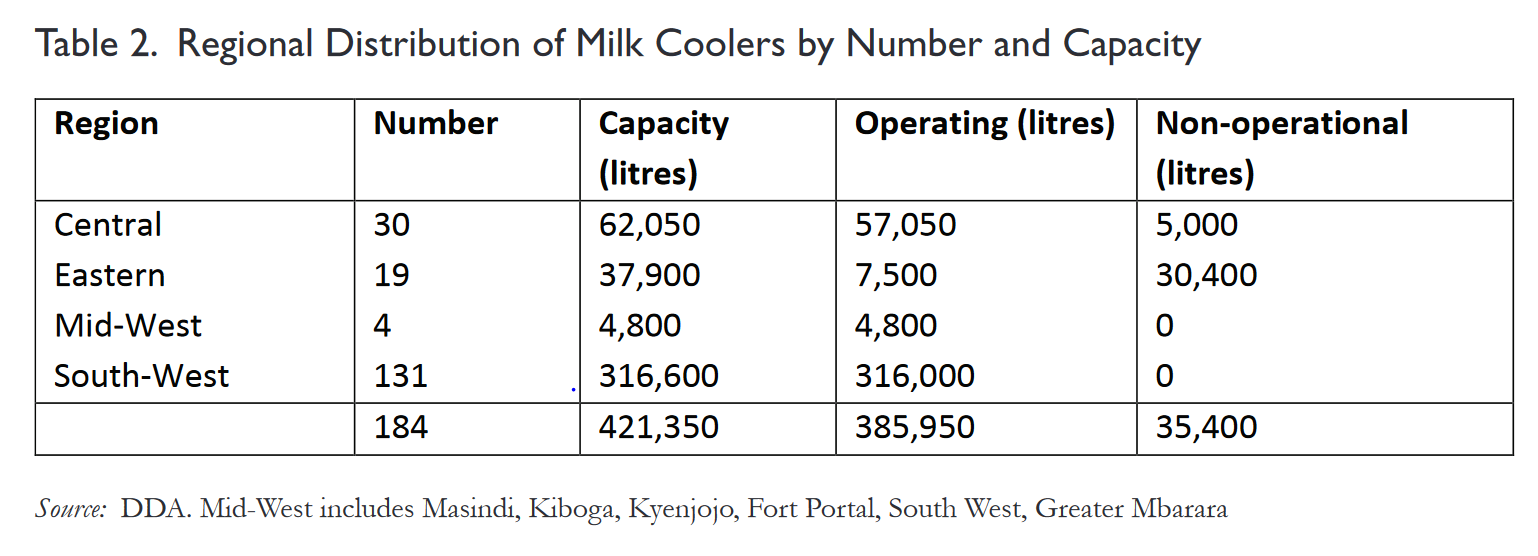
It is a known fact that the economic growth and influence of any sector player in Uganda today is unlikely to be based on the profit worthiness of the sector alone but more on informal networking with the ruling elite. Being powerfully connected has proven as the ideal catalyst of flourishing in business or a region having its development needs addressed.
Today, you chest thump over the progress made in this sector and rightfully so. However, you know that it has taken decades of a deliberate effort that had your keen participation to get where we are today. I once visited some dairy plants in Mbarara and was surprised to find cheese products that are specifically produced for foreign niche markets. It is common knowledge that today our neighbours like Kenya, Tanzania and Rwanda are scared of our dairy products because they out compete their locally produced ones. Hence the limitations on our exports. We are exporting to a number of further off destinations as a result and this is a total opposite of the bad, very poor quality milk we used to have access to from the milk farmers before the turn of the last century.
Did you ever even once stand up and justify the importation of milk as a result of the poor quality produced locally at that time?
Now to the Rice!!!
As you answer the question I just posed, Your Excellency, Uganda is a country with a high potential to be a very big player in the regional rice production. From the Eastern, up through the Teso region all the way to Northern Uganda, you find very many suitable rice growing areas with numerous peasants engaging in the activity. These scattered rice growing peasants are akin to the scattered balaalo who used to herd cattle for the fun of it until you woke them up.
While something has been done in regard to rice support, I want to point it out that your government has not put much effort in ensuring that this sector becomes globally competitive.
It is a pity you do not eat rice as stated. However, the rice produced locally has a uniqueness that could render any taste buds glued to it.
You are a champion of value addition, a trait that we share closely. For Uganda to produce the kind of quality that you admire, it is crucial that you pick interest in seeing the right things done. I tend to believe that sometimes you are taken for a ride by the ruling elite that surround you.
By blame throwing and letting in tax exempt rice easily from abroad, you are killing the emerging local industry. A few individuals that are benefiting from the mass importation of rice may be walking all the way to the banks with smiles but the unwashed masses whom you continuously claim to represent and want to see them uplift their livelihoods remain wallowing in avoidable poverty.
There are numerous ways you can address the value addition issue in our rice sector but that is a topic for another day.
As I wait for the Members of Parliament who come from the rice growing areas to come forward and dispel your perception, I humbly give you the view of a lay Ugandan.
As the rice growing regions, we are disadvantaged on the political-economic front hence the tendency to take lightly the issues that matter to us considering that the ruling elite from our areas lack the courageousness to face off with you when it comes to clamoring for those they represent.
I thank you for reading upto this far.
I hope you enjoyed the Bushera under the cool breeze.
Help us the rice farmers. Do unto Rice, what you did for Dairy.
I remain Yours
James Wire
X (Twitter) – @wirejames
Threads – @wire_james





 The Wire Perspective