
Category Archives: Technology

Hon. Minister Sir, This is what I wanted to say


In Uganda, it is out of the ordinary for a Government minister to engage the citizenry in a consultative manner. In most cases it is a one way engagement where he/she is telling the citizens what to or not to do. This is why I was taken aback when I received the call inviting me to the ICT & Communications Stakeholders’ dialogue convened by the Ministry of ICT and National Guidance that took place on the 7th of July 2016.

That morning, I decided to pen down issues I thought I needed to share but midway my attempt, the little devil in me reminded me that it was going to be business as usual hence I might not even get a chance to air my views. I proceeded to send some Whatsapp messages to my Wawa buddy Simon Kaheru.
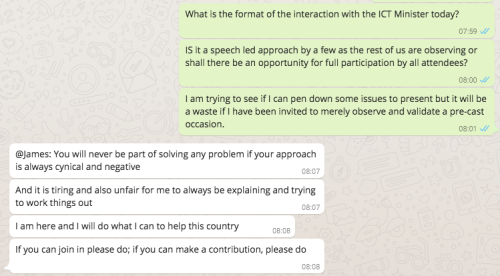
Screen Shot 2016-07-08 at 09.03.21

As you can see, he lambasted me for being negative and that is when I realised that just maybe, this is likely to be Business Unusual this time round. Given two minutes to make my submission, I realised that I had a herculean task and hence had to summarise in a manner that would make the creators of WinZip envy me.

Hon. Frank Tumwebaze, this is what I had to share after being fervently reminded that it was a dialogue NOT a finger pointing and popularity seeking contest.

Uganda may have made strides in the ICT sector over the years but like any other industry, we are always on the road, seeking moving on to the next best thing. As a result, my views on the industry currently while not exhausted by this submission are;

Get the National Fibre Backbone closer to the people. The National Data Backbone rollout by government is an impressive feat and should be applauded. Despite the hiccups faced in it’s initial stages, the team at The National IT Authority, Uganda (NITA-U) was able to turn around a nearly failing project into the deployment success it currently is. Steps were taken to have a private sector company manage it’s commercialisation but to-date, we are yet to see and feel it’s effect directly as citizens. While it may be interconnecting some critical government infrastructure that we rely on already, as well as offering capacity to some large corporates, as a resident of a village in Mukono Town Council, I would like to see it impact me directly. Short of working out ways in which we can see real value as lay men, it will remain a white elephant to us.

Case in point, Smile Telecom and Roke Telekom have some pretty decent internet access offers, however, because they have to roll out their networks from scratch as they extend the services from town to town, this has slowed their growth. Why can’t we win over some of these providers to use this backbone as a backhaul thereby allowing them to concentrate on final delivery of services in the various towns? The argument might come up that “They haven’t approached us” or “we failed to agree” but this is not the attitude of a proactive mindset. It always helps to engage and find out what middle ground one could achieve. So, the company contracted to manage this fibre needs to offer more services than merely maintaining the proper functionality of the cable. It should be able to advise the government on how to better utilise the resource, attract more customers through well packaged incentives.

By offering good backhaul links between the towns, this fibre has the potential to create a spinout of numerous Virtual Service Providers who can effectively offer services in their local areas and hence widen the catchment area of internet and e-government usage in this country. Imagine if the fibre has a termination point in Kumi and a one Ejalu sets up a local WiFi network in Kumi town with backhaul access to Roke Telekom in Kampala via the National fibre, he can provide not only a much cheaper service than the grossly expensive bundles that our Telecoms have made us accustomed to but also has the opportunity to customise its delivery through the use of open source software as well as language translations to suit the locals. The future of most services is localisation.

Certification of ICT Practitioners. NITA-U has come up with a proposal to regulate all ICT practitioners in the country just like is done in the Legal, Engineering and Surveying sectors. This is being met with alot of resistance from industry players.

However, in my personal opinion, this resentment is probably as a result of uncalled for Fear, Uncertainty and Doubt (FUD). The government needs to come out and sensitise the affected parties about the intentions of this initiative as well as make modifications where necessary.

The ICT industry is not as straight jacket as the Legal, Architectural, Survey and Engineering domains that are pre-defined out of the box. Many, including yours truly are self trained practitioners who spent sleepless nights utilising internet resources to gain skills. To be told that you need to have a certain certificate before being allowed to offer an IT service is a threat to our very existence. However, more of this is covered in this article I wrote on the need for certification.

Outsourcing. Through NITA-U, the government has made efforts to promote this sector of ICT Business. Truth be told, not much has been achieved and this could be attributed to the misguided belief that business opportunities will come from outside the country as opposed from within.

The Indian BPO industry honed its skills from the pro-active approach taken by the government to outsource services for some of their work to local businesses right from the local government level up to the national. A similar approach would help our companies too.

It is no secret that most government departments in Uganda need digitisation of their records. Secondly, there are numerous citizen centered services that the BPO sector could run on behalf of Government agencies e.g. The immigration department could have a tracking system for Passport management run by a private company to respond to various passport related queries instead of the massive human traffic that makes daily pilgrimages to their offices giving a semblance of a busy environment.

The Uganda Revenue Authority had a similar problem when it used to centrally manage all lodging of paperwork by clearing agents and various tax payers until they came up with an IT solution that allowed third party service providers to plug into the system and offer the same services. The traffic at their head office reduced very significantly.

Local Content. Local Content refers to the percentage of locally produced materials, personnel, financing, goods and services rendered to an industry and which can be measured in monetary terms.

Just like the Oil Industry, it is high time a local content policy for the ICT industry in Uganda was effected. I know NITA-U is working on this but it’s important that we bring it to the fore. During the run up to the previous elections, the discontent by many arose from the fact that most opportunities in the country are seen to be bypassing the local providers in preference for foreign. With all ‘big’ jobs naturally gravitating to foreign owned companies, this has left many brilliant ICT professionals with nothing to do locally as well as led to the closure of many a business venture.

Take a stroll around Africa and you will be amazed at the number of projects Ugandan ICT professionals have implemented. During a consulting gig for the Common Market for Eastern and Southern Africa (COMESA), I felt very proud when the head of the ICT department praised the Ugandan consultants they had used claiming they always did a great job. Why then can’t these very resourceful Ugandans be appreciated back home in preference for foreign journeymen way past their sell by date in their home countries? Yesterday, a friend intimated to me that a reknowned financial institution in Uganda flew in expatriates to install a Cat6 Cable Network in their offices. It is such instances that make me resort to Tamale Mirundi’s expletives “Ngalabi Za Mitwe” (Drum heads).

The cry by Government officials that we are not yet skilled enough is hogwash because we would not be hired by international agencies if that was the case.

I propose that an inventory be done of ICT practitioners in this nation complete with their areas of specialisation and businesses (if any). A move towards empowering them either through selective bidding (locking out foreign entities) or ensuring a procurement structure that enforces partnership of foreign entities with local businesses in order to undertake projects would be welcome. We need to start sieving the deal makers from the real solution providers and this is where accreditation through certification might come in handy.

National ICT Strategy. It is said that one human year equals four technology years. In other-words, every three months that elapse equal to one technology year. As a nation we are good at making plans, policies and the like, however, in some cases these are driven by the need to achieve simplistic quick gains without looking at the long haul.

We also tend to have a disease of implementation. When the good plans are made, either the resources (not only money) required to see them through are not availed or government departments attempt to outmuscle one another for implementation rights.

What we need is a well rounded strategy with a multi-disciplinary and long term perspective. ICT is an enabler, so any plans should take into consideration our aspirations in the Health, Education, Agriculture, Manufacturing, Transport, Tourism and other sectors. How can we can use ICT to address corruption, traffic jams, trade, manufacturing, illiteracy, security, travel, piracy, climate change among others. The desire for shortcuts will keep us heading back and forth in an unending loop only to take us back to the starting point.

Hon. Minister Sir, this is what I never had a chance to share in detail. I am glad you have read it in it’s entirety now. By the way, you asked where the developer of Me2U is. I would like to gladly tell you that he is very alive and plying his trade from Entebbe with a largely foreign clientele that keeps him busy. Not wanting to soil his career with the intricate dynamics involved in getting local business (especially government), he opted for the foreign strategy. Otherwise he is one of the most deeply rooted nationalists I know of in this country.

For God and My Country

Follow @wirejames on Twitter

To Certify or Not, NITA-U in the Dock


She broadcast the message onto one of Uganda’s largest online platforms for IT professionals, the I-Network Uganda and it read:

Please find link to read and know about Regulations that support the Certification process. These Regulations include: the National Information Technology Authority, Uganda (Authentication of Information Technology Training) Regulations 2016 and the National Information Technology Authority, Uganda (Certification of Providers of Information Technology Products and Services) Regulations, 2016.”

Within minutes, responses to the thread were flowing in. One of those that briefly summarised the general mood went as follows;

They do not account for experience.

They do not account for online courses.

They do not account for interning/mentoring.

They do not account for self taught prodigies and IT savants (PC whisperers).”

What are these regulations all about? The National Information Technology Authority – Uganda has come up with regulations that it wants passed in order to regulate the ICT industry. These regulations affect Individual and Corporate service/product providers as well as Training institutions. Information Technology is one of those industries that has largely grown organically with very minimal regulation.

On a fora dominated by more youthful ICT practitioners, comments were as follows;

Eh! Above requirements in document are going to bite all experienced players in contrast to those who have proffessional qualifications.

It might also spur employment of jobless professionals by the experienced players. Either way, I am emigrating.”

Shouldn’t the SMEs and startups put on evil smiles? All those ‘experienced’ chaps getting kicked out are theirs for the taking”

An unregulated market is how everyone loses out : Profit flight, Uganda being a supermarket for everyone to come and sale, Low levels of skill, Low tax bases, Those kinds of things

On I-Network, a forum dominated by middle aged first and second generation ICT practitioners, the discourse was dominated by such responses below;

I perused through the document and I kept desiring to throw up my breakfast. I request clarification on the documents shared above. Are they specific to individuals and organisations that intend to work with government or do they include people relating with private businesses. The documents seem to only aim to make the Authority relevant and to also increase its revenues through an unnecessary six month certification (taxation).

We appreciate the initiative by NITA-U to protect customers’ interests but I think rather than making it mandatory and making it criminal if you are not certified by NITA. An even more prudent approach is make it optional and spend all the resources educating customers on how to look out for a “suitable” IT solutions supplier. This is achievable and requires less resources to implement.

There is a reason that training is done . You have been doing the work but you don’t have the qualifications to do the work. ‎As a regulator there should be precedence as to what qualifies someone to do/offer a service. We can’t continue to run on try and error because it has worked in the past. If you haven’t studied the subject what principles do you use to do the work

Very interesting debate and dialogue going on here. I am still struggling with the ‘spirit’ of these regulations? How will these regulations enhance competence that is so lacking? So if my University is certified as a service provider and continues to churn the products it is delivering what is the value of this certification?

Let’s look at this as trying to streamline and provide some customer protection. It’s not a surprise that most people that don’t support this are service providers. May be tell us what you are trying to run away from.”

These regulations can form the start of the MRA’s (Mutual Recognition Agreements) for the ICT sector in Uganda. I hear the issue of the professionals with no formal education. What is needed is to work with NITA and have this category amended. Because as we stand today those people would not be able to get a work permit anywhere outside Uganda. Our ability to cover them in the proposed regulations would create a starting point for this category.”

I took time to read through the proposed regulations and from those targeting Service Providers and noted the following:

Part II 3(a) A person shall not provide information technology products or services unless that person is certified in accordance with the Act and these Regulations.

I believe this is a good provision. We are always complaining of poor service provision in our industry and being undercut by people who hardly have a clue about what to deliver. It is not strange finding a Fish Processing firm winning tenders in ICT only to later subcontract the work to a little known firm with the skills but then again pay them measly sums.

There are individuals who have specialised in these brokerage services and always win tenders due to their underhand methods of operation. Fifteen years ago, the Electoral Commission was involved in phoney dealings with a self styled Computer Expert, a one Frank Katusiime that saw the organisation spend over 3 Million dollars on ICT related consultancies that saw some consultants bag US$ 2000 per day. Do we want to maintain the status-quo?

We have lots of youths who have various ICT qualifications but are lacking work to do. This is an opportunity for them to team with the money bags to either run businesses together or work for them in order to ensure that their operations are compliant.

The only amendment I would propose to this regulation is that it should be paraphrased as;A person shall not commercially provide information technology products or services unless that person is certified in accordance with the Act and these Regulations.” This will give a breather to my 15 year old son who is already interning in my business operations learning how to fix computers and software.

Part III 7. (2)Without limiting the general effect of subregulation (1), a person intending to provide information technology products or services shall-

(a) in the case of a legal person, be registered in accordance with the law;

(b) abide by the standards for the provision of information technology products or services;
(c) demonstrate financial viability, where necessary;
(d) put in place and maintain a sound quality management system;

(e) have in place policies and procedures to govern the provision of information technology products or services;
(f) where applicable, employ competent and qualified staff to provide information technology products or services;

(g) provide appropriate infrastructure and equipment required to provide information technology products or services.

This regulation serves the purpose of facilitating the industry to address;

a) Fly by night business operators who have no interest whatsoever to observe the laws of the land hence operating but in an unregistered manner thereby defrauding the state of money through tax dues.

b) Unprofessional service providers that have no intention whatsoever to offer services in accordance with generally accepted standards.

c) Reduction of the prevalence of those service providers who are merely brokers. They specialise in clinching the deal and then pass it on to other financially capable players whose service provision may be questionable.

d&e) Unprofessional market players since having a professional setup in place is conducive when it comes to effective customer care.

f) The rampant joblessness of our youths many of whom have high qualifications.

Part III 8. (4)For the avoidance of doubt, the Authority shall assess every application to ascertain that the application-
(a) complies with applicable administrative, legal and technical
requirements issued by the Authority from time to time;
(b) demonstrates experience in the provision of information technology products or services;
(c) complies with applicable standards relating to the provision of
information technology products or services.

I foresee this netting those Fish Processing businesses that pose as ICT vendors. They have to pass all the hurdles indicated here. This provision while kind of scary for the small business or start-up, it should be looked at as a necessity. The small businesses in ICT have an opportunity to up their game, conform and then have a field day.

Part III 9. Grant or refusal of certification

(1)The Authority shall within forty five days after the receipt of an application grant or refuse certification.

.

(4)Where the Authority rejects or refuses an application for certification, the Authority shall give reasons and the registrar shall notify the applicant of the rejection or refusal within thirty days after the decision.

The commitment to a speedy handling of applications is a good sign since it shall not keep practitioners second guessing their status for mote than two months. If this is implemented as is, then few will complain of the process. However, after interacting with some NITA-U officials, I learnt that their goal is to set up an online engine that shall enable all applicants engage in the registration process without having to leave their offices. The engine shall have ensure full transparency of the process as the applicant will have frequent feedback on the status of the application. This addresses the fears expressed by some of having to make visits to the NITA-U offices from up-country.

Part III 11. Suspension or revocation of a certificate

(1)The Authority may suspend or revoke the certification to provide information technology products or services where the Authority is satisfied that–

(a) the person is operating in contravention of the Act or these Regulations;

(b) the capacity of the person to provide information technology products or services has diminished in a manner that affects the certification.

The beauty of this regulation is that it will be a continuous check for quality service provision as well as ethical behaviour. If customers are empowered to report unscrupulous registered albeit bogey providers, using this regulation could render them redundant.

Part IV 18. Products not in conformity with standards

Where the Authority refuses an application because the information technology products do not conform to approved standards for information technology products, the Authority shall take appropriate action including seizing and destroying the products at the cost of the applicant.

Scary as it may seem, this one serves to deter especially those that are into importation of fake products expecting to dupe our gullible consumers. The act of destroying all the stock is to ensure that it is not offloaded onto the black market.

I do hope that this regulation can be amended to exclude local innovators’ products that are testing the market. My proposal is to paraphrase it as; Where the Authority refuses an application because the information technology products do not conform to approved standards for information technology products, the Authority shall take appropriate action including seizing and destroying the products at the cost of the applicant. This shall however, not apply to local innovations that are a Work In Progress.

Part V 20. Persons providing information technology products and service prior to coming into force of these Regulations

(1) A person providing information technology products or services immediately before the coming into force of these Regulations shall apply for certification in accordance with the Act and these Regulations.

(2) The application under subregulation (1) shall be made within 90 working days after the coming into force of these Regulations.

Current players have been given upto three months to apply and that too is a fair deal since they definitely need some time to compile their paperwork as well as beef up their teams if compliance necessitates so.

Application Form

This deserves separate attention as it has generated a lot of debate and created fear among those practitioners who have no formal qualifications to justify them as ICT professionals.

Part 5 reads as:

EXPERTISE/ STAFF AND QUALIFICATIONS

(c) Indicate the qualifications in information technology of the staff as follows —

(i) Ph. D. holders

(ii) Masters

(ii) Bachelors

(iv) Diploma

(v) Certificate

(vi) Other Professional Certification

There are many competent ICT practitioners that are self taught and lack formal qualifications. I was one of those for a long time till I begun raking up various professional certifications with the aim of proving to those considering to engage me that I knew what I was doing. However, many have not toed my line and are not about to. They now are faced with the possibility of being stripped of a lifeline.

After my investigations with the NITA-U officials again, I realised that they have already catered for this group only that they could have erred by not indicating it in the application form. They plan to use the Skills Framework for the Information Age (SFIA).

SFIA offers a skills based description approach to Information and Technology roles being handled by professionals. It gives individuals and organisations a common language to define skill, abilities and expertise in a consistent way. As opposed to the theoretical curriculums that many institutions are bound to give you which are then based upon to judge your level, SFIA looks at what you can do and through a well defined process, you get rated.

The output of the SFIA analysis is categorised in seven levels:

  1. FollowWorks under supervision; Has minimal influence; Performs routine activities; Uses basic information systems.
  2. AssistWorks under routine direction; Interacts with many and may influence immediate colleagues; Performs a range of varied work; Demonstrates a rational and organised approach to work.
  3. ApplyWorks under general direction; Interacts with and influences department / project team members; Performs a broad range of complex and non routine work; Demonstrates an analytical and systematic approach to problem solving.
  4. EnableWorks under general direction within a clear framework of accountability; Influences team and specialist peers internally; Performs a broad range of complex technical or professional work activities; Demonstrates an analytical and systematic approach to problem solving.
  5. Ensure, Advise Works under broad direction and tasks are usually self initiated; Influences organisation, peers, customers, suppliers and partners in areas of own speciality; Performs an extensive range and variety of complex technical and/or professional work activities; Advises on available standards, methods, tools and applications relevant to own speciality.
  6. Initiate, Influence Has defined authority and responsibility for a significant area of work including technical, financial and quality aspects; Influences policy formation on the contribution of own speciality to business objectives; Performs highly complex work activities covering technical, financial and quality aspects; Absorbs complex technical information and communicates effectively at all levels to both technical and non technical audiences.
  7. Set Strategy, Inspire, MobiliseHas authority and responsibility for all aspects of a significant area of work, including policy formation and application; Makes decisions critical to organisational success and influences developments within the IT industry at the highest levels; Leads on the formulation and implementation of strategy; Has a full range of strategic management and leadership skills. Understands, explains and presents complex technical ideas to both technical and non-technical audiences at all levels up to the highest in a persuasive and convincing manner.

For those who thought you were affected, do you now realise that using the SFIA approach you can still get high ratings for your experience based skill-sets? You can learn more from the SFIA 5 Framework Reference.

The Ugandan ICT industry in my view needs some form of regulation if it’s to nurture players with serious potential as opposed to the fly by night deal makers that currently typify it. With lots of innovative individuals as well as local businesses attempting to break in, the spirit of this move by NITA-U is aimed at not only protecting the consumer but in the process giving genuine players an opportunity to blossom.

@wirejames