
Blog Archives

Stealing Articles – The Cancer afflicting Writers today


It was one of those routine work days, I branched by my local supermarket before reaching home to buy a few groceries and snacks. At the entrance, on the newspaper stand, I saw a headline that rang a bell on the cover page of the ABC newspaper.

I immediately decided to buy the paper and take a copy home for further reading. What I found out was so shocking and frustrating. The paper had lifted this entire article from The Wire Perspective Blog and published it under the name of one of their staff. It took me a while to believe that a seemingly professional outfit like ABC Africa Newspaper would have such gross disregard for copyright matters. Anger welled up inside me and I realised that I had to do something. Interestingly, I had been told by a number of readers before that some consultants were passing off my articles as theirs while marketing their business services. This is something I had never verified but this time round, I had a solid culprit.

I made a few calls to my seniors in the field of writing and most told me to just turn a blind eye claiming that it is normal and I would be wasting time and resources pursuing the matter. Unfortunately for me, I do not usually take no for an answer, so I made a choice to follow the matter to its most logical conclusion.

This is how I recalled an old acquaintance, Mr Charles Batambuze, who I quickly reached out to for advice. He wasn’t too bad and immediately referred me to a law firm KTA Advocates that offers free legal services on Intellectual Property matters for the Uganda Reproduction Rights Organisation and its members. Progress!!

I had a chance to interface with Counsels Ivan Ojakol and Edwin Tabaro who took me through the details and possible outcomes depending on what direction I chose to take on ABC Africa Newspaper matter. 
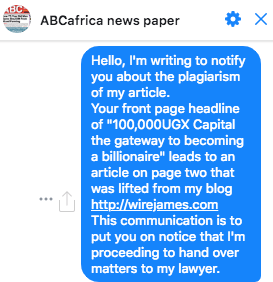
Screen Shot 2019-03-14 at 10.06.28

My initial message to ABC Africa

Amidst all this, I was already communicating to ABC Africa over this matter and the kind of response I got from them was heart wrenching. The arrogance with which they initially responded to my communication made me question whether they have professionals at the helm of the organisation. How can you claim to be a professional journalist and you do not have any respect for Copyright?

 

Screen Shot 2019-03-14 at 10.09.02

A reply from ABC Africa newspaper that left me shellshocked

Upon receiving a notice from my lawyers intending to sue, the tone of communication changed and they became more responsive. It took some back and forth before we settled for them to publish an apology as well as republishing the article under my name.

I felt a sigh of relief having concluded this matter in the most logical way and thanks to Karuhanga Tabaro Advocates who offered me an entirely free service, I was able to demonstrate to the chaps at ABC Africa Newspaper that arrogance doesn’t always pay off.

Are you an author who is also tired of such infringement of your works? Do something about it. Do not sit back and relax. Until we start making these infringers uncomfortable, they shall keep going about it like it is Business As Usual.

James Wire is a Technology & Business Consultant based in Kampala, Uganda.

Follow him @wirejames on Twitter

Email – lunghabo [at] gmail [dot] com

UNBS, consider restoring the S-Mark


The Uganda National Bureau of Standards (UNBS) is a statutory body set up by the Government of Uganda to among others formulate and promote the use of standards as well as enforce standards in the protection of public health and safety.

As part of its duties, the UNBS operates a Product Quality Certification Scheme targeting the manufacturing sector. When a product is certified, the manufacturer is given permission to affix the UNBS quality mark either on the product itself or on the packaging. The purpose is to give the customer confidence that what they are purchasing is suitable for use.

In years gone by, this certification had two versions, the Q Mark and the S Mark. The S Mark was an entry level certification that could be attained by a manufacturer for product recognition within Uganda. The Q Mark was a higher end version of the S Mark that enabled one to freely export their product to the regional markets without hindrances of any form.

For budding SMEs involved in production especially food processing, the S Mark was a breather considering that it was easier to conform with based on their limited resources and expertise as they marshalled their way towards eventually getting the Q Mark.

Then one day, UNBS woke up and made a ground breaking announcement that it was removing the S Mark and leaving only the Q Mark. The key reason being advanced was that local companies needed to be able to export their products to the regional market. Flimsy and non convincing reason in my view.

First of all an assumption was made that every producer wants to export to the region. Secondly, the resources required to achieve the Q Mark certification are way out of the league of most SMEs. A simple food processing outfit could need not less than UGX 10 Million to simply put in place the necessary infrastructure and processes that enable it to qualify for that standard. How many SMEs can afford that investment?

UNBS further followed up this decision by mandating that all products in the local Supermarkets should have the Q Mark certification. This further makes me wonder what they were thinking as they hatched this seemingly ingenious plan. There are numerous supermarket suppliers who will never afford the Q Mark certification requirements and blocking them from the supermarket shelves shall not only ruin livelihoods but also go against the spirit of Buy Uganda Build Uganda.

Other than forcing even locally focused producers to take on the Q Mark, UNBS should spend time focusing on how to facilitate these SMEs to transition into certification affordably. The best way around this is to have a basic quality mark in place (like the S Mark) which can guarantee the basic product quality expectations thereby enabling the small producers to also get covered.

By restricting all producers to one Q Mark standard, UNBS gives very little room for flexibility and as they enforce the use of the standard, numerous small businesses are likely to drop off the radar with grave consequences to the overall economy. Remember that SMEs form over 80% of the private sector business.

To UNBS, restore the S Mark or introduce an intermediary mark that can easily be acquired by small businesses that are not yet even interested in the export market. You can’t have a one size fits all arrangement here. Should you continue to insist, the results shall speak for themselves with a drop in producers, something which doesn’t augur well for an institution that is meant to play a facilitatory role to the nascent SME private sector.

James Wire is a Business and Technology Consultant based in Kampala, Ugandans

Follow him @wirejames on Twitter

Email lunghabo [at] gmail [dot] com