
In Honour of James Seipei Stompie Moeketsi


In 1974, somewhere in Parys, Free State, South Africa, a baby was born and named James Seipei Stompie Moeketsi. He was born at a time when the fight for black liberation in South Africa had gained steam. The likes of Nelson Mandela had been imprisoned as his wife Winnie Mandela continued with the struggle on the outside.
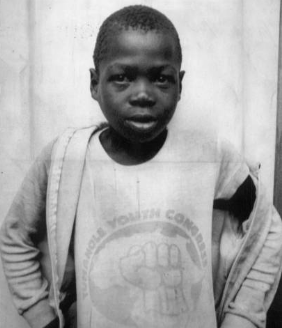
stompie

James Seipei Stompie Moeketsi – Photo, Huffingtonpost.co.za

Growing up in a wretched environment strategically designed by the apartheid perpetrators to dehumanise and disempower the black South African, the young boy gained a sense of purpose at an early age in life. Unlike today’s urban dwelling child who spends time just watching cartoons, playing their X-Box or hanging out in exotic play areas, Stompie realised at an early age that he had to be part of the solution to the disempowerment of black South Africa.

By the time he clocked ten years, he had joined the active anti-apartheid uprisings and went on to make a record of being the youngest political detainee at 12 years. This is the age when today’s child is still considered a baby and is pampered like the world will end if they do not get what they asked for. The zeal of teenagers and youths when it comes to some of these matters has a tendency to cross acceptable limits. They usually believe in the ideas thrown at them 150% potentially creating radicals out of them.

Stompie was that guy who made it a life time call to achieve freedom for the black South African. Like fate would have it, on December 28th 1988, he and three other boys were kidnapped only to be murdered on 1st January 1989. At the age of 14 years, this young energetic, zealous beacon of hope for Black South Africa had his life terminated by a one Jerry Richardson who was a member of the infamous Mandela Football Club.

The death of Stompie sent reverberations throughout South Africa with the liberation struggle proponents questioning each other on Who did or didn’t do it!

Little did they know that thousands of miles up north of South Africa, a young man, born in 1974 like James Seipei had grown so fond of the liberation struggle. His interaction with South African students who were studying in exile had given him a taste and feel of what was going wrong that side of the continent. He was lucky to be in school studying at a time when Stompie had dropped out in preference for pursuing the struggle.

The death of Stompie jolted this young man out of his sleep and after a period of grief, he decided to take on the names Stompie Seipei Moeketsi in memory of the late. This young man begun referring to himself as James Wire Stompie Seipei Moeketsi. Later, his school mates broke it down and while some called him Stompie Seipei, others referred to him as Moeketsi. Eventually, the name Stompie became synonymous with James Wire.

Alot is said about who killed or didn’t kill Stompie and one may be wondering why I chose to honor Stompie today. Once again, as I write this, thousands of miles south of Uganda, in Orlando Stadium, Soweto, Johannesburgh, the late Winnie Madikizela Mandela is being honored for her role in the struggle for Black South Africa emancipation. She was behind the notorious Mandela Football Club and the death of Stompie is attributed to her by many. However, it is not my role to condemn or exonerate her. All I can say is that she is closely tied to the circumstances that led to the demise of James Seipei.

Winnie Mandela, being in a struggle might have made some mistakes and for those who do not know, a struggle isnt a walk in the park. All parties involved tend to slip up here and there. This however doesn’t negate the very positive contribution this lady made to the struggle. She kept the candle burning while her husband was incarcerated. Many other incarcerated liberators had wives too but how many came up to keep their husbands’ ideals alive?

For all she did, I thank God that she was able to see South Africa come out of the apartheid era. As for James Seipei, it is a pity that he ended up being collateral damage in a game that involved very calculative and sophisticated tormentors backed by the oppressive apartheid regime.

In 2013, I paid a visit to South Africa and this time round had a deep conviction to find out more about how the blacks lived. It therefore came as no surprise when I walked out of my hotel in the plush Rosebank suburb with the intention of spending an entire day in the impoverished suburb of Alexander. My guide happened to be a resident of Alexander and he didn’t disappoint.

southafrican_shack

The home I visited in Alexander, South Africa. 

What I saw there made me question whether what James Seipei Stompie Moeketsi died for had been achieved. The levels of poverty are unimaginable. The kind of housing for people who dwell in an environment where temperatures swing from as low as 5º C upto 30º C was very questionable. I entered an excuse of a home that was basically thin flimsy iron sheets nailed on poles to form a wall with others covering the top acting as a roof. This 4m X 5m size shack was home to a family of five. Three children of whom two were already teens aged above 13 years staying with their two parents. I could only see one bed in the house, a corner reserved for cooking and another that had multiple uses among which was that of being a bathroom at the appropriate time. Privacy was non existent in that home, food was just enough for the next meal, so much was not right but what could they do about it after being abandoned by their liberators that chose to join the looting elite?

With a sorrowful heart, I vividly recall this sad experience as well as many others while in Alexander and wonder really whether Sompie Seipei is happy for the ultimate sacrifice he made for his country.

RIP Stompie Seipei Moeketsi

God Bless South Africa.

James Wire

@wirejames

Investment Opportunities at home for Ugandans in the Diaspora


The army of Ugandans in the diaspora is growing each passing year. By the close of 2016, Uganda’s diaspora remittances had hit the US$ 1.1 Billion mark. According to a study by the Bank of Uganda, most of the remittances are utilised for consumption. This however needs to change especially for those that have designs of retiring back home after the many years spent toiling abroad.

In a previous article, we saw the challenges Ugandans in the diaspora face when trying to invest back home. This time round we are actively assessing the possible investments that can be pursued. I hope that by the time you are done, you’ll have had one or two light bulb moments.

Uganda is not short of investment opportunities for diasporans. Its biggest hindrance is the lack of information on the lucrative opportunities. Matters are worsened by the laissez faire approach of the powers that be who don’t bother to aggressively expose the secrets of this country to those living outside.

It is essential to emphasize that the identification of investment options should follow a comprehensive review of your personal financial circumstances and goals by a qualified financial advisor if you have access to one.

As a diasporan, some of the opportunities you could consider exploiting are;

Unit Trust Funds

This is a fund composed of investors’ money which is invested in a variety of financial assets.

Investopedia defines it as, an unincorporated mutual fund structure that allows funds to hold assets and provide profits that go straight to individual unit owners (investors) instead of re-investing them back into the fund.

Uganda has a few Unit Trusts in place that are regulated by the Capital Markets Authority (CMA). If you are characterised by any of the following;

  • Interest in having a guaranteed modest income
  • Interest in higher returns from your money than say bank interest rates
  • Interest in capital stability
  • Have been a victim of crooked investment opportunities

Then, this is the kind of product for you. You are not only guaranteed of some returns, but you also have an assurance of the safety of your transactions. Being regulated, these funds are closely monitored to ensure that they do not rip off investors.

As a diasporan, it is possible to indulge in this especially if you have an account with any of the local banks. Some of the renowned local Unit Trust managers are Stanlib Uganda and UAP Financial Services.

Investment Companies

These are companies whose role is to invest the pooled money on behalf of their investors that in return share in the profits and losses.

Whatever assets the company accumulates, ownership is based on the proportion of shares held in the business by the individual investors. The investors proportionately share the profits or losses as and when they arise.

Imagine ten individuals, each with the capacity to raise UGX 300,000 (Three hundred Thousand) monthly for investment. These individuals are probably employed or living in diverse locations but have a desire to engage in business together. Besides, based on their big dreams, that money can’t do much at an individual level. However, if they come together, they are able to raise UGX 3,000,000 (Three million) monthly and within a year, jointly have UGX 36,000,000 (Thirty Six Million). At this point, they can then choose to buy shares in listed companies, or invest it in projects they deem desirable.

I know of one such Investment company that brings together Ugandans based in multiple countries globally. They are always on the look-out for investment opportunities especially on the regional stock exchanges. If it has worked for them, it can work for you too.

Investment Clubs

The Uganda Investment Authority defines an investment club as a group of less than 100 people who pool their money to invest in ventures they deem profitable. These have become common lately in Uganda especially among the urban working elites.

Have you heard of the Investment Clubs Association of Uganda? Yes, it exists and that is a sign of how serious these initiatives are lately. Diasporans could learn from this and borrow a cue.

Take the example of the Ugandans in North America Association (UNAA) that has been around for donkey years and gained a sizeable membership. It could organise itself into an Investment Club, collect annual contributions from members and invest in large scale projects back home. This could go a long way in adding value to the association, its membership or even entirely re-inventing it to suit the changing times.

Private Equity

This is money invested in firms which have not gone public (listed on stock exchange). As a private equity investor, you identify a business that is already operational, has potential and is probably not yet profitable. The investor buys the business, restructures it and supports it towards a path of good performance. Thereafter, one could choose to sell it off or even list it on the stock exchange.

There are numerous local businesses in Uganda that could get a new lease of life if only they had an infusion of this nature. Diasporans have the skills, exposure and even money to undertake such opportunities.

Government Securities

Defined as, a set of instruments that are used by the government to borrow money from the general public. This is one of the ways, other than through taxation that the government can raise money to fund its activities. They take the form of Treasury Bills and Bonds.

Treasury Bills are issued when borrowing money for a period less than one year. Specifically, these are issued for either 91 days, 182 days and 364 days.

Bonds are issued for money borrowed for a longer period over one year. They can be issued for 2 years, 5 years, 10 years and 15 years.

They are regarded as having the least risk among investment options simply because they are backed by the strength and credibility of the government. By offering a time bound repayment plan and predictable interest, their risk is near to zero.

You may be wondering how you can easily participate in trading. Life seems to have been made easier. I came across Money In Africa a website that facilitates you to monitor and trade in these securities online. Upon creating an account, one is able to view the offers from selected Government offers. In my case, I could see Kenya and Uganda only. The entire process is simple and user friendly. You might want to give them a try.

Alternatively, most local banks trade in these securities on behalf of their clients. By contacting your local bank, you should be able to achieve this with ease. More on this was covered in an earlier article.

Trading in Shares

Uganda has a vibrant stock exchange that traces its roots to the 90s. With eighteen companies listed currently, you have a choice and can trade in shares.

Once again, as a diasporan, Money In Africa is in position to make this experience much better. It offers not only profiles on these listed companies but an indepth analysis on each of them, complete with a list of recommended brokers.

Real Estate

This takes the form of land and buildings. It has been deemed by many as a lucrative investment and nearly all diasporans that want to do something at home consider purchasing land or building a structure as a priority.

The biggest challenge here has been the informal approach largely used to achieve this form of investment. Most diasporans have in the past relied upon relatives and friends to purchase land, construct structures among other things including even the processing of title deeds. As a result, there are a lot of stories of the untold suffering many of them have faced in regard to the levels of betrayal.

The good news however is that as a result of these challenges, some entrepreneurs have taken advantage and come up with businesses focused on serving the interests of diasporans in this regard. I have so far heard of two companies that specialise in construction projects for diasporans and offer their clients frequent updates utilising social media applications.

Another approach to this angle would be for property developers to team up with banks to offer mortgages for buyers of their properties. This would then allow them to sell to both locals as well as diasporans. Such an approach guarantees a diasporan of a quality property, funding as well as minimum exposure to the fraud earlier talked about. The only downside here would be the high interest rates of our local banks. This interest rate exposure though could possibly be reduced by borrowing from a foreign bank (where the diasporan is based) given that USD and Euro interest rates have been at historic lows. The foreign borrowings would be used for a substantial deposit on a local mortgage.

Agribusiness

Uganda is endowed in Agriculture. With very good soils, large masses of water as well as a dual growing season cycle annually, nothing beats that. The country can support the growth of numerous crops including some that have hitherto been considered alien like vanilla.

The major hindrance to this sector has been the lack of value addition through processing of the produce. Maize is sold as the basic grains, same to millet, ground nuts, beans etc. However, the increasing urbanisation in the country as well as international demand for food has led to the emergence of opportunities in this sector. Agro-processing is gaining traction. A diasporan I know based in the USA is currently processing Shea Butter and exporting it to well paying markets.

Opportunities here include processing of cereals, fruits, nuts among others. One could choose to participate in the actual farming of this produce through leasing of land or better still utilise a network of outgrowers.

If there is any sector pregnant with opportunity for diasporans, it’s this Agriculture sector. Focus though should be on export oriented opportunities.

Oil and Gas

As a new entrant in this industry, Uganda is rife with opportunities in this regard. The industry is being set up from scratch hence offering lots of opportunity for those with the know-how. A number of local content initiatives aimed at ensuring that Ugandans do benefit from this industry have been kickstarted and in my view, those with some knowledge of this sector stand a high chance of being early bird reapers.

More information can be got from these listed resources;

How best can this be realised?

Amidst all these opportunities, it is crucial that some of the following be done;

As a diasporan you need to arm yourself with some knowledge on business, financial literacy, agriculture, tourism among others. This will help you make more informed decisions as an investor even when you may have an investment advisor.

The Government of Uganda needs to get out of its slumber and proactively reach out to the diasporans. The current efforts aimed at the diaspora seem to have a feeble impact and we would be better off having a dedicated agency focusing on Ugandans in the Diaspora. The Diaspora Services Department in the Ministry of Finance still has a long way to go.

Taking the example of South Africa, under Brand South Africa which is the nation’s marketing agency is a programme called Global South Africans that reaches out to South Africans in the diaspora and gives them statistics and facts about the nation so they can then be equally empowered to not only promote their country but also attract investments back home.

Will you invest in Uganda?

James Wire is a Small Business and Technology Consultant

Blog: wirejames.com

Twitter: @wirejames

Email: lunghabo (at) gmail (dot) com