
The Merriam-Webster dictionary defines money as; Something generally accepted as a medium of exchange, measure of value, or a means of payment.
We’ve grown up knowing that money is largely paper and comes in the form of notes. That is why it’s a lot easier for one to identify the US Dollar and differentiate it from the Euro or Uganda Shilling. Over the years, advances in technology have changed the way we do what we do, or even perceive things. There was a time when it was perfectly ok to write a letter through the Post Office to a friend and wait for a month to get a response yet today, we achieve the same feat within seconds or minutes through the use of email and various social media tools.
As the buzz of CryptoCurrencies takes shape globally, many do not understand what they really are and that is the purpose of this and more articles to come on this matter.
The definition of money already highlighted earlier clearly gives room for the evolution of different types of currencies as long as they meet the key deliverables in the definition. In this digital age, money is taking on various digital forms and in Uganda, one of the latest innovations in this regard is the digital money we call Mobile Money which is an electronic wallet service that lets users store, send and receive money.
A CryptoCurrency is a digital currency that uses cryptography for security thus making it difficult to counterfeit. In otherwords, when you look at that paper money that you’re very much accustomed to, you’ll notice various security features embedded in it to prevent the counterfeiting of the notes. With cryptocurrencies, because the money is not physical in nature, it uses electronic security approaches to prevent the possibility of counterfeits.
Cryptography converts data into a format that is unreadable for any unauthorised user, allowing it to be transmitted without anyone converting it back into a readable format until the intended recipient receives it. You can look at cryptography as an effort to conceal something by a sender with the aim of enabling the right recipient to be able to access it. Simply put, you write a letter, put it in an envelope and seal it. The hope is that the envelope will be opened by the addressee only. That envelope concealing the letter is what we would call cryptography in its most basic form.
Before we deal with Cryptocurrencies, there is a whole underlying framework of operation that gave rise to them which we have to first understand. It is called Blockchain.
What is Blockchain?
In our daily operations, we’ve gotten accustomed to relying on intermediaries in most of our transactions. Below are some of the examples of our dependence on intermediaries;
-
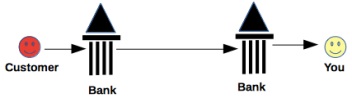
Current transaction process
Payments. When paying someone or getting paid by an employer or customer, banks and various financial institutions are an unavoidable intermediary. Your customer instructs their bank to send money to your bank before you can get access to it on your account.
-
Land Dealings. When you want to buy or sell land, there is a process that involves going to the Lands Registry office primarily to verify the authenticity of ownership and eventually to transfer the land to the new owner. The Lands office is the intermediary here.
-
Identity. Proof of one’s identity is linked to a database of Government records. In Uganda’s case, it’s held by the National Identification and Registration Authority (NIRA). NIRA becomes the intermediary for any inquiry regarding your identity.
-
Asset Ownership. When you purchase a car, its registration and ownership information is handled by an agency and in Uganda it’s the Uganda Revenue Authority (URA). They issue you the log book as proof of ownership. They are the intermediary in this case.
These and many more cases show how we have been brought up to rely on some intermediaries in most of what we do. These intermediaries are not necessarily a bad idea because they were the only alternative that was envisioned as a way of enhancing trust in transactions. We have been made to believe that banks are safe and can be trusted to keep our money safely and make payments on our behalf. We have been made to believe that the Land registry can be trusted to keep a true account of our land title deeds, same applies to NIRA with our identity records.
If you live in Uganda, I am sure you know quite abit about the mess in our Lands Registry. Land titles are changed at will by crooks who connive with internal staff. The level of corruption in that Lands office is so gross that many have had their land titles transferred without their knowledge. All this because the database is only accessed and manned by a privileged few by virtue of their employment in that office. The rest of us just have to believe that these privileged few are doing their job the right way.
Now to the banks, while we have this confidence in banks to keep our money safely, there have been cases in the past of banks falsely reporting clients’ accounts. Some have been rumored to use customer accounts to launder money. A common story is said about a recently failed Ugandan bank that had a double accounting system in place. It had the official one that showed the true account status of its customers and a second unofficial one that mapped onto the official one and was used to launder money by falsely crediting it on the numerous customer accounts. One day, the official accounting system was overridden by the unofficial one and all of a sudden, customers who hardly kept money on their accounts found them credited with millions of shillings. It was a bonanza as many of these customers withdrew the money before the bank reversed the error. Interestingly, the bank kept mum about it.
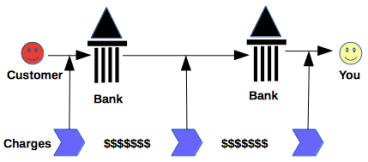
The overhead imposed by intermediary charges
The two cases above show why we might most likely be living in a mirage putting trust in intermediaries that we cannot prove are as trustworthy as they claim to be. These intermediaries also add an extra layer of cost onto our transactions. If you attempt to pay someone in South Africa from Uganda, chances are you’ll be charged at least UGX 50,000/= (USD 13) in transaction costs. When you go to the Lands registry to carry out a search on a title, there is a cost attached.
Do we really need to have these intermediaries? Why is it that you can send an email or WhatsApp message directly to your intended recipient at no extra cost but not do the same with financial payments or car ownership transfer?
Enter Blockchain, its purpose is primarily to remove the numerous intermediaries in our transactions and encourage direct peer to peer interaction basing on public trust.
Going back to our example of the Land Registry and how it is plagued with thuggery, the waning trust by the general public can be won under the following circumstances that blockchain facilitates;
Imagine a community of people say in Uganda, we own, purchase and sell land. Just imagine that the database that holds records for these land title deeds is a public one which we can get access to anytime we feel like using various technologies like phone apps, computer programs among others.
Step 1: If James wants to transfer land title ownership to Musa, he makes a request on his phone using an App to carry out that transaction.
Step 2: This request is then broadcast to all other users of a similar land registration app or software which we shall call nodes. The purpose of this broadcast is to seek validation from those nodes as to whether James’ transaction should be considered valid or not. This is aimed at ruling out a double transaction (maybe James had previously transferred the land title to Echweru).
Step 3: All nodes then crosscheck their records based on the local copy of the public database they have access to. If they find no problem with the transaction, they go ahead to flag it as clean hence validating it as authentic.
Step 4: Once the transaction is considered authentic, it’s then recorded in the public database and the title deed gets transferred to Musa. At this point, James cannot turn around and reverse the transaction because any change has to go through a peer reviewed system hence greatly reducing the possibility of fake or multiple transactions.
So, how would this approach be different and why is it necessary in solving our problems with the Lands registry?
Consider that the current status is our reliance on a central database hidden away at the Lands Registry accessed by a privileged few. If someone makes a change to it, we have no way of preventing such occurences. When the server crashes or is hacked and information deleted, we are at a loss to reconstruct it painfully, time lost not withstanding. A systems administrator could easily tamper with the server records at will (we have seen this happen at universities where marks for students are changed within the server).
In the blockchain approach, you do not have a central database but rather each node (computer or phone using the software concerned) acts as a store of the database. Any change to the database requires peer approval of all nodes that are active. Once a change has been approved, the database is updated and re-broadcast to all nodes in order to ensure that there is uniformity. A record of any change is kept for posterity. Do you now realise how hard the thugs will find it to make unscrupulous changes to our land title deeds?
In summary, Blockchain is a database of all transactions happening in a network. Using our outgoing example, the network in this case would be composed of land owners and dealers.
Issues to note about Blockchain;
-
The database is not owned by a single party but is basically a public one (however, technically, there can be private blockchain implementations too e.g within a bank)
-
The database is distributed, not stored on a single centralised computer in a particular organisation or by an individual. It’s instead stored on many nodes all over the entire network, they could be phones or computers.
-
It is constantly synchronised in order to keep transactions uptodate and secured using cryptography.
-
For any successful record to be made, blockchain requires that the nodes on the network all approve any transaction that is initiated.
-
Transaction validation is followed by recording of the details in a public ledger for the general public to see. No middleman is required.
-
This peer reviewed approach reduces system abuse and increases trust.
I hope you have an idea of what Blockchain is. This technology can be used to manage crypto currencies, contracts, asset management and many other things. In the next article, we shall talk about Cryptocurrencies like Bitcoin and Ethereum. Have you got any questions so far?
James Wire is a Small Business and Technology consultant based in Kampala, Uganda.
Follow @wirejames on Twitter
Email lunghabo [at] gmail.com
 The Wire Perspective