
Tag Archives: business

Do you need that business loan?


I begun with 70 broilers, and next time I kept 220 and it went on till now I have 350 chicks and I’ve booked 600 chicks …. I want a loan.” This was an actual inquiry for help by Robby, a member of a farmers’ group am subscribed to.

Robby’s inquiry didn’t come as a surprise to me as I have seen similar tendencies exhibited by many small business owners. From that brief message, one can see that Robby started off small (like we all usually do) and managed his resources with passion. This saw his flock grow in size five times. Considering the success he has registered, he now wants to rear nearly three times the current flock size by acquiring more birds. Unfortunately, he seems resource constrained.

Robby’s growth and decision making process reveals to us the following about Small businesses;

  • Passion yields Progress: The phenomenal growth experienced by small businesses especially in the early stages is usually more about the passion than abundance of resources. Robby must have balanced the few resources he had in place and excitedly worked tirelessly to see that he looked after these birds in the best way possible. He most likely achieved this by investing alot of personal time. This naturally gave way to positive returns hence the remarkable five fold growth in flock.
  • Excitement comes before a downfall: Robby is clearly excited and very pleased with his achievements. While that in itself isn’t a bad thing, he needs to avoid succumbing to the ‘fast growth‘ syndrome that the media subjects us to. Alot of praise is usually heaped onto businesses that achieve so much in so short a time without mentioning the underlying catalysts to that progress. While he may have this grand plan of having a 10,000 broiler farm, the steps towards that vision should be measured. Deciding to borrow money to engineer your growth without looking at the holistic implications could turn out to be your nemesis. There is still alot he needs to understand about the business in order to grow it sustainably.
  • Organic is better than Artificial: In Uganda where the cost of capital is very high with interest rates ranging from 25% to 30% per annum, one can hardly achieve a profitable growth in a legitimate business by opting to borrow money. An organic approach that would see Robby re-invest his income regularly and consistently is much better off than rushing for a loan. While it may take longer to achieve the much desired growth, the organic approach would help him achieve two things; One, he gets a chance to experience the growth pains of the business a stage at a time without leap frogging (usually called the Entrepreneur’s school fees) thereby giving him a more solid foundation and Two, he has a better chance of growing with his clientele (most people like rushing to acquire big already established clients but their demands tend to lead small businesses into a wall. Often times it is better in the early stages to get clients that are within your supply ability and grow based upon their demand).
  • Understanding market stability: Robby needs more time to understand the market dynamics fully. While he may have sold his 200 birds with ease, the timing and size of flock might have been in his favour. What happens when he has 700 birds that he needs to sell off at once and the market demand is low? Every extra day that broilers stay on your farm after they are due for sale means increased overhead costs. Losses are likely to ensue and matters would be worsened by the demand of the bank loan.
  • Management is a puzzle: Like I pointed out earlier, due to passion, Robby might have played a very big role in managing the flock thus far. With increasing numbers, he’s likely going to look for staff to help him out. Is he sure that the staff are going to do the job with the same zeal as his? Any drop in the level of care for these birds has a direct implication on the eventual income attained. In any small business, it’s always a challenge getting staff to work with the same zeal as the visionary considering that most come primarily to make money.
wire_mushroom

The author assessing the supply potential of a mushroom farmer. Busolwe Town Council, Butaleja District, Uganda.

To my dear friend Robby, while borrowing money may look like the most obvious option, I advise you to step back and assess the options available to you. Having to pay interest rates of 30% per annum on capital for a business generating you not more than 25% gross profits is a recipe for disaster. You by now know too well the kind of competition in the poultry business.
The Market always exists


She’s got a great business idea out of her culinary skills. While most of us keep defaulting to already existent menu templates to prepare special dishes especially for special occasions, she has the gift of coming up with unique recipes that are based on the actual tastes of an individual.

Lisa (not real name) has been at this game on a voluntary basis for some years now. Friends and family all tell her how marvelous she is at coming up with unique surprise recipes. At the same time, she has always been bothered by the fact that she has no ‘side hussle‘ (personal business) she can call her own or even fall back to in the event of being relieved of her job. Eventually she figured out that instead of trying out what she didn’t know like; setting up a baby clothing shop, operating a Mobile Money outlet and Events Decoration, she was better off doing something that came easy with her and that she loved from first principles.

She then begun prospecting the market and trying to find out what clientele base lay out there. She talked to some people and while they found the idea interesting, there was no ‘effective demand’ generated. She needed to get people to start paying for her services if this business idea was to make sense. That’s when she came for advice.

After a detailed discussion, her key challenges lay in two areas;

  • Reaching out to a wider base of potential customers

  • Getting people to actually pay for her services

Reaching out to a wider base of potential customers seemed such an uphill task considering that she had been trapped in the traditional mindset of customer acquisition. She complained of lack of money to market herself at events e.g. through printing fliers and the word of mouth approach wasn’t yielding the expected results. This is when I probed her presence on Social Media and how much impact it has on her and her community of friends. To my surprise, she turned out to be an avid Social Media user with Twitter, Facebook and Instagram taking the lion’s share of her time. With over 7000 followers/friends across the three networks, she had such a rich resource to tap into. When we reviewed her communication, it was always responded to by the friends/followers. Unfortunately, she had never imagined Social Media to be a business tool for her nascent business idea. My advice to her was to utilise this network of friends online and start tickling their interest through a number of different approaches aimed at suiting the different networks. Instagram for example would be good for her to profile photos of her prepared foods while Facebook can be used to generate discussions on her recipes and even highlight some of her satisfied customers.

Then came the challenge of getting people to pay for her services. Changing from a pro bono arrangement of service offering to a paid one is always a challenge since it has a lot to do with mindsets of the people. On this one, following a lot of debate, we agreed that among others she’s going to have to do the following:

  • Brand herself in line with the service she wants to offer. This she can do through physical networking with people, talking about what she does, carefully crafting posts for her online community aimed at promoting her new found brand among others.

  • Opening up a blog that she can use to share some recipes with the rest of the world as well as stories of how she has approached various requests for her services and how things turned out.

  • Client Recommendations. She can seek these recommendations from those she has already offered services and profile them on her blog, and through her other social media outlets like Facebook.

  • Formalising of her communication to potential clients. Verbal or carelessly written communication has a way it doesn’t elicit the right responses from potential clients. There is a need to make it formal and straight forward in order to show that you’ve got what it takes. The middle class who seem to be the major target of her business dwells a lot on formality.

Are you out there procrastinating over a business idea and thinking you might not have customers? The customers are always there. You just need to look around you. From family, to friends and eventually to the unknown people out there, you can grow your idea into a business that thrives.

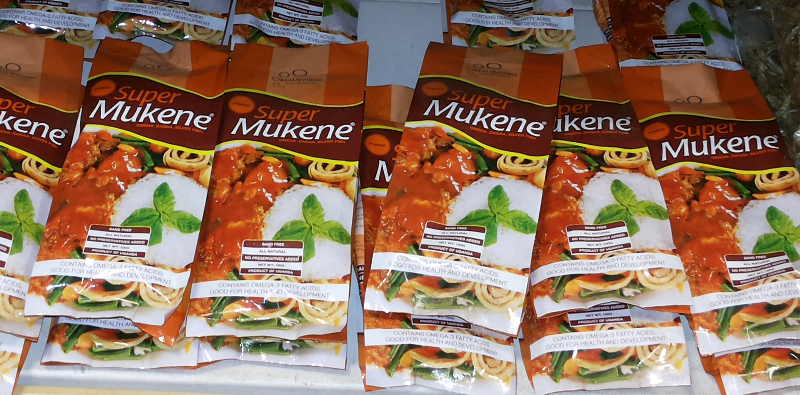
Package attractiveness plays a key role in the Supermarket product sales.

Super Mukene on a Supermarket shelf

I did the same for my Silver Fish (Mukene) business which started off by providing the products to my brothers, sisters, aunties, cousins and friends only to later get into the supermarkets after perfecting. We’ve now been at it for Six years.

Wake up / Zukuka !!!