
Tag Archives: mtn

Get ready to buy shares in MTN Uganda


A new road has just been completed, just as we are basking in the feat and proud of having access to a pothole free stretch, the following morning we are greeted by a team of workers chopping away the tarmac to lay a fibre optic cable across the road. Two months later, another team mutilates the same road in a bid to lay fibre optic cable for another company. Familiar?

I subscribed for a line with Telco A and have used it for the past 15 years. Due to the ever degrading service, I would like to shift to Telco B but do not want to lose my number since it has been widely shared with my business contacts. This forces me to get a second number with Telco B and still bear the burden of retaining the old number too. Familiar?

Directing people is such a nightmare in Uganda. If I have to direct you, landmarks like ffene trees, rolex stalls, retail shops, black gate are the ones that are most suitable to enable someone locate my home as elaborated in this article.

These are just a few of the challenges we grapple with in this country that require simple policy formulation coupled by implementation enforcement. It is therefore with so much joy that I welcomed the recent approval of the National Broadband Policy by the cabinet on the 17th of September 2018.

This policy among others plans to address the following issues;

Integrate Broadband Infrastructure in the planning and development of physical Infrastructure such as roads, railways, energy and oil pipelines. With the vast investment being undertaken in infrastructure, it is only prudent that broadband spread be considered side by side. The additional cost of laying a fibre optic cable alongside the new SGR railway or Oil pipeline heading to the coast is very minimal when compared to the overall project total cost. Besides, it also opens up numerous redundancy options that can be exploited.

Regulate, coordinate and harmonize the development, deployment and sharing of all Broadband Infrastructure (both private and public) among all stakeholders. Different communication market players have been setting up independent infrastructure even in areas where sharing is feasible. Walk along most of the roads in the central business district of Kampala and you’re greeted with fibre installations for all the Telcos laid separately but serving the same purpose in the same area. As for masts, a single roof top may have two telecoms with installed masts. All this is unnecessary duplicity of infrastructure that drives up the cost of service provision to the consumer. This policy expects to compel the various players to share infrastructure.

Promote and implement the national postcode and addressing system, towards last mile delivery of services to facilitate e-commerce. A post code and addressing system is very crucial for any community that permanently settles in any location. This is the only way one can trace their way around with ease, visitor or not. With the advent of e-commerce, if orders are to be delivered seamlessly, well addressed homes and offices that are easily traceable shall boost the business. On the security front, the police should find it easy to trace areas that are having trouble in case of any robberies.

Businesses can better organise their sales and marketing efforts like targeted promotions as well as where to locate product depots for easy supply.

Improvement in public services. There are many cases where Fire Brigades and Ambulances have got lost and failed to reach their intended destination as a result of lack of proper addressing systems.

Ensure all government sectors deliver their services online for efficient and sustainable service delivery. Have you tried applying for a National ID or seeking a replacement? The attachment towards a manual delivery of services leaves many bewildered in this age of hi-tech. You are made to manually fill in forms, walk to a bank, make payments, photocopy documents and then wait for months before receiving the document. Surely, why should all these man hours be wasted when solutions already exist that could make the citizen’s experience more comfortable?

Promote open source, and government ownership of the source code for all government information systems, software and e-solutions. This will ensure sustainability and promote innovation. Open Source refers to something that people can modify and share because its design is publicly accessible. For the Government of Uganda to come out and recognise this need is a very big achievement. It implies that for software and hardware that the Government procures, its openness shall be a big issue of concern.

Local technologists should be excited about this as it opens doors for them to develop integrated solutions that can tap into Government systems.

Spectrum management – The spectrum being a scarce and finite government resource, needs to be managed and utilised efficiently, optimally and rationally. These resources should not be owned by the private telecom service providers. Spectrum in this case relates to the radio frequencies allocated to the mobile industry and other sectors for communication over the airwaves (GSMA Definition).

In the past, the Uganda Communication Commission would pre-allocate spectrum to the different telecoms and it was upto them to use as they wished. Whenever they felt they needed more, they always approached UCC. However, the loophole here was the hoarding that begun taking place. A telecom would have X amount of spectrum while in reality utilising only half of that capacity. They would then limit the spectrum that late entrants would have access to. Government is now saying that it shall have the right to assign and re-assign spectrum at will.

National roaming – Roaming refers to the ability of a customer to automatically make and receive voice calls, send and receive data, or access other services, even when travelling outside the geographical coverage area of his service provider, by means of using the service of the other service provider’s network. Whenever one travels from Uganda to Kenya, if you are an MTN customer, you automatically receive services from Safaricom. However, the most surprising thing that we seem to have considered normal is the failure to roam within the country. Take the case of an Africell user heading to Adjumani only to find no network there. Why shouldn’t they be able to roam onto MTN which might be having a service there?

The policy aims to address this matter too in order to enable universal services access.

Number Portability. This refers to the ability for one to retain their phone number even when they transfer their choice of services from one telecom company to another. Take the example of a number 0771-123456, an MTN number but in case the owner wanted to change to Airtel, they would still retain the same number but enjoy the latter’s services. This will effectively reduce the current semblance of imprisonment by most customers as well as the discomfort of having to juggle multiple mobile numbers.

Stock Exchange Listing. This is undoubtedly one of the best things to me mooted by this policy. All Telecoms are required to go public and list on the Stock Exchange. Considering how attractive the pie has been and the allegations of capital flight levelled by the government against the telecoms companies, this is a win-win. While the policy is not specific to what tune shares must be availed to the public, my proposal is that at least 40% of the shares should be dispensed. The time is now for Ugandans to reap from a sector where they spend a lot of their money.

These are just a few of the proposals in the policy that I felt worth sharing. On the whole however, it was a well thought out document and the next challenge is to see to it that implementation occurs.

James Wire is a Business and Technology Consultant based in Kampala, Uganda
Follow @wirejames on Twitter.
Email lunghabo [at] gmail [dot] com
HOW TO – Start a Mobile Money Business


Mobile Money (MM) is a form of electronic money service that enables phone owners send, receive and store money. The relative safety, ease of mobility and convenient nature of this service has endeared it to all sections of the society from the rich to the poor.

Before we proceed, it is important that we familiarise ourselves with some terminologies.

Agent: A person or business that is contracted to facilitate transactions for users. The most important of these are cash-in and cash-out (i.e loading and withdrawing money onto/from the MM system). They sometimes register new users, a service that earns them extra commission. As front line personnel, they also teach users how to best use the service.

mobile_money_agent

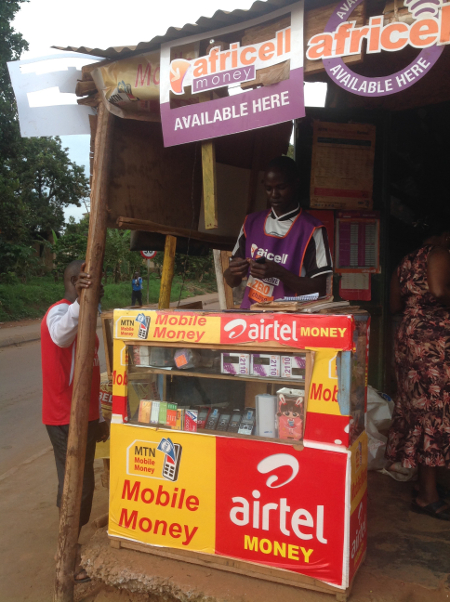
A Mobile Money agent in Kyebando, Kampala, Uganda

Aggregator: A person or business that is responsible for recruiting new MM agents. This role is sometimes combined with that of a Master Agent.

E-Money: Known as Electronic money in full. It is stored value held in the accounts of users, agents and the provider of the MM service.

Cash In: The process by which a customer credits their account with cash. This is done usually via an Agent who receives the cash and proceeds to credit the customer’s MM account.

Cash Out: The process by which a customer withdraws cash from their MM account. It is done usually by an Agent who gives the customer cash equivalent to a transfer the customer makes to the Agent’s MM line.

Float: The balance of e-money or physical cash that an agent can immediately access to meet customer demands to purchase or sell e-money.

Liquidity: The ability of an agent to meet customers’ demands to purchase (cash-in) or sell (cash-out) e-money.

MasterAgent: A person or business that purchases e-money from a Mobile Network Operator wholesale and then resells it to agents who in turn resell it to users. They usually manage the cash and e-money liquidity of their agents.

Mobile Money Transfer: A movement of value that is made from a mobile money account to another through the use of a mobile phone.

Platform: The hardware and software that enables the provision of a mobile money service.

In Uganda, the Mobile Money system works as follows;

The Mobile Network Operator (MNO) like MTN, Africell and Airtel sets up a platform that offers a service for phone owners to be able to “store and transfer” e-money using their phones.

A phone owner registers for the mobile money service with the telecommunications provider who creates the mobile money account associated with that particular registered phone number.

The customer then proceeds to cach-in onto their mobile money account by using a Mobile Money agent whom they give cash in exchange for e-money on the Mobile Money account.

This customer can through the execution of some commands send e-money to another mobile money account holder anytime they so wish. The recipient is at liberty to cash-out as and when they desire.

Just to show you how Mobile Money services have permeated our economy and become an integral part of our operations, picture the following scenarios;

  • Oloya works in Kampala and is constructing a house in the village. Every two days he is expected to pay for the services of the builders. By using MM, he is able to pay each builder directly onto their phone hence being assured of their commitment.

  • Nankabirwa is a produce dealer who has a network of buyers traversing numerous villages in Rakai, Masaka and other outlying districts. Their role is to identify produce for purchase and acquire it. By using MM, she is able to send money to these buyers of hers in the nick of time. She makes at least eight transfers daily during the peak harvesting season.

  • Pabire a rice farmer in Doho rice scheme by virtue of his mobility utilises MM transfers to pay for his workers’ services. These workers engage in activities like planting and weeding rice, land preparation, harvesting among others. This allows work to flow smoothly even in his absence.

  • Bakka leaves home for work fully knowing that there is no money for food that day. When he reaches his workplace (a washing bay), he transfers his income from washing the first three cars of the day to his wife at home using MM. Come evening, he is assured of finding food at home.

  • Sangalo is organising a wedding and she has reached out to relatives and friends to fundraise. The mode of pledge fulfillment being used is MM. Those contributing are sending their cash pledges directly onto her Mobile Money account.

  • Mugerwa, a parent at one of the boarding secondary schools is called by his son who reminds him about the study tour they are supposed to go for requiring a contribution of UGX 50,000/= per student. Instead of driving there to make payment, he simply sends th money via MM to the concerned teacher who then registers his son for the trip.

  • One can also pay for electricity, water, television and other services using Mobile Money.


234x60 Start a Business

So, how does one start this business as an Agent?

You need to have the following basics:

  • Two sim cards (Airtel and MTN). They are the biggest networks and handle at least 98% of the transactions. Others like Africell are still insignificant players.

  • Display Table. You need to have a display table that will not only store the tools of your trade but it can be stocked with other complementary products like mobile phones, accessories like phone jackets, screen protectors among others.

  • A dual sim card phone

  • A chair

  • Transaction books

  • Location

There are three approaches one can use to kick off. They are;

  1. Hiring a Transaction Line: This one involves hiring an already registered Mobile Money transaction line from someone or a company. With this line, you simply start off business without going through any registration hurdles. The things to note about this option include among others:

    • Paying a monthly rental fee of at least UGX 50,000/= for the MM line.

    • Income is in the form of a percentage commission earned on each transaction and is paid at the end of the month.

  1. Acquiring a Transaction Line through an Aggregator or Master Agent: Aggregators or Master Agents are companies that control specific territory on behalf of the Mobile Network Operators. Territories could include places like Kyebando, Kanyanya, Nakawa, Seeta, Bweyogerere e.t.c. These Master Agents get agency tenders through some bidding process and thereafter become responsible for licensing MM agents in their territories. For one to be licensed as an agent, you need to:

    • Present an Identity Card

    • Present a letter of introduction/recommendation from the Local Council

    • Have a deposit of UGX 80,000/= (Eighty Thousand Shillings) to purchase the kit

    • Fill in an application form

    • Have starting Float of UGX 2,000,000/= (Two Million shillings)

Income earned here is in form of commission on transactions. An additional surcharge of upto 10% (depending on the Master Agent) of your income is deducted for tax to the Uganda Revenue Authority.

  1. Direct Registration with a Mobile Network Operator (MNO): One is at liberty to register as an agent directly with an MNO like MTN or Airtel. Its requirements are more than the previous two options and they include:

    • Business Registration

    • Introduction/Recommendation letter from the Local Council

    • Functional bank account (for at least three months)

    • Filled application forms

    • An 80,000/= (Eighty Thousand Shillings) charge for the kit

    • Initial Float of UGX 2,000,000/= (Two Million Shillings) only.

Like the rest, income earned is in form of commission made on the transactions carried out. Unlike option 2 (two) above, with this form of registration, you are only charged the tax levy for Uganda Revenue Authority when your commission earnings exceed the UGX 1 Million Shillings threshold. The MNO then proceeds to deduct 4% which it channels to the tax man as opposed to the 10% deduction by Master Agents. This is definitely a better deal.

Option 1 is as instant as they get. If you want to hit the ground running, you may opt for this one. However, the margins are greatly reduced by the fact that you hire a Transaction line at a fixed monthly sum and because you are operating under another Agent, your margins are lower.

In the case of Options 2 and 3, After application and paying the UGX 80,000/= for the kit, you have to wait for two to three months prior to being approved as an agent. Once that is done, an Agent kit is availed and it consists of; three (3) phone lines, a phone handset, transaction books and other branding material like an apron.

Upon collection of this kit, you’re expected to deposit a float of UGX 2,000,000/= (two million shillings) on your Mobile Money line. Do I see you getting disheartened? True, raising this two million shillings lumpsome is a daunting task to many but there is always a way out. One trick is to borrow that money for a day, place it onto the MM line as float subject to approval and collection of your business material from the Master Agent or MNO. Once you have all that you need, proceed to cash out the borrowed money and return it to the lender.

How do you earn commission?

There is a well established commission structure clearly outlined by each MNO.

Airtel Agent’s Commission Guide (Extract)

Transaction Tiers

Cash In

Cash Out

Min

Max

500

2,500

150

100

2,501

5,000

150

125

5,001

15,000

285

450

125,001

250,000

520

1,300

1,000,001

2,000,000

4500

7,500

When a customer walks in and requests to deposit e-money onto their MM account, depending on the amount, you earn the commensurate Cash-In amount. If it is UGX 10,000/= they are depositing, then the agent will receive a cash-in of UGX 285/= on that transaction. Similarly, the Cash-Out commission applies to money withdrawals from the MM account.

Airtel does allow agents to check their commission status on a daily basis via the phone. However, the same does not seem to be true with MTN Uganda.

Success Factors for the Moble Money Agent business

  1. Trustworthiness: If you have to employ someone to operate this business on your behalf, you need to be able to trust them Anything short of that, you’re setting yourself up for failure. There are very many opportunities that these workers get to collude with crooks.

  2. Location: It is crucial to choose a location that is good. Since the commission on individual transactions looks small, the trick lies in volumes. How many transactions can you notch up a day? Ideal locations are corners of buildings or roads, boda-boda stages, busy trading centres, low cost residential suburbs, shopping arcades, taxi parks/stages among others.

    mm_corner

    A corner location like this one is very conducive for the Mobile Money business

  3. Customer Care: Many customers are ignorant about the operation of the Mobile Money services. They tend to ask questions one may consider dumb hence the need for any agent to have very good customer care skills. While researching for this article, I found agents being swamped by customers who wanted help with Sim Card verification. Imagine!!! Do not compromise on this particular issue when recruiting someone for your business.

    mm_operator

    Good customer care is dependent on the Mobile Money operator

  4. Mathematical Knowledge: The operator needs to have good mental maths skills. Customers come with all manner of requests and you need to be quick to mentally calculate and determine how much to transfer as requested. I witnessed a case where a lady came and requested the operator to cash out money from her account which has UGX 15,000/= (fifteen thousand) and ensure that it remains with only UGX 6,000/= (six thousand). He had to ensure that the transaction fees were factored in too. The operator had to first engage in some quick mental math before eventually fulfilling her request.

  5. Float Availability: How much do you have as e-money or cash? Customers keep walking in and out either cashing in or cashing out. You need to be in position to meet their needs most of the times otherwise they are likely to resort to the competition. I once had a need to cash-out UGX 300,000/=. I walked to three different MM agents in Wandegeya and none could meet my need. Out of frustration, I settled for partial cash-outs based on the float each agent had and this saw me use four different agents to meet my need. Since then, I never go to Wandegeya for MM cash-outs. Remember, if you set a reputation of always having adequate float, more customers patronise your services thereby enriching you commission-wise.

What are some of the notable challenges of this lucrative business?

  • Conmen: There are many conmen on the loose who target MM agents. Any form of sloppiness can lead to severe punishment. There was a case of a man who pulled up his sleek car infront of the agent’s display table, requested her to transfer UGX 450,000/=. She faithfully yielded as he pretended to count some money. The minute he confirmed reception of the money, he simply drove off leaving her stranded.

Most sophisticated conmen have been observed to operate from the city centre locations. So, in case you’re starting out, as you gain the experience, try to operate from the suburbs first.

  • Theft: Due to the carelessness of some agents, there cases of customers whose sole intention of patronising your service is to get to know the PIN number used to access the MM line. Most times agents type in the PIN number in full view of the customers. What the crooks then do is to later return and find a way of stealing the phone handset. Within minutes, they have withdrawn all the money and discarded the phone.

  • Cash Robbery: There are cases where an Agent has to bank the money earned. Sometimes due to late business closure, they might have to go home with the earned cash. Depending on how secretively one handles their operations, thugs tend to get wind of your earnings and simply way lay you.

  • Attention to detail: A customer once walked to an agent and requested to cash-in UGX 99,000/= (Ninety Nine thousand shillings). The agent instead punched UGX 990,000/= (Nine hundred and ninety thousand shillings). The customer paid up and left. During the evening reconciliation, she realised there was a massive shortfall and upon close scrutiny, the anomaly was discovered. It took a week of negotiations and a 100km journey to Masaka from Kampala for the money to be recovered.

  • Collusion: Some staff running the MM outlets have a tendency of conniving with other people to defraud their employer. They then feign ignorance or put the blame on mistakes.

Just to give you an idea, earnings can start from as low as UGX 50,000/= (fifty thousand shillings) per line per month with start-up Float of UGX 500,000/= (Five hundred thousand shillings) reaching an average of UGX 1,000,000/= (one million shillings) with a float of UGX 3,000,000/= (Three Million shillings).

The monthly pay for Mobile Money Operators ranges between UGX 100,000/= and UGX 150,000/=.

While offering the MM services, always consider selling complimentary products like Airtime, Flash disks, Memory cards among others. Airtime commissions can very easily supplement your income too. The current commission structure on airtime of UGX 10,000/= (ten thousand shillings) is as follows:

MNO

% Commission

MTN Uganda

4%

Airtel

5%

Africell

7%

Welcome to the Mobile Money Business.

James Wire is a Small Business and Technology Consultant based in Kampala, Uganda

Follow @wirejames on Twitter.

Email lunghabo [at] gmail [dot] com

Other Articles of Interest:

Additional information from GSMA – Mobile Money for the unbanked.