
Tag Archives: small business

Be Slow to Trust in Business


A short while back a friend of mine lost his grandmother and had to got to the village to attend her burial. This friend of mine runs a small business that records music and videos for customers in one of the Kampala Suburbs.

For the uninitiated, in Uganda, due to the social fabric we have starting from family to the clan (which is a collection of families) and then up to the tribe (a collection of clans), we always show respect by ensuring that we attend to others’ misfortunes within that social circle. Hence it is considered very selfish of one to hear of a relative’s death and not do anything about it.

Prior to departing, he decided to hand over his operations to a young man he has known for years and had reason to trust him. Having explained all the operational issues to him, he set off for the burial confident that business continuity in his absence was sorted.

Some days later, he returns from the village and on doing an audit of his business, he practically found everything messed up. There was no money from daily sales, stock was down to almost nothing, the computer hardware had been compromised with some parts exchanged for poorer alternatives. To make matters worse, this is someone he has known and been with for a long time.

This brings us to the subject matter, Trust in Business. This topic isn’t new to anyone that has had a stint in business. Trust is an issue when dealing with partners, employees and customers. I dwelt on the issue of selecting partners in this post and trust is one of those silent considerations that are always at the background of your decision.

On the part of customers, a raw material supplier to my food processing business had grown immensely and made a lot of progress in his business. Within a year of operation, he had become an exporter to Rwanda and the DRC. He had this customer who would buy his products in bulk. Ordering for a 4 tonne truck each time. Due to the seemingly cordial relationship that had come up between them, my supplier begun extending credit to this customer from Rwanda who would proceed to pay up once the goods were delivered. A time came and the customer ordered for three 4 Tonne trucks on credit and as usual my supplier went ahead to fulfill his part of the bargain. That is the last time he heard of that customer. This single move on his business crippled him and his operations ground to a halt.

Employees are another source of challenges when it comes to trust. We keep reading in the newspapers about employees of various companies and Government agencies defrauding their employers. Now for the big organisations, their financial might may be able to cushion these shortcomings. However for you that has that small Chicken rearing business, imagine if a staff member never administered the required drugs to the chicken and opted to sell them to other chicken farmers, this could eventually lead to the loss of your entire stock. Such a setback means a lot to a small business.

What do I think about this trust issue?

In life we relate with many people and as a result we have all reasons to trust or not trust them. However, over the years I have learnt that you need to have compartments of trust if you want to live a simple life. There are people you can trust to deliver when it comes to getting work done, others when it comes to keeping time, securing secrets, handling money and so on and so forth.

When you start relating with someone, it is always important to identify which compartment of trust you’ll place him or her in. Truth be told we each have our own areas of weakness as humans and so can’t be relied upon to be trusted 100%. This implies that someone that can be entrusted to deliver on a certain project may not necessarily be entrusted with handling the finances of that project. This saves both parties from the embarrassment caused by the potentially bitter fall out.

From my friend’s experience I learnt why some other shop owners prefer to close their shops entirely whenever they are going away. They are justified to do so since the thought of making massive losses in absentia outweighs the need to keep customers served throughout, at least for the moment. Now this may sound scandalous especially when you are hearing it from an MBA like me. The business books will always tell us one thing but in reality some modifications matter a lot. Most of the material one studies in business is oriented towards large operations with the expectation that small businesses can simply copy and paste.

If you are in a business that doesn’t need the 24 hour cycle to stay alive, you have the lee way to shut it down occasionally just in case you haven’t identified someone worthy of entrusting the operations with. However, for those that have business operations that require babysitting like in the Agriculture sector, it’s high time you worked out a solution towards ensuring that you bottle up your staff or partners in compartments of trust. While it may not bring down the potential losses to zero, it will create some sanity and avoid the kind of extreme circumstances my friend found himself in.

Am glad to conclude by saying that he’s getting back onto his two feet once again.
Grow your business using Supermarkets


Are you toying with a business idea but are probably stuck on how to eventually sell your products? Do you lack the money to start up a shop nor the experience to run such a fully fledged operation. Take heart, don’t feel defeated, there is a way out for you.

One of the most prevalent business opportunities in Uganda is the trade in physical goods. From imported electronics, garments, furniture to imported and locally produced food products. Twenty years ago it was the in-thing to own a shop if you were to prosper in business and the mentality is still largely similar today. Shopping for home supplies was a process that involved hopping from shop to shop buying sugar in one, beans in a second and margarine or bread from another shop.This required one to have a mind map of the shopping area you were going to and knowing what to buy from which shop off your list. While I don’t discount the benefits of these Mom & Pop shops, they have over time not lived upto the demands of the ever changing society that we live in. Some of the challenges they pose are;

  • Time: Due to the need to hop around in different shops, alot of time is wasted in the process. Most shoppers lately prefer a one stop point where they’ll pick up all their groceries for example and head home.
  • Variety: They tend to lack variety since today’s customer wants to have the luxury of choosing among numerous options of a similar product range so they get the semblance of value for money.
  • Customer Service: The increasing sophistication of today’s customer demands ever improving customer service quality. Due to the very nature of these shops, they hardly grow in this regard and hence lose out on a number of potential customers.
  • Convenience of Access: With the increasing number of motorised consumers in urban areas, facilities like parking area access, security or even ease of reach to public transport all play a key role in shopping destination decisions. Most of these shops are severely limited in this regard and tend to rely on non gazetted roadside parking.
  • Market Limitation: This is more of a challenge to the proprietor. To have a fixed geographical location of operation automatically creates a limit on the customers one can reach out to. This has an implication on the potential growth of the business. However, hopefully with the ever increasing usage of online services, this challenge can be addressed.
  • Unwarranted Overheads: Another challenge for the proprietor is overheads of the business. To be competitive in the price sensitive Ugandan market lately, one has to keep margins as minimally acceptable as possible while looking at churning out volumes in order to make it. The shop approach definitely creates limitations in this regard if you have to pay for rent, security, some employees, electricity among others.

A look at most of the shops littering the various shopping arcades in Kampala reveals a gloomy scenario, you will be hard pressed to find profitable ones. With over reliance on walk-in customers, many of these arcade shops hardly make profit if we are to consider the book definition of the term. Rates of rent are usually high and in US Dollars yet goods are sold in local currency, a good section of the target clients hardly patronise arcades lately e.t.c. A friend of mine who is a seasoned trader in down town Kampala intimated to me that most of those arcade shops are actually ’employment’ channels for wives of working professionals and are run like NGOs. No expectation of profit and whatever is earned is consumed by the proprietor leading to a new infusion of capital by the ’employed professional’ when the next stocking cycle is due.

It was until 2009 while trying to find a way of selling packaged and processed food products that I chanced upon the idea of retailing through Supermarkets. Initially I was apprehensive about the fact that I had to surrender control of my product sales to a third party and have faith to be paid without interfacing with the actual consumer. Having been groomed in the Shop Keeping era, I initially thought of opening up my own shop and selling the products. However, six years down the road, I must say that I am proud of having decided to use the Supermarket outlets. Supermarkets make a better proposition for any producer or seller due to the fact that by their very nature they;

  • Increase your market reach at a minimal cost. The major investment required of a supplier to supermarkets is product delivery and credit. Other than that, the supermarket exposes you to customers all over the country by virtue of their foot print. Imagine a supermarket that has branches spread out in Namugongo, Ntinda, Kampala Central, Lubowa (Entebbe Road), Gaba, Old Kampala, Mbarara, Gulu and Mbale. By supplying that one supermarket, you are sure of accessing a very wide market thereby increasing the possibility of business success.
  • Allow you to operate with a low investment.  Apart from investing in procuring or processing your products and distributing them, you are unlikely to be weighed down by the burden of fully fledged sales and office operations.
  • Third Party Marketing benefits. Most big Supermarkets heavily invest in advertising their outlets as a way of attracting customers. They even compete to open up in the new malls. All this is beneficial to a small supplier as you become a direct beneficiary of any increased traffic into the supermarket. Right now, when one wants to buy some of my products, I simply read out a list for him/her of the Supermarkets where to find them.
  • Ease referral sales. Most of your new sales are likely to come as a result of referrals by existing customers. With a presence of the products in leading supermarket chains, it becomes easier for a satisfied customer to direct a friend on where to buy the same product.

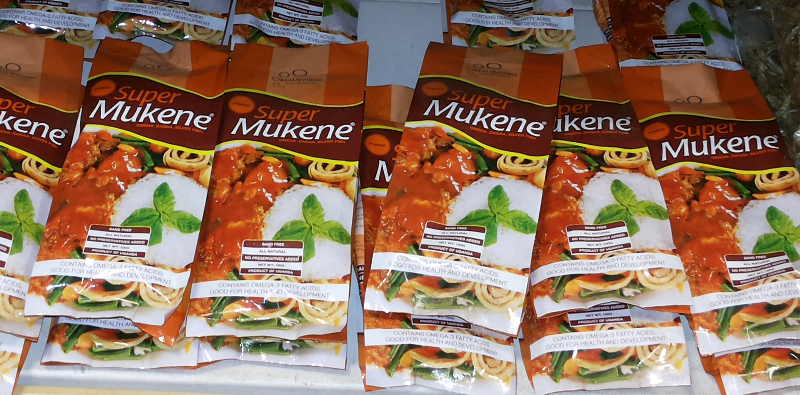
Using Supermarket outlets to retail one’s products allows you to make money without having to be present at the sales points and the trick is usually in having splendid packaging that stands out on the shelf.

Package attractiveness plays a key role in the Supermarket product sales.

Package attractiveness plays a key role in the Supermarket product sales.

The prevalence of supermarkets in Uganda today is a sign that shopping trends are changing in that direction and as a budding entrepreneur, this is food for thought.