
Tag Archives: sme

Grains Processing greatly improving in Uganda


Uganda is known for its competitive edge in agriculture. With 70% of the population being engaged in the agriculture industry, one cannot hide away from the fact that there is a lot of money to be made in this regard.

While growing up, I always frequented mills in order to process the maize and sometimes millet that my parents grew. The typical Ugandan mill is a rickety housed old and cranky machine that blows out dust at will leaving anyone in the vicinity with a ghostly look.

I was however taken by surprise recently when I visited Arise and Shine Maize Millers. Tucked away in the Kampala suburb of Kawempe is an ultra modern computerised mill of its own kind. Having specialised in Maize milling, the proprietors have taken time to grow their niche from the very rudimentary processing facilities that are typical of the Ugandan Food Processing industry. 
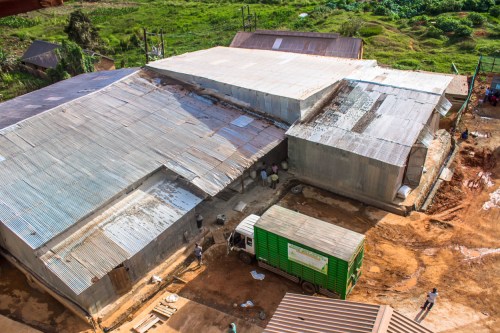
old_mill

The iron sheet structure old mill (Photo credit – Nabwiso Films)

Having operated for a number of years in a rudimentary fashion, it dawned upon them that there was a need to upgrade their operations to suit the changing times. They had some challenges that needed addressing as well as opportunities to take advantage of like the export market.

The primary challenges were, cleaning, drying, storage and safe food handling. Mr. Matia Mubangizi the Investment and Business Development Manager at the facility noted that, “the biggest challenge in the grains business is storage. Moisture content and impurities cause a lot of loss for the grain dealers and they have to be dealt with.

Armed with this in mind, the company took on the services of a consultant to help address the challenges. This consultant came on board courtesy of support from the Competitive and Enterprise Development Project (CEDP), a project under the Matching Grant Facility, funded by the Government of Uganda and the World Bank.

As a result of the consulting support, the company acquired new machinery with intent to modernise all its operations. They then applied for a Matching Grant Facility entitling them to a 50% reimbursement of expenses towards equipment installation.

This machinery upgrade helped improve the handling of grains thereby reducing aflatoxin presence which is a key impediment for the export market. The deployed equipment involved among others;

  • A weigh bridge

  • A 20 – 25 tonnes per hour drier

  • A cleaner with an hourly capacity of 25 Metric Tonnes

  • A 300 Metric Tonnes storage facility

  • Packaging lines

weigh_bridge

The new weigh bridge (Photo credit – Nabwiso Films)

During my visit to the mill, I witnessed first hand the delivery of maize and how dirty it can be upon arrival. The problem seems to start with the farmers who do so little in terms of proper post harvest handling. As the bags were being emptied, one could see maize cobs, leaves, stones and all sorts of chaff mixed up in the maize. This implies that if the maize miller buys the declared kilos without cleaning, a loss awaits them. It’s on record that Kenya has rejected maize from Uganda on quality grounds.
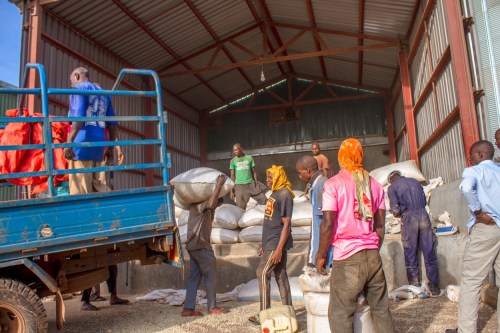
maize_delivery

Maize Delivery in Progress (Photo credit – Nabwiso Films)

With the new machinery, the maize is taken through an automated cleaner that removes all foreign matter. Once the moisture content of the maize is found to be insufficient, it’s then redirected into a dryer that dries it to the recommended level. This has tremendously increased the product quality of the mill.

part_of_mill

Storage Facilities for the newly installed mill (Photo credit – Nabwiso Films)

A comparison of the production matrix before and after the installation of the new mill reveals drastic progress.

Before

After

  • Used to handle 5 – 6 trucks of maize daily
  • Currently handle upto 30 trucks of maize daily
  • Used to receive 50 – 70 tons of maize daily
  • Currently receive 200 tons of maize daily
  • Supplied local market entirely
  • Currently supplying both local and foreign market

The process improvements as well as new markets have had a positive impact on the production and profitability of the mill. Aspects like automated weighing drastically reduced the turn around time of attending to each delivery truck. The export market was catalysed by the ability to produce premium products that meet international food safety standards.

On the Human Resource front, 30 graduates were invited to participate in the training during the installation of the machinery, upon completion, 11 of them were hired.

Without doubt, the story of Rise and Shine Maize Millers is worth sharing and confirms the potential Uganda has as a country in the value addition of agricultural produce.

James Wire is a Business and Technology Consultant based in Kampala, Uganda
Follow @wirejames on Twitter.
Email lunghabo [at] gmail [dot] com

How to go through challenging business times


You’re a small business out there, things are getting tougher and murkier by the day. While in yesteryears you easily raked in decent revenues on a monthly basis, you now probably get less than half of your previous revenues.

The economy seems to be in hibernation mode, activity is limited, Government is complaining of being broke, people are making less purchases, products and service prices are skyrocketing, basically everything seems to be working against your business.

In most developing countries, small businesses are never given the support they need by their Governments apart from the usual lip service from some politicians. As an example, Local Content policies or laws aimed at promoting Governments doing business with local Small businesses are hardly in place and even where they are, implementation has been ignored.

As a small business, you have to realise that you are largely on your own. The only time the government really cares about you is when it needs to collect its tax.

So here you are, struggling to stay afloat, taking care of overhead costs, meeting the tax man’s demands, as well as growing the business.

What can you do to not only stay afloat but also emerge out of these lean economic times as an even better business?

1. Share with other Entrepreneurs. There is no problem you are going through that others have not experienced. Do not let that challenge swell up inside of you, keeping you frustrated as well as feeling downtrodden. They say, “a problem shared, is a problem halved.”

One thing I have realised is that most business owners are always willing to help out each other especially at an advisory level. Take advantage of this and talk to your circle of friends in business.

2. Be action oriented. William Shakespeare said, “when sorrows come, they come not single spies, but in battalions!” while a common Luganda proverb states, “ekub’omunaku tekya.” These two phrases all refer to the fact that when things start going wrong, more opportunistic incidents add to your sorrow.

Just imagine you have hardly acquired a new client over the past three months, repeat business from existing customers has dropped by 70%, there is no visibility for new business, you’re wondering how the office rent shall be paid over the next quarter, staff salaries haven’t been raised, the bank loan needs servicing and then out of the blue the Revenue Authority slaps you with a Tax request beyond your means. It doesn’t get any worse than this.

Take heart however because where there are problems, there are solutions. Inaction is what you need to avoid. When you do nothing, nothing progressive happens. Start sorting out out these mountains before you one at a time.

3. Critical Analysis. Use this opportunity to critically assess your business in its entirety. Maybe there are things you are doing that need altering. Your processes, products, services, delivery etc may be wanting. Times are changing rapidly thereby putting pressure on those doing business to change at a similar pace.

Some challenges are a warning signal for us to adopt new ways of doing things. A good example is the hair styling industry. With the growing number of affluent people in Kampala, some of them for one reason or another are abandoning going out for a haircut or hair dressing in the public salons. Realising that he was losing out on customers, the proprietor of the salon I patronise introduced mobile services. Today, he has close to thirty upscale clients in this niche.

4. Time to change. The fact that there are some challenges in the business you are running automatically implies that you have to change the way you are doing things. Sticking to the traditional approach you’ve always used might simply push you into further ruin.

A friend of mine had this negativity about Social media preferring to label it as a channel used by gossipers and lewd characters. Despite my efforts to impress upon him how it could be of value, it took a rise in costs of the traditional channels he used in business development for him to seek solace in Social Media. Today you can find him on nearly all common social media channels.

There is something for you to change in that business. Do not be oblivious of this need. Is it the demand for bribes that is slowing down your acquisition of new business? Consider revising your marketing/sales strategy to target opportunities with less tendencies towards bribery.

Are you working from an expensive office yet your customers hardly come over? It’s time you thought about shifting your office to much cheaper locations or even your home and maintain your client visits as usual.

Are salaries an issue? Consider converting staff to a Pay per Job arrangement as opposed to a flat rate salary commitment.

5. Staff. Do you have staff? Assess all of them and find out whether you are indeed getting value for money from each. You need to establish what their tangible contributions are to the business. Go beyond the camaraderie and we are a team mantra to ensure that every coin spent on human resource gives you generous returns.

6. Mentor. Defined as an experienced and trusted advisor, a mentor is a must have. If you do not have one, please start scouting carefully. Just like a goat gives birth to a goat, the same should apply to your choice of a mentor.

If you are planning to scale greater heights in running private business, seek out for a mentor that has excelled in that regard. I came across this young entrepreneur who was seeking mentorship from a gentleman whose claim to fame was being a senior manager in one of the leading banks. It dawned upon me after interacting with him that the mentor had no clue what kind of business support would work for this young man. He was quick to regurgitate advice from textbooks as well as motivational speakers without interfacing it with real life circumstances.

Your mentor should be someone that has proven experience in the kind of trenches you are navigating.

7. Re-Skilling. Lean times demand for a reassessment of your individual self too. Your business success relies on skills that you have. With slow business, consider using that available idle time to acquire new skills.

In 2014 when I made a major decision to transform my career from a purely ICT orientation to integrate Agribusiness, I made a decision to start writing articles. My first attempt definitely wasn’t that good but as time went by, I got better. The results of this move is The Wire Perspective that is now highly read. Today, I have a much more vibrant online presence that is acting as an additional income stream.

What new skill can you add onto your bucket of skills? How can it be of help in terms of growing your business or income? How does it position you for the future?

8. Who do you spend time with? This is coming last but happens to be a very important aspect. The company you keep determines who you are. Our lives, thoughts and actions are shaped by what we see, hear and interact with continuously.

Keep the company of negative minded people and you too shall retreat into that mode and start looking at things from a failure or impossibility point of view. It doesn’t matter how bad the times get, in my view, it’s imperative to always maintain a positive mindset. The Italian designer Domenico Dolce once said, “the worst times can be the best if you think with positive energy.”

If you have read this article to this point, then you definitely resonate with what I just shared. In conclusionI urge you to be as flexible as possible as you navigate the challenging times, you’ll enjoy much bigger success eventually.

It’s always darkest towards dawn.

James Wire is a Business and Technology Consultant based in Kampala, Uganda
Follow @wirejames on Twitter.
Email lunghabo [at] gmail [dot] com