
Tag Archives: space

Earth and Space studies in Uganda’s O Level Curriculum


When you look at your house and compare it with the city you live in, it pales in comparison. Compare that city with your country and the city becomes a dwarf. Compare your country to the entire earth and you struggle to find something smaller to define the comparison. The sun is at least 100 times bigger than the earth in diameter. The sun and all the planets that rotate around it form the Solar System with the Sun being one of the 200 -400 billion stars in the Milky way Galaxy. A galaxy is a large group of stars, dust, gas and dark matter held together by gravity. The Solar system is part of the Milky way galaxy which is 100,000 light years wide.

milkyway

Milky Way Galaxy. Photo courtesy of Frankfurter Rundschau 

Why light years? Due to the astronomical distances between planets and stars, the kind of numeracy required to keep track of Kilometres and miles gets crazy. So, scientists came up with the measure of Light years which is the distance covered by light in one year. Light moves at a speed of 300,000 Km per second giving us 9,500,000,000,000 kilometers per year. So, when we say the Milky Way Galaxy is 100,000 Light years wide, we mean it is 950,000,000,000,000,000 Km across.

Wow!!! Do you realise how much we pale in comparison to the universe? Remember we have not yet dealt with the other galaxies that populate the universe like Andromeda among others. Phew !!!

If you’ve read this far, congratulations. Now to the subject matter.

We have complained and continue to do so about the falling education standards in Uganda. We keep demonising the government for not doing enough to turn around the situation. When Universal Primary and Secondary Education came up, the corruption that dogged it become the hallmark of such a well intentioned initiative. Over the past decade, the National Curriculum Development Centre has been painstakingly working on curriculum reviews that already saw the Primary Schools convert to a thematic guided curriculum and next is the Ordinary Level (Senior 1 -4).
screen-shot-2016-09-26-at-15-35-53

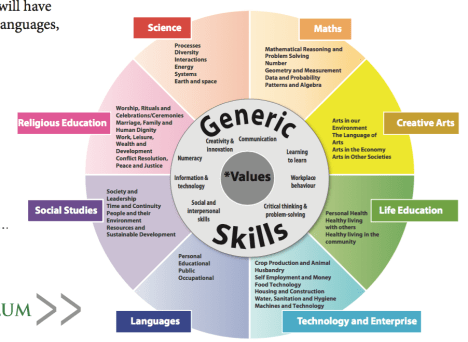
New O Level Thematic Curriculum

My biggest excitement about the O Level curriculum is not only the thematic approach that allows students to pursue their competencies from the word go but also the inclusion of a futuristic subject called Astronomy (referred to as Earth and Space in the image).

A young man Ghazali Mohammed has been foresighted enough to already have begun outreach in rural Ugandan schools teaching children the marvels of Astronomy. It is guys like him and the Fundi Bots honcho Solomon King doing similar outreach in Robotics that will show the way to those of us who are content with mere criticism.

Take it or leave it, within the next 30 years, we shall have human colonies on Mars and the moon. Space tourism is likely to be the next big thing (Shiyaya stand warned). Those that have excelled at attracting tourists to Gorillas will now have to compete with man’s curiosity with Space travel. Our children or grand children are likely to be part of expeditions to other planets and solar systems. Comets are seen as a likely source of mineral matter for us to utilise. The moon is already allegedly being mined of Helium 3. Elon Musk has indicated his strong desire to retire to Mars for the rest of his life. We already have probes currently billions of kilometres away from earth sending back updates of what space is like. Technology is advancing so fast that in the not so distant future, we shall cover millions of kilometres in a matter of minutes if Faster than Light (FTL) or Light Speed travel is achieved. That, is where we are headed.

For any curriculum to make sense in Uganda today, we need to look at the future of this world of ours. To be competitive, a good understanding of where we are headed as well as preparing our future inhabitants to harness the opportunities will be the best thing we shall have done for them. Every child today needs to learn about Astronomy. It is not enough for you to know how many Square miles of land are occupied by Uganda. Horizons are expanding, new states are likely to be formed. Like the europeans who ventured out across the oceans and founded colonies in North America, we shall have new countries or even stateless cities and countries on various planets while others could be floating in space above planets like Venus. While this may look far fetched, incremental improvements on knowledge are what will most likely get us there and this is the time to start.

Currently, the moon is slowly but surely moving further away from the earth at a rate of 4cm per year. [I see you laughing] What does that imply? If it ever leaves us, disastrous weather related consequences are expected since for example it has an effect on the tide in the oceans. However, it is believed that before the moon does this to us, the sun will have taken care of the destruction of our earth after achieving the red giant phase.

While such predictions of earth’s demise are billions of years away, the time is now to start enriching our interplanetary knowledge and make it as basic as the operation of a mobile phone. As a specie, we are going to have to migrate from this planet one time for it definitely will eventually become inhospitable. Who better to prepare for that eventuality than our school going children today?

My question though is, how ready are our teachers to teach such subjects like Astronomy? Can they tell what a Star, Black Hole, Pulsar, Quasar, meteorite, Galaxy or Dwarf star is?

Your guess is as good as mine.

Follow @wirejames on Twitter
The unravelling reality of Space Travel


Welcome back the Shepard, perfect landing, we made history today. Now, who wants to go to space?” said the commentator in the video after the second landing of the New Shephard rocket that Blue Origin has been working on to realise the dream of space travel. Wondering, what the heck this is all about?

Let’s go down memory lane. The 18th and 19th centuries were spent with various individuals experimenting on air travel. Many mistakes were made, however, their persistent efforts paid off when at the dawn of the 20th century, The Wright brothers among others were able to come up with mechanised flight.

The first commercial flight in recorded history occurred on January 1st 1914 between St. Petersburg and Tampa in the USA covering a distance of 21 miles (34 Kilometres) in 23 minutes at an altitude of 15 feet (5 metres). The amount paid then by the passenger was US$ 400 which is equivalent to almost US$ 10,000 today.

KLM the world’s first commercial airline opened it’s doors in 1919 and transported 345 passengers and 25,000 Kg of mail and cargo in its first year. This is equivalent to the load carried by a single Boeing currently. Since then, a lot of progress has been made in the aviation industry with flights today traveling non stop for over ten hours at speeds we currently consider fast.

In the middle of the 20th century, the space race begun and was largely a two horse battle between the American and Soviet Governments. The Soviets drew the first blood by sending the first man to space as well as launching the first ever satellite. Subsequently, the Americans outdid them by landing the first men onto the moon. Alot of effort has since gone into space related research with the launch of numerous satellites and probes sent to distant planets.

The entry of private players into the Space Age that had been a monopoly of state actors begun remarkably changing many things and injected a lot of much needed money as well as innovative ideas.

In 2002, the commercialisation of space travel saw Mark Shuttleworth become the first African to travel to space and spend eight days at the International Space Station. It however came at a hefty cost of Twenty Million US Dollars. Not many can afford such sums of money to achieve the dream of space travel.

One of the reasons space flight has traditionally been expensive is the need to use new rockets each time a pay load has to be taken to space. It is similar to having to purchase a new plane for each flight that is going to be made. There has always therefore been a need to come up with ways of landing rockets safely back to earth and reusing them for future missions.

On April 29th 2015, Blue Origin launched the first flight of the New Shepard rocket that flew upto 307,000 feet (Approximately 94 Km) which was just 6 Km shy of the Kármán Line at the altitude of 100Km regarded as the Edge of Space. The rocket came back to earth and made a successful upright landing much to the joy of the development team.

As if that was not enough, seven months later, on November 23rd 2015, a repeat flight was made by the same rocket that achieved a distance of 329,839 feet (100.4 Km) above the earth effectively reaching the edge of space.

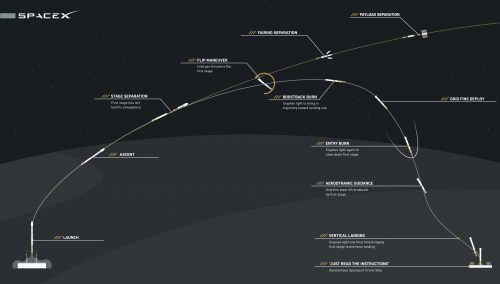
On the 21st of December 2015, Space X a company whose goal is to enable people live on other planets sent the Falcon 9 rocket to space and it duly delivered eleven (11) low earth orbiting satellites after which it returned and landed safely back on earth. Similar to Blue Origin, Space X took the game further using a more powerful rocket while attempting a much harder feat. Not to be outdone, the New Shepard was sent on another trip back to sky on 22nd January 2016 confirming to many that Blue Origin means business.

16892430560_f87dff78c0_o_1

Falcon 9 rocket route plan. Picture courtesy of SpaceX

What does this all mean to humankind?

“If one can figure out how to effectively reuse rockets just like airplanes, the cost of access to space will be reduced by as much as a factor of a hundred. A fully reusable vehicle has never been done before. That really is the fundamental breakthrough needed to revolutionise access to space.” Elon Musk, Space X founder.

At the turn of the 20th century, the pride of many was being able fly in an aeroplane and visit other continents on earth. The 21st century however has come with its own demands. Today, with a greater understanding of the solar system, galaxies and the universe, humanity is aspiring to colonise other planets and make them habitable or at worst extensions of our civilisation. Why can’t one go for holiday on mars or the moon? How about taking a guided tour of the Solar system giving you an opportunity to see planets like Pluto, Saturn and it’s many moons all from the heavens’ eye view? Imagine closely trailing a comet or asteroid on its journey orbiting the sun? Let alone having real estate on the moon with a retirement apartment for you? For the work freaks, wouldn’t a floating office in space give you the extra zeal to work?

All this may seem too imaginary and unreal but it’s as outrageous to you just as the idea of flying an aeroplane was to earth’s inhabitants six centuries ago. The human race has all it takes to conquer the universe and with the advances made technologically, one day at a time, I can’t rule out inter planetary travel being the norm in the next thirty years with inter galactic travel being achievable within a century from now.

Our ability to visit space repeatedly, at will and with ease will go a long way in enabling us push the boundaries of space ambition. A rocket should be able to take off from earth, deliver passengers into space and return all within minutes and then make another flight within the hour, essentially being re-used five to eight times a day. That way, the cost of access to space per head will drastically go down.

This is one of the reasons am excited about the foresighted approach of the new Ugandan Secondary School syllabus that has added Astronomy as part of the package to be taught to students. A good understanding of what the universe has in store for us will push our children into aspiring to challenge the new horizons. Maybe it could also be one of the solutions to the numerous land conflicts that we are faced with.

@wirejames on twitter

Subscribe to this blog to get regular updates for new posts.