
Tag Archives: value addition

Grains Processing greatly improving in Uganda


Uganda is known for its competitive edge in agriculture. With 70% of the population being engaged in the agriculture industry, one cannot hide away from the fact that there is a lot of money to be made in this regard.

While growing up, I always frequented mills in order to process the maize and sometimes millet that my parents grew. The typical Ugandan mill is a rickety housed old and cranky machine that blows out dust at will leaving anyone in the vicinity with a ghostly look.

I was however taken by surprise recently when I visited Arise and Shine Maize Millers. Tucked away in the Kampala suburb of Kawempe is an ultra modern computerised mill of its own kind. Having specialised in Maize milling, the proprietors have taken time to grow their niche from the very rudimentary processing facilities that are typical of the Ugandan Food Processing industry. 
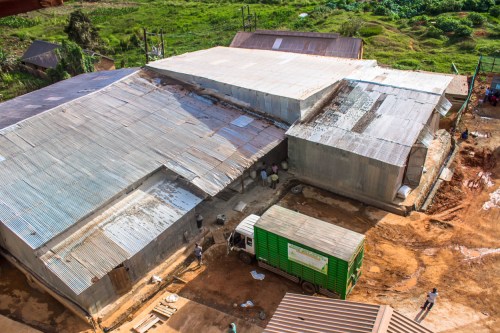
old_mill

The iron sheet structure old mill (Photo credit – Nabwiso Films)

Having operated for a number of years in a rudimentary fashion, it dawned upon them that there was a need to upgrade their operations to suit the changing times. They had some challenges that needed addressing as well as opportunities to take advantage of like the export market.

The primary challenges were, cleaning, drying, storage and safe food handling. Mr. Matia Mubangizi the Investment and Business Development Manager at the facility noted that, “the biggest challenge in the grains business is storage. Moisture content and impurities cause a lot of loss for the grain dealers and they have to be dealt with.

Armed with this in mind, the company took on the services of a consultant to help address the challenges. This consultant came on board courtesy of support from the Competitive and Enterprise Development Project (CEDP), a project under the Matching Grant Facility, funded by the Government of Uganda and the World Bank.

As a result of the consulting support, the company acquired new machinery with intent to modernise all its operations. They then applied for a Matching Grant Facility entitling them to a 50% reimbursement of expenses towards equipment installation.

This machinery upgrade helped improve the handling of grains thereby reducing aflatoxin presence which is a key impediment for the export market. The deployed equipment involved among others;

  • A weigh bridge

  • A 20 – 25 tonnes per hour drier

  • A cleaner with an hourly capacity of 25 Metric Tonnes

  • A 300 Metric Tonnes storage facility

  • Packaging lines

weigh_bridge

The new weigh bridge (Photo credit – Nabwiso Films)

During my visit to the mill, I witnessed first hand the delivery of maize and how dirty it can be upon arrival. The problem seems to start with the farmers who do so little in terms of proper post harvest handling. As the bags were being emptied, one could see maize cobs, leaves, stones and all sorts of chaff mixed up in the maize. This implies that if the maize miller buys the declared kilos without cleaning, a loss awaits them. It’s on record that Kenya has rejected maize from Uganda on quality grounds.
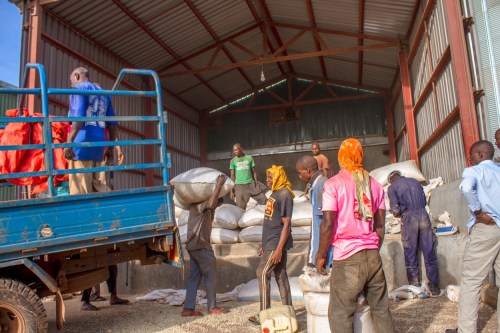
maize_delivery

Maize Delivery in Progress (Photo credit – Nabwiso Films)

With the new machinery, the maize is taken through an automated cleaner that removes all foreign matter. Once the moisture content of the maize is found to be insufficient, it’s then redirected into a dryer that dries it to the recommended level. This has tremendously increased the product quality of the mill.

part_of_mill

Storage Facilities for the newly installed mill (Photo credit – Nabwiso Films)

A comparison of the production matrix before and after the installation of the new mill reveals drastic progress.

Before

After

  • Used to handle 5 – 6 trucks of maize daily
  • Currently handle upto 30 trucks of maize daily
  • Used to receive 50 – 70 tons of maize daily
  • Currently receive 200 tons of maize daily
  • Supplied local market entirely
  • Currently supplying both local and foreign market

The process improvements as well as new markets have had a positive impact on the production and profitability of the mill. Aspects like automated weighing drastically reduced the turn around time of attending to each delivery truck. The export market was catalysed by the ability to produce premium products that meet international food safety standards.

On the Human Resource front, 30 graduates were invited to participate in the training during the installation of the machinery, upon completion, 11 of them were hired.

Without doubt, the story of Rise and Shine Maize Millers is worth sharing and confirms the potential Uganda has as a country in the value addition of agricultural produce.

James Wire is a Business and Technology Consultant based in Kampala, Uganda
Follow @wirejames on Twitter.
Email lunghabo [at] gmail [dot] com

From Subsistence to Commercial Farming. Smallholder farmers at crossroads


Muniru, a rice farmer from Leresi in Butaleja district has been growing rice for over fifteen years. He however doesn’t know why he’s still a poor man. His story was no different from that of other farmers I met during a Rice Value Addition training organised by The Pearl Foundation for Children and Widows supported by the Skills Development Facility (SDF), a project under the Private Sector Foundation of Uganda (PSFU).

As urban elites, we tend to have a lot of theories on how to transform our largely peasant dominated small holder farming population into a more prosperous one. Unfortunately, until we get to understand the psychology of these farmers, we shall keep shooting off target with our noble but poorly thought out solutions.

sorghum

Sorghum crop

Over the past twenty years, the ever growing urbanisation and industrialisation has led to a vast increase in the demand for all types of crops including those that were never considered cash crops three decades ago. Produce like cassava, simsim, soya beans, millet, groundnuts and rice are now leading cash crops for most farmers.

Among the over one hundred farmers I had a chance to train in this PSFU initiative, all of them confessed to selling off at least 85% of their produce. This got me to realise that these farmers are actively delving into commercial farming.


If they are earning money, why then do they still lament about poverty?

My overall conclusion was that, these small holder farmers are approaching commercial farming with a subsistence mindset.

Their subsistence mindset is betrayed by the fact that;

  • They freely grow any crop for as long as there is someone to buy it.

  • Growing crops usually takes on the traditional approach that has been tried and tested over the centuries.

  • They spend as little money as possible on growing the crop while expecting to get as much as possible from the produce sale.

  • They sell most of their produce and use the money earned to meet various needs in and outside the home. Little or nothing is put aside for the production process.

  • Little effort is made to store food since it might get spoilt or better still the possibility to earn money from a quick sale outweighs the storage option.

  • There is minimal use of technology.

  • The land farmed is little. Hardly over three acres.

  • There are a lot of post harvest losses due to poor produce handling.

  • They operate as individual farmers right from production to produce marketing.

  • They have little or no understanding of the eventual consumer of their produce.

While I do applaud their move towards commercial farming, I have a lot of discomfort about the way they have chosen to approach it. Many of the mistakes currently being made are borne out of ignorance about commercial farming as well as third party forces like manipulation by the middlemen, poor mobilisation by the local leaders among others.

Any commercial engagement is usually premised on some of the following tenets;

  • A good understanding of the consumer’s expectations

  • A quality offering (service or product)

  • Use of appropriate inputs

  • Supply guarantees

  • Market access

  • Value addition

It’s the lack of knowledge about the foundational requirements of commercial farming that seems to be one of the biggest letdown for these smallholder farmers.

active_participation

Eager Learners

These farmers are not fools nor are they resistant to change, they simply do not know better. They exhibit a high affinity for acquiring new knowledge, and this should be closely followed up with implementation support.


old_learner

The elderly study too

Old and young, these farmers will surprise you by their openness to new ways of doing things. I found farmers who were simply comfortable with the way they grew and sold their rice under the belief that there was no better way.

Following a well structured training that traversed the entire process from seed selection through the transplanting process, to weeding, harvesting and eventually produce sale, they were able to identify numerous ways of improving their product offering.


elderly

Packaged rice by the farmers

Farmers that had always been content with selling stone filled broken rice to traders at the mills are now empowered both skills wise and psychologically to add value to their produce upto the level of branding and packaging ready for the eventual consumer. 

Using this experience, I now realise that efforts aimed at improving farmer livelihoods especially under the various wealth creation programs that we are bombarded with need a shake up.

An approach that does not focus on merely availing free inputs to farmers but goes ahead to integrate tailored trainings and mindset change is likely to deliver much better results.

Right now, my challenge has graduated from making these farmers appreciate value addition of their rice produce to seeking out urban markets for their high quality graded rice.

Thanks to the World Bank funded PSFU project, I have had a chance to contribute to the betterment of farmer livelihoods through this Pearl Foundation for Children and Widows initiative.

James Wire is a Small Business and Technology Consultant

Blog: wirejames.com

Twitter: @wirejames

Email: lunghabo (at) gmail (dot) com