
If there is one thing that I admire about President Museveni, it’s the simplicity with which he occasionally approaches issues. Months back, he appeared in the media advocating for irrigation using bicycles, jerrycans, plastic mineral water bottles and other non complex methods. His assurance was that as a nation, we needed to embrace irrigation if we are to combat the rampant crop failure year in year out as a result of over reliance on rain fed agriculture.

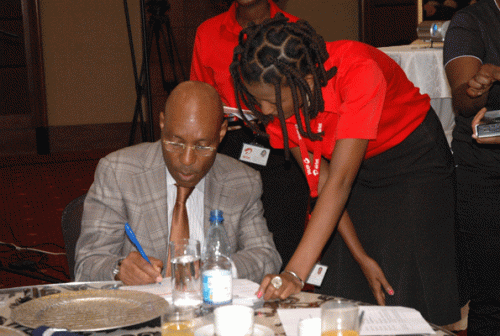
President Museveni demonstrating drip irrigation at the Kityerela Presidential Demo Farm, Mayuge.
The stand he took however created a backlash on social media with the elite filled platforms criticising his efforts as falling short while baptising them by coining a new term called jerrygation. I am a small scale (largely subsistence) farmer who has never achieved even 50% of the recommended production potential each time I have grown beans, maize and groundnuts. I clearly know that the rain patterns have affected me big time. This experience led me into seriously concluding that irrigation is a pre-requisite to the future of farming in Uganda. In the Doho Rice scheme where I have well irrigated fields, I never make a loss and my production is always spot on.
In defense of President Museveni’s jerrygation, what Uganda’s farmer needs today is a consistent supply of water to be used to grow their crops. While the problem and solution have been well identified, a big gap remains when it comes to turning the solution (in this case, irrigation) into a reality.
Mr President, your demonstration farms are staffed with people who are paid a salary and have it as their job to be around day in, day out to pour water into bottles with the aim of ensuring that drip irrigation is a success. The rural farmer has no where near the resources your demonstration farms boast of. However, this does not mean that they cannot try to emulate you.
Simply put, irrigation is the application of water to plants. It requires two key things; one is, access to a water source and the other is water distribution to the garden.
While Uganda is a small country, it has different geological characteristics as you traverse it. This has an implication on what one can grow and how irrigation can best be undertaken. Parts of the country are hilly, like the West as you near the DRC border, East at the border with Kenya, while others are flat like the near East (Busoga / Bukedi), North East (Teso and Karamoja Sub Regions) as well as the North.
The crops grown across the country vary too. From the largely cereal crop base in Northern Uganda to vegetables in the South and South Western part of the country, Sugarcanes in the East and tea in the West.
All these variations have an implication on the kind of irrigation that can be undertaken, hence the approach of one size fits all not being feasible.
In order to achieve the wider goal of irrigation fed agriculture in this country, the government is going to have to among others do the following;
Zone the Country
The country has to be zoned in a manner that brings together locations with similar irrigation requirements to make it easy for eventual service provision. This zoning is also likely to help the professionals focus on addressing farmers’ water challenges with a better appreciation of the local status-quo.
Deployment of appropriate technology
Due to the variations mentioned earlier, the different areas of the country shall need varying technologies in order to have successful irrigation installations. Some of the details to be looked into while planning this are;
-
Water: Is the source of this water, surface or ground? What is its quantity, availability, flow rate and quality? An example is water that is highly saline cannot work well with sprinkler irrigation.
-
Soil: Soil texture determines its water retention capacity, permeability and transmissivity. This is very important as it determines intervals between irrigation. Permeability in particular plays an important role in surface design and sprinklers.
-
Crops: Different crops demand different watering approaches. A good number of vegetables dislike overhead water application as it tends to make them more susceptible to disease attack when their leaves are continuously wet hence the preference for a drip approach concentrated near the roots. Sugarcanes can do well with overhead as well as surface irrigation.
-
Location: Structures used in establishing the irrigation system should be able to withstand the various environmental hazards like wind, temperature, rains among others.
These and many others need to be well synthesised.
Pilot the deployment
In each set zone, there shall be a need to initially set up pilot installations in order to learn from the anticipated successes and failures. This shall have the net effect of reducing on the White Elephant approach of most government projects that display gross optimism at the start only to end up in a miserable state shortly after.
Set up a National Irrigation Authority
The current approach of letting farmers individually come up with irrigation solutions for their farms is only feasible for the big players. That small farmer with one or three acres of land might not have the resource base to undertake the infrastructural requirements.
Just like we have the National Water and Sewerage Corporation which is responsible for supplying water to homes, we need to set up a National Irrigation Authority which will be tasked with investing in the infrastructure required to ensure that different farming zones have irrigation water systems in place ready to be tapped by farmers at the last mile. This is akin to the current state of affairs where anyone setting up a house can just tap from pre-existing National Water infrastructure to get water.
This authority can then through the employment of professionals address the gaps in the current haphazard crusade aimed at promoting irrigation.
Why do I think this authority can work? Taking a look at the Doho Rice Scheme where I am a rice farmer, the Government invested in the irrigation infrastructure and all we do as farmers is to tap water as and when needed from the channels. During the low water seasons, the management team in charge rations the water flow and this helps avoid conflict among the farmers. Such a model if extrapolated to the national level could go a long way in realising the much needed progress in Agricultural production.
Some of the roles of this authority could be;
-
Carrying out feasibility studies for new irrigation projects
-
Planning, Designing, Constructing and implementation of irrigation infrastructure in the country
-
Operation and maintenance of the irrigation projects in place
-
Training farmers on different methods of irrigation
This authority can then be mandated to report directly to the office of the President since he is the champion for this cause.
It is my view that if only 30% of the total acreage of arable land in Uganda today was to be made productive year round through irrigation, we would create market leadership in food production on the African continent.
While jerrygation is a good shot at this irrigation behemoth, a more structured approach is likely to yield longer term results.
James Wire is a Small Business and Technology Consultant based in Kampala, Uganda
Follow @wirejames on Twitter.
Email lunghabo [at] gmail [dot] com
Other Articles of Interest:
Photo Credit: Operation Wealth Creation
 The Wire Perspective