
Tag Archives: entrepreneurship

Business has Seasons


I opened up a small DVD burning business in November last year, experienced very good sales in December and early January but thereafter business slumped and each time I tried to find out why, customers simply said they had no money. Its now march and am just beginning to see a change for the better.” In this email, the proprietor was expressing fear for his business thinking that it was bound to fail. After assessing all aspects of his operations, I realised that it wasn’t much about what he was doing wrong but merely the season.

There are always competing forces for the money held by customers. To spend their money on an item or service, opportunity cost sets in. December being virtually a holiday period, the customers were in a better frame of mind to spend on Movies and Music Videos hence the surge in demand for the services. However, as it is typically in Uganda, after spending so much during the festive season which lasts till early January, concern is now shifted to raising school fees for children and other pressing needs like paying house rent and basic survival considering that many are usually broke by this time. Hence if one were told to choose between purchasing a DVD Movie and paying School fees, the latter would obviously take precedence.

It’s always important to know the crests (peaks) and troughs (lows) of your business cycle. Every business has them and they are unavoidable.

Business Peaks and Troughs

Business Peaks and Troughs

The table below illustrates the Crests and Troughs of some common businesses in Uganda;
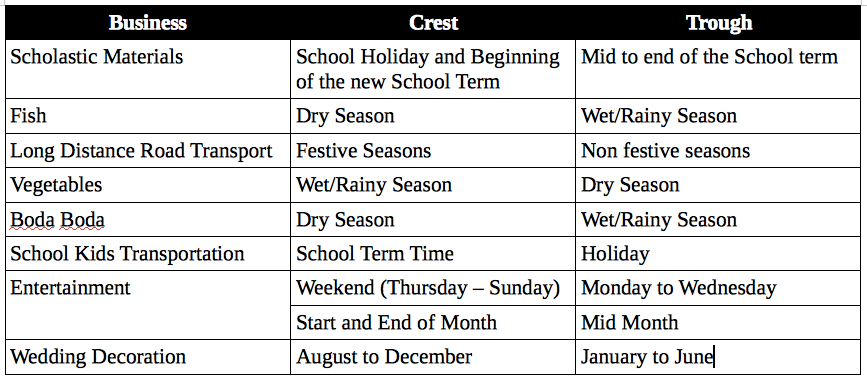
Common business seasons in Uganda

Common business seasons in Uganda

Taking the case of Wedding Decoration, most weddings are held in the latter part of the year while the first half of the year is a pretty low season. This could be based on reasons like the difficulty of raising finances in the first quarter of the year since it is a school going season that comes right after the heavy spending of the December Christmas festivities.

The latter part of the year is a more likely period for one to get financial support from friends and family while at the same time conducive for family members based abroad to attend since they can come during the Summer holiday or Christmas break.

As you get into business, it’s important to understand this principle of seasonality in order not to be caught off guard. You may be wondering how these seasons can affect you. These are some of the ways;

  • Failure to pay office rent on time
  • Failure to meet salary obligations of your staff
  • Failure to remit overdue taxes to the authorities
  • Poor Cashflow
  • Loss of staff morale

However, it is also possible to insulate one against these troughs to a certain extent. You can do so by;

  • Ensuring that there is a reserve of finances built during the Crest(peak) seasons for use when revenues have dipped.
  • Creating promotions to entice customers during the low (trough) season.
  • Adjusting your staff contractual/hiring terms to reflect their availability during the low and peak seasons.
  • Diversification. This enables you to take on another product or service whose low and high seasons do not coincide with your main business. This helps level out the cash flow.

Embrace seasonality and work around the troughs if you are to last in business.

It’s never too late to earn Business Expertise


I am not a fan of the current education system. A fact known to many that have followed me overtime. In my life, I chose to self-teach, guided by my curiosity. However, there is one bit of my journey I have come to regret. As I mastered and gained expertise in programming computers, I missed building expertise in business which is a key component in monetizing my skills. Given the opportunity to go back in time, I would start a shop or any other business on the side while I mastered computers,” lamented a friend of mine.

For all I know, this young man can never be classified as a loser. Infact he is a leading thinker among guys I have meet of his generation. Largely self taught, a dreamer that pursues his dreams without fear, I was taken by surprise reading this message from him. On the flipside, this could be a reaction of a fast thinker who believes he/she must notch up various accomplishments as soon as possible.

From personal experience, I concur with him. Many times we spend alot of effort polishing our expertise in numerous technical areas and forget to understand business. In 2006, I had a heart to heart with a leading Consulting Engineer in Uganda and he told me, “James, avoid the trap of the mechanic. You spend too much time repairing customers’ cars and leave someone else to collect and count the money for you. That someone will earn the money leaving you at sea.” I never understood that statement and even didn’t bother to seek clarification. Two years later, when an accountant I had hired, in a bid to cover her tracks of stealing company money set my office on fire, I vividly recalled this discussion and vowed to change my approach. I always wondered why Indian shop keepers never leave the till, but after this experience, I realised that you ought to be where the money is or else you lose out.

So, if you don’t have business skills like my friend just stated, what do you do? Start acquiring them. These are some of the ways you can do so;

  • Reading books. There are lots of self help books out there that can teach you lots of tricks on “how to” or “how not to” do business.
  • Interaction. Make it a point to meet at least two people per week who you believe can share freely with you their business journeys. They don’t have to be superstar businessmen/women because there is equally as much to learn from those that are riding the tide of success as well as those that have failed.kiosk_in_india
  • Pet Projects. Like he rightly put it, “… I would start a shop …” There are always some basic businesses one can engage in to master some basic skills. These could be selling Airtime, Mobile Money Agency, a roadside kiosk, commodity trade among others. They teach you how to handle cash flow, bargain, manage creditors and debtors, price your products or services, deal with workers, detect fraud, swallow losses among others.
  • Apprenticeship. Find someone or people who can mentor you in specific areas. You can talk to them about spending an hour or two with them to learn through observation. This can only be realised if you are in good standing character wise and have people that trust you.
  • Training. Even when you are fed up with the formal education system, it doesn’t mean that it is entirely bad. There is always something to learn through some of these formal structures. You may not be after the certification that is provided but at least get the skills the training offers. Careful selection of what suits you is important.

For an entrepreneur, it doesn’t matter how old you are or how long you have been at your game, you can always learn something new. As opposed to the formal education systems that put time frames for acquiring knowledge/skills e.g. You need three years to become an accountant, in this space even a few days are enough to arm yourself with relevant knowledge in a particular field of endeavour. You don’t need to master all the details of double entry book keeping in accounts. Being able to understand and interprete a bank statement, profit & loss statement or a balance sheet is enough to steer you into making prudent decisions.

Back to my brother, its not too late. Appreciate the fact that you have realised this need early. Even to you that may consider yourself too old to learn, change your mindset and you’ll be on course to run a wildly successful enterprise.