Sim Card Verification exposes the joke that UCC has become


Only Dr. Stella Nyanzi in my view has the right vocabulary to effectively describe the Uganda Communications Commission (UCC) and its haphazard handling of issues.

Five years ago, the commission huffed and puffed about the need to register sim cards citing security as one of the key reasons it was being done.

mkts01px

Eng. Mutabazi being assisted during the launch of the registration exercise. Photo Credit – Daily Monitor, 2012

The Executive Director, Eng Godfrey Mutabazi is on record having said that, “In countries where SIM card registration has been taken seriously, a drop in crime especially cybercrime has been registered. We want to emulate this and see to it that such unlawful acts are done away with.”


Many of us supported the move and even used various fora to enlighten the general public about the importance of registration. The deadline set for 2013 passed and before we knew it another threat was issued to the telecoms companies to ensure that the process is completed in 2015. Interestingly, we were led to believe that the issue had been sorted once and for all.

To my shock, earlier this year, information from the Police begun pointing fingers at the use of unregistered simcards by criminal gangs. The UCC kept mum. Is it because the victims were largely lay men? It wasn’t until the investigations into the assassination of the Assistant Inspector General of Police, Mr. Felix Kaweesi (RIP) that the UCC was jolted out of its slumber.

With the kind of resources this institution commands, it is foolhardy for one to believe that they have a genuine reason for such a lapse in judgement. I strongly believe this is a sign of gross incompetence in the institution that is failing to offer the much needed direction for the ICT industry, preferring to concentrate on shutting down internet during election time as well as shopping for pornography tracking equipment. It seems like UCC is narrowing its attention to matters that involve procurement (this was actually intimated to me by a Member of Parliament) as they offer quick gains to the individuals involved there-in as well as satisfying the politburo’s demands. These two areas of engagement I presume form the basis for any contract renewal that the head of the institution is definitely interested in.

By failing to do the obvious, the Eng Mutabazi led outfit has slowed down the pace set by Mr. Patrick Masambu the former Executive Director of UCC who is currently the Director General of the International Telecommunications Satellite Organisation (ITSO). Despite the massive hurdles he went through to set up this institution, Mr Masambu defied all odds to leave a healthy and globally acclaimed institution in place.

The latest gaffe has been the press release by UCC that orders Telecommunication service providers to verify all SIM card subscriber details within seven (7) days starting 12th April 2017. The communique advises the public to visit the nearest authorised telecoms service centres as well as utilising the *197#.

I can only shake my head in disbelief because whoever came up with this decision at UCC is out of touch with reality. Do they think that they are managing a home? Do they realistically expect even 50% of the Ugandans to get sorted within one week? Which world are these !#%&^396$#@ living in? (Dr. Nyanzi the queen of metaphors please come to my rescue here)

Now to Eng Mutabazi and your team, do you really believe that:

  • All Ugandans are within 7 days reach of a recognised Telecoms Service Centre?

  • All Ugandans will have got the information to pursue this activity within 7 days?

  • All Ugandans will have the money and time to make it to the various centres within 7 days?

  • All Ugandans have National IDs?

  • All Ugandans are utilising their cell numbers within the boundaries of this country?

  • All Ugandans have time to repeatedly go to Telecoms service centres in a bid to repeat activities they had already engaged in?

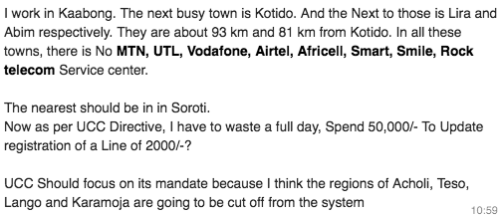
Take the example of this guy
kaabong

Meanwhile, like you can see, he at least might be able to afford the entire exercise financially. What happens to the many that cant afford it and also reside where he is currently working? [Pointing my index finger onto my bald head saying “COMMON SENSE IS NOT COMMON”]

Meanwhile of the seven (7) days given, four of them are taken up by the Easter Holidays. For a country that is over 70% Christian, why do you think they will leave their celebrations to attend to an exercise that was caused by your incompetence?

When will you get out of this gambling nature that seems to have become a part of your operational manual? I do believe that UCC as an institution has some very brilliant minds, a number of whom are known to me personally but the way the institution is operating as a whole, makes any outsider think it is a bunch of jokers. This should be a wakeup call to the appointing authority, at this rate, the efforts to attain Middle Income status are likely to be sabotaged by an inefficient Communication and Technology Sector whose regulatory agency seems to be operating in a reactive rather than proactive manner.

This seven day deadline is simply a poorly thought through decision that only serves to lay bare the incompetence of the institution we are meant to look upto for guidance. Could it be time for a total purge?

Let me go pick my orange tree seedlings and plant before the rains cease. I think I have had enough of this circus.

James Wire is a Small Business and Technology Consultant based in Kampala, Uganda

Follow @wirejames on Twitter.

Email lunghabo [at] gmail [dot] com

Other Articles of Interest:

HOW TO – Start a Chapati Business


Rolex, one of the CNN recognised world famous foods is basically a Ugandan Chapati wrapped around a fried egg. Chapati is one of the most sought after snack like foods by all categories of consumers.

chapati

Chapati as it is known in Uganda

Making and selling Chapatis is one of the businesses that many find easy to set up due to the low start-up investment costs as well as high demand for the product(s). It is however important to note that while you can run it as a standalone business, it is always wise to have two or three other complementary products alongside it in order to reap maximum benefits. Some of these products are Samosas (sumbusa) and Mandazi that have similar requirements for inputs. What is shared here can be similarly applied to other products like doughnuts.

What infrastructure do you need to effectively run a Chapati business?

  • Operating Table. Notice the concealed compartment. It is a pre-requisite when selling food products by the roadside in Kampala.

    OperatingTable

    Operating Table for a Chapati business

  • Charcoal Stove

    CharcoalStove

  • Saucepans (At least two big ones)

Saucepan

  • Frying pan (For preparing the chapati)

FryingPan

  • Bench (for customers to sit on while eating)

  • Plastic plates (for customers to use when eating)

  • Jerrycans (keeping a water reservoir for customers to clean their hands or even wash your utensils)

  • Basin (for mixing dough)

Key considerations when setting up the business

This is a basic, easy to set up business. However, one need consider the following issues:

  1. Business Plan: A basic plan can suffice. It ought to answer a few questions like target market, desired sales targets, long term outlook, product mix (are you dealing in chapati alone or a mixture of products), planned operation approach among others. If you feel encumbered writing it down, at least have some of these issues answered mentally.

  2. Recipe: For those that know all about Chapati, you definitely can tell the difference between a good and bad one. This usually boils down to recipe and of course workmanship. Considering that there are many chapati sellers especially in the key trading or residential areas, having an attractive recipe will guarantee you return clients.

  3. Location: In this business, location is paramount. It is essentially a roadside business whose ultimate goal is to prey on the gullibility of people going about their usual routines. You need to make it as convenient as possible for someone to part with that loose change in order to satisfy their hunger pangs. Common locations for chapati stalls are trading places with shops, restaurants and supermarkets; residential neighbourhoods; public transport stages as well as environs of bars.

    location

    Notice the strategic roadside corner location of this chapati business

  4. Raw Materials: Other than the earlier mentioned equipment, recurrent costs go to cooking oil, Wheat flour, baking powder and any other ingredients of your choice. Most of these are readily available in supermarkets and shops. Just make sure you purchase quality and unadulterated products.

  5. Products: Chapati can be packaged in different ways to form different products. You can offer a plain chapati, Rolex or even a Kikomando (Chapati mixture with beans)

    kikomando

    Kikomando, one of the best selling products

  6. Human Resources: If you do not plan to directly run the business, then you need to hire decent people or a person that will ensure you offer a very tasty product as well as manage customers well. Do not underestimate the kind of person you choose to play this role. They are the face of your business. Structure out a motivating payment structure. As opposed to a fixed salary, a sales oriented approach towards payment is likely to be more enticing.

hr

Some of the factors that attract customers to your chapati stall are;

  • A nice recipe

  • Good public relations / sales language. The way your staff talk to the customers especially ladies who happen to be the biggest customers is key.

  • Smartness. Ensure that you or your staff manning the stall is smart at all times.

  • Endeavour to keep the operating area as clean and free of insects like flies.

How can one invest in the Chapati business

One can venture into this business in different ways. Some of those that I have been able to identify are:

  1. Renting Space. You might be having a shop or premises that are in a strategic location by the roadside. You can simply rent out space to anyone who is interested in setting up a chapati stall and they are in position to pay something commensurate monthly.

  2. Hiring a Location and erecting key infrastructure. As seen earlier, the operating table can take on different designs as well as abilities. Some people have specialised in identifying customer friendly locations, erecting a shelter as well as the required operating table then renting out the facilities to actual chapati sellers for a daily rate. One of those locations I know of earns the landlord UGX 50,000/= daily!!!!!

  3. Acquire all the requisite infrastructure and set up a chapati stall. This would imply running the business in its entirety. It might involve you manning the stall directly or hiring an individual that you pay.

What is the sales outlook like?

The location in which I did the research from was in a Kampala suburb called Kyebando. It is not as busy as many of the suburbs I know. However, the sales figures were quite interesting.

One packet of Wheat Flour weighs 2 Kilogammes and on average produces 20 chapatis. The highest selling stall in that area consumes not less than 24 packets daily. The arrangement used is option two where the actual chapati seller hires infrastructure from someone else. He pays a daily rate of UGX 50,000/=. Considering that each plain chapati costs UGX 500/=, this guy should be earning gross revenues of at least UGX 240,000/=. This is exclusive of extra income that comes from Rolex and Kikomando sales.

Something definitely looks quite appealing. Don’t you think so? If I were to go into this business, I would focus on eventually setting up a chain of outlets using investment model II above.

Welcome to the Chapati business. I wish you the best in your endeavours.

James Wire is a Small Business and Technology Consultant based in Kampala, Uganda

Follow @wirejames on Twitter.

Email lunghabo [at] gmail [dot] com

Other Articles of Interest: